

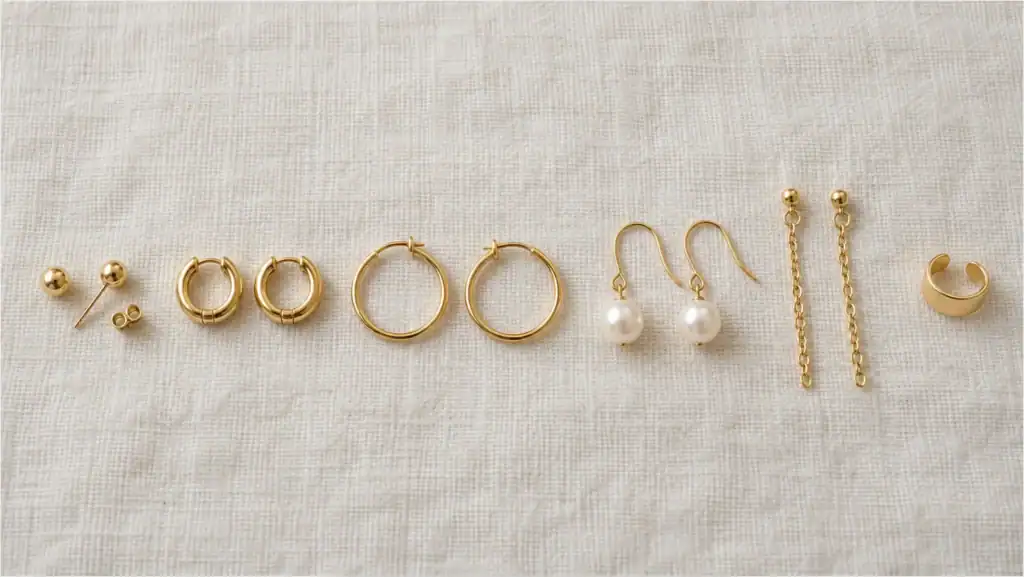
Earrings come in dozens of named styles, but most are variations on a few basic designs. What separates one type from another is where it sits on your ear and what holds it in place.
This guide sorts earrings into five groups, then covers the backs that hold them in and how to choose for sensitive ears, new piercings and everyday wear. The last section is for jewelry brands.
Key takeaways
- Where an earring sits and what holds it in sort nearly every style into five groups: on the lobe, around it, below it, beyond it and no piercing needed.
- Stud and hoop sizes aren’t standardized, so go by the millimeters and check whether a hoop’s size is inside or outside.
- Jewelers of America rates screw and La Pousette backs highest and push backs medium, but we found no published tests comparing backs.
- For sensitive ears, check what the post and back are made of, not the word “hypoallergenic.”
- Skip gold plated, gold filled and vermeil jewelry in a new piercing, and wait until it heals to switch styles.
- If a back won’t budge or has sunk into the skin, see a doctor instead of digging it out.
The Main Types of Earrings: Three Parts, Five Groups
Most earrings are built from the same three parts, and nearly every style fits into a map of five groups. The diagram below shows both.
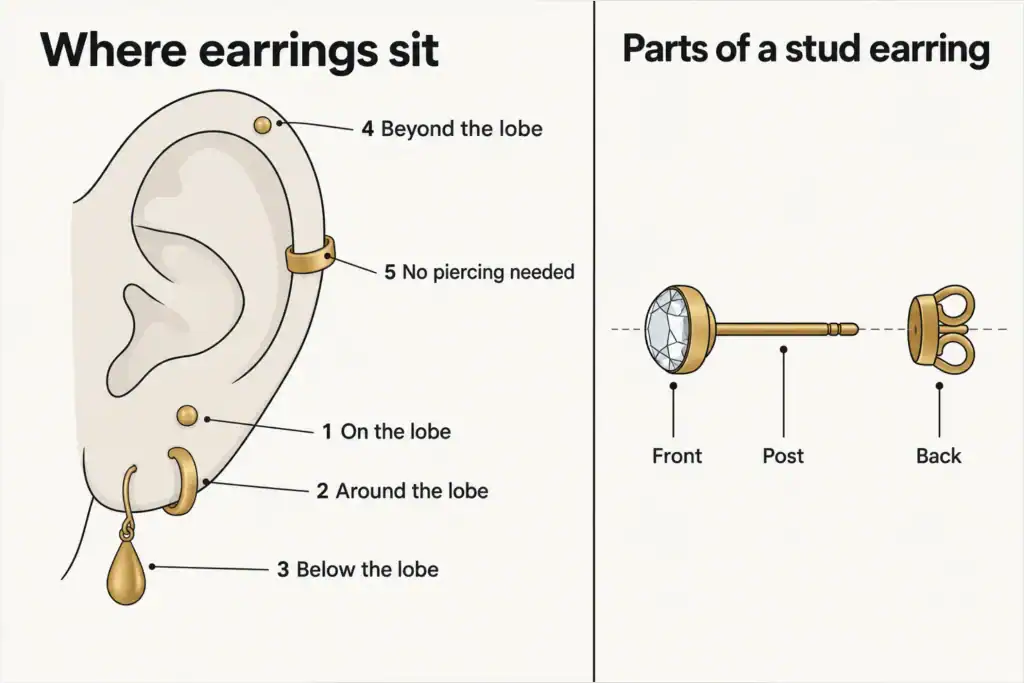
Three parts. The front is the decorative part people see. The second part goes through your piercing: a straight post on a stud, a curved ear wire on many drop earrings or the hoop itself. The back, or closure, keeps the earring from slipping out. On a stud, that’s most often a push back (also called a butterfly or friction back), which slides onto the post until small notches on the post stop it, as the Gemological Institute of America (GIA) explains. Most huggies and many hoops use a hinged closure (sometimes sold as click-top) built into the hoop. A French hook (also called a fish hook) usually just hangs through the piercing with no lock.
The front gets the name, but the other two parts do the work. Names like solitaire, cluster and teardrop describe the front. Whether the earring stays in depends mostly on the post or wire and the back, and how it feels depends on those parts as well as its weight. GIA notes that a back that’s too loose is easy to lose, while one that’s too tight can be uncomfortable, even painful, to put on and take off.
Five groups, sorted by where the earring sits. The first four follow position: on the lobe, around it, below it and beyond it. The fifth covers styles that stay on without a piercing, such as clip-on earrings, also sold as non-pierced earrings.
| Group | Styles | Usually held by |
|---|---|---|
| On the lobe | Studs, including solitaire, cluster and pearl studs | A post and push back, or a screw back on valuable studs |
| Around the lobe | Hoops and huggies | A hinged closure, or a latch or lever back on some hoops |
| Below the lobe | Drops, dangles, chandeliers, threaders and tassels | A French hook, a lever back or a post and back (threaders usually have none) |
| Beyond the lobe | Ear climbers (or crawlers), ear jackets, ear cuffs and cartilage earrings | A lobe post and back, or the cuff’s own grip; cartilage jewelry varies |
| No piercing needed | Clip-on earrings, magnetic earrings and most ear cuffs | A clip, magnets on both sides of the lobe or the cuff’s grip |
Ear cuffs show up twice because they sit on the rim and most don’t need a piercing. Some common names describe a look rather than a type: “statement” means a bold look, a teardrop is a drop with a pear-shaped front and a mismatched (or asymmetrical) pair can come from any row. When a name is new to you, ask where the earring sits and what holds it in.
What are the three types of earrings? There’s no official answer. None of the sources we checked, including Oxford Learner’s Dictionaries, GIA and the trade group Jewelers of America, sorts earrings into a set number of types. If you want three, use the ones almost every guide includes: studs, hoops and drops. The 11 earring style guides we compared listed anywhere from four to 21 styles, but all 11 covered studs and hoops, and 10 covered drops.
The rest of this guide follows the table row by row, starting with studs.
Stud Earrings: Styles, Sizes and Backs
A stud earring, or ear stud, sits on the front of the ear, usually on the lobe. A straight post runs from its decorative front through the piercing, and a back holds it in place.
What do solitaire and cluster mean? They name the front. A solitaire holds a single stone, and a cluster groups several small stones or elements into one shape. Halo, pearl and geometric studs are named for the front, too. None of these names tells you the size or the back.
How is stud size listed? There’s no standard sizing system for studs. Gemstone studs are usually listed by the stone’s size in millimeters or its weight in carats. One carat equals 200 milligrams, so carats tell you weight, not width. Under the Jewelry Guides of the Federal Trade Commission (FTC), a decimal diamond weight such as 0.47 carat should be accurate to the last decimal place. A fraction such as 1/2 carat isn’t exact, so the seller should say so and give the range it covers.
Per earring or per pair? Diamond stud listings often give the total carat weight (ctw) of both earrings, so a pair listed at 1 ctw has about half a carat in each ear.
How thick is the post? There’s no official standard. Common friction posts from major U.S. jewelry-parts suppliers measure about 0.76 mm (0.030 in.) across and 9.5 mm (3/8 in.) long, and threaded posts for screw backs can be a little thicker, around 0.86 mm. Some listings give a gauge instead, borrowed from the American Wire Gauge, where a higher number means a thinner wire: 20 gauge is 0.81 mm and 18 gauge is 1.02 mm. Go by the millimeters.
Which back should a stud have? The push back on most studs is the quickest to put on and take off, and for an everyday pair it’s usually enough if it grips firmly. But Jewelers of America (JA) rates push backs medium security and notes they can loosen over time, so replace one that slides on with almost no resistance. For a pair you’d hate to lose, JA rates screw backs and La Pousette backs highest. A screw back only fits a post with matching threads. A La Pousette back locks on with spring clips, and JA says it’s offered on high-end fine jewelry such as diamond studs.
Next come hoops and huggies, which wrap around the lobe.
Hoop and Huggie Earrings: Fit, Sizes and Stud vs. Hoop
A hoop earring is shaped like a ring, and the hoop itself goes through your piercing. A huggie earring is what retailers call a small hoop that wraps closely around the lobe instead of hanging below it. Every huggie is a hoop, but not every hoop is a huggie.
Where does a huggie end and a hoop begin? There’s no agreed size. The retailers we checked list huggies anywhere from 10 mm to 16 mm, and some file those same sizes under small hoops. So a label won’t tell you whether a pair will hug your ear, but two measurements will.
Will a huggie hug your lobe? A hoop has to wrap around the part of your lobe below the piercing, so compare the hoop’s inside diameter with the distance from your piercing to the bottom edge of your lobe. If the two are about the same, the hoop sits snugly. If the inside diameter is clearly larger, the hoop hangs below the lobe with a gap. If it’s smaller, the hoop will press on the lobe or may not close at all. A thicker lobe needs a little extra room. This is simple geometry, not an industry rule.
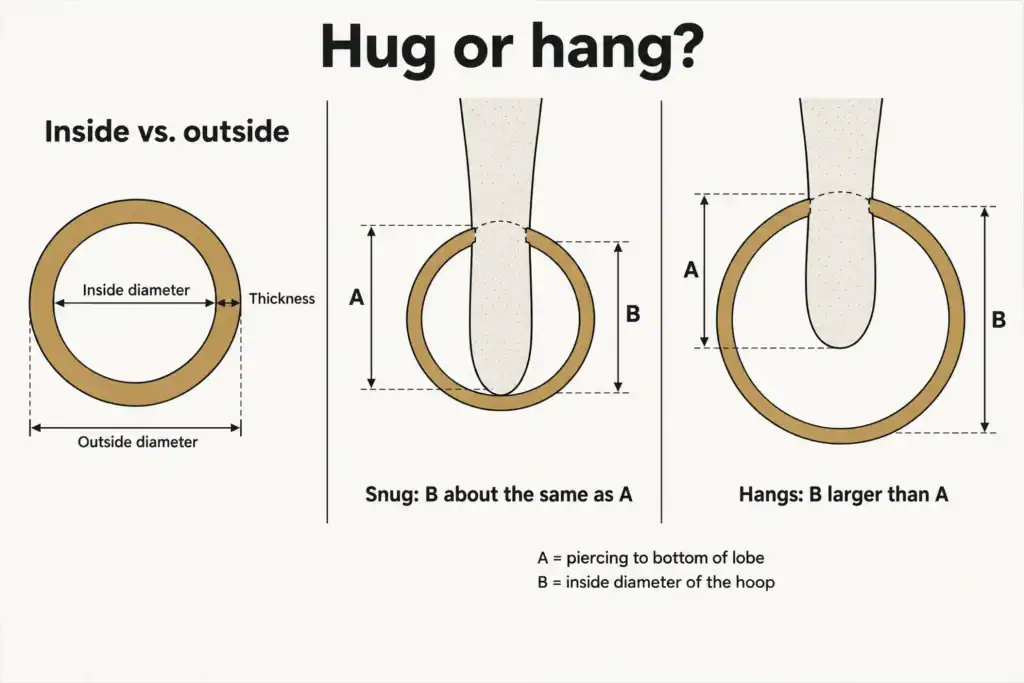
To find your distance, look in a mirror and hold a ruler with millimeter marks against your lobe. Measure from the piercing straight down to the bottom edge. Or measure the inside diameter of a hoop that already sits the way you like and shop for that number.
Is 12 mm the inside or the outside? Brands may list either, and the two differ by twice the thickness of the hoop. Take a huggie listed as 12 mm, made from a hoop 2 mm thick. If 12 mm is the outside diameter, the inside is 8 mm. If it’s the inside diameter, the opening is the full 12 mm. On a lobe that measures 8 mm from piercing to edge, the first pair hugs, while the second leaves a gap of about 4 mm. If a listing doesn’t say which diameter it gives, ask before you compare.
Stud or hoop: which should you buy first? A stud sits flat against the lobe, so there’s little to catch on hair or clothing, though its push back can loosen. A huggie is nearly as compact, and with its closure built into the hoop, there’s no separate back to lose. Larger hoops stand out more but catch more easily, and in neighboring piercings they can knock together. So start with a stud for the flattest fit, or a small huggie if you’ve lost earring backs before, and move up to a larger hoop once you know what size and weight feel comfortable.
Next come the styles that hang below the lobe.
Drop and Dangle Earrings: Chandeliers, Threaders and Weight
Drop and dangle earrings, along with chandeliers, threaders and tassels, hang from a lobe piercing. Because the design hangs below the hole, the back and the weight of the pair matter more than they do on a stud.
What’s the difference between drop and dangle earrings? Neither term has a formal definition. Retailers often use “drop” for an earring that hangs fairly still, such as a single pearl, stone or teardrop, and “dangle” for one with chains or linked parts that swing freely. Judge by the photos, not the name.
What are chandelier earrings? They’re long, tiered designs that widen toward the bottom.
What are threaders and tassels? A threader is a thin chain or wire that passes through the piercing, with one length in front of the lobe and one behind it. Most have no back, so nothing locks them in. A tassel is a bunch of chains, threads or beads hanging from a top piece. It swings, so by the rule of thumb above, it would count as a dangle.
Which back keeps a drop in? Many drops hang from a French hook, which usually has no lock. Lever, latch and omega backs stay attached to the earring, so they can’t get lost, and JA notes they’re common on larger drops. On a drop with a post, choose a bigger push back. JA says a larger back holds more securely and helps a heavier earring stay upright.
Can heavy earrings stretch your earlobes? They can, over time. An American Society of Plastic Surgeons article says heavy earrings worn for long periods can gradually stretch the lobe, and a 2018 paper in Dermatologic Surgery says split lobes usually result from long-term wear of heavy earrings. That goes for large hoops, too.
How heavy is too heavy? There’s no medically established weight limit: no dermatology or plastic surgery organization we found gives a number in grams, so treat any “safe weight” online as a seller’s opinion. If a pair pulls the hole downward or the piercing starts to look longer, wear it for shorter stretches or switch to something lighter. When a listing gives a weight, compare it with a pair you already wear comfortably.
Next come the styles worn beyond the lobe.
Ear Climbers, Ear Jackets and Ear Cuffs: Beyond the Lobe
These styles carry the design up the rim, out from behind the lobe or into the cartilage. Climbers and jackets use your lobe piercing and most cuffs need none, so all three give a fuller look without new holes. Only cartilage earrings need a piercing outside the lobe.
What are ear climbers? Ear climbers and ear crawlers are two names for the same style: a regular lobe post with a front that runs up the edge of the ear. We found no source that tells them apart. Because a climber is anchored at the lobe, how neatly it follows your ear depends on how well its curve matches yours.
Will an ear jacket fit your studs? An ear jacket is a separate piece that slides onto a stud’s post behind the lobe, so part of the design shows below it. Because it shares the stud’s post and back, it uses up some of the post. The common friction posts described in the stud section are only about 9.5 mm long, so a thick lobe or jacket can leave the back too little post to grip. Before pairing a jacket with studs you own, check that its hole fits the post and the back still goes on firmly.
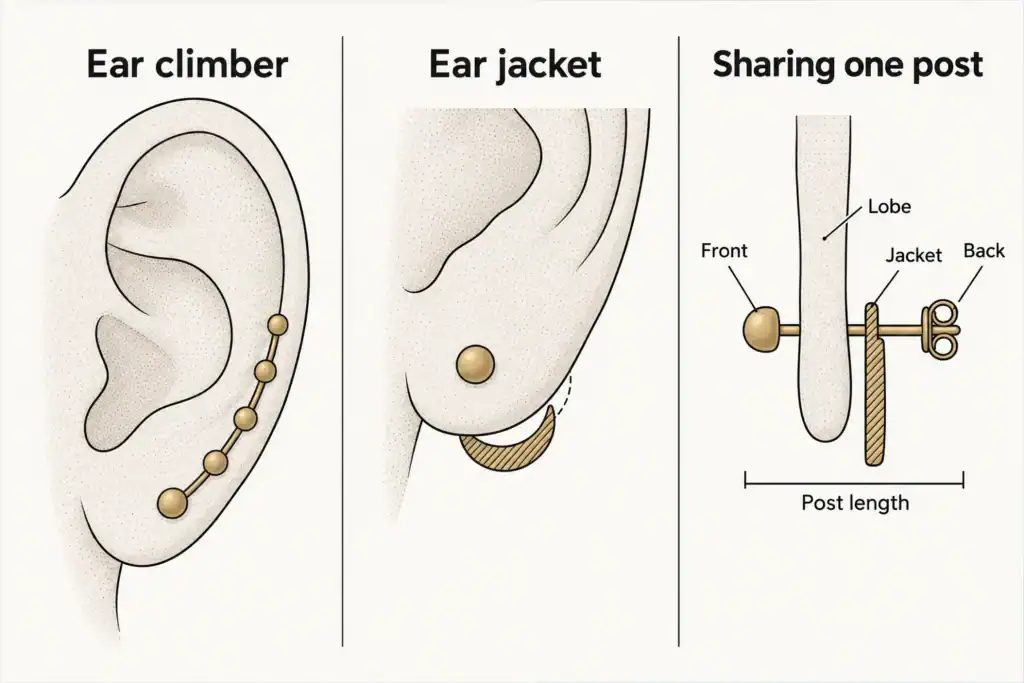
Do ear cuffs need a piercing? Most don’t. They hook or clamp onto the rim of the ear and stay on by their own grip, though some retailers also sell pieces that attach to a pierced earring as cuffs.
What about cartilage piercings? Your earlobe is soft tissue, while the rest of the outer ear is cartilage, including the spots for helix, tragus, conch, daith and rook piercings. Cartilage has a poor blood supply, so these piercings can take longer to heal. What goes into a new one is up to your piercer: the Association of Professional Piercers (APP) says the jewelry should suit your anatomy and the placement, and no reliable source we found assigns a style to each piercing.
Ear cuffs also belong to the fifth group: styles that need no piercing at all.
Clip-On Earrings, Magnetic Earrings and Ear Cuffs: No Piercing Needed
If your ears aren’t pierced, three kinds of earrings still work: clip-on earrings, magnetic earrings and most of the ear cuffs described above. Each stays on by pressing on your ear instead of going through it, and that pressure is the main trade-off.
How do clip-on earrings stay on? A clip folds up against the back of the lobe. A hinged clip’s grip is set by its hinge, while a screw clip has a small screw you turn to adjust it. That screw is a different part from the screw back on a stud.
How do magnetic earrings work? Magnets on each side of the lobe pull toward each other through it. In the U.S., they fall under the Consumer Product Safety Commission (CPSC) magnet standard, 16 CFR part 1262, which names “jewelry (including children’s jewelry)” and limits how strong small, loose magnets can be. Even so, keep magnetic earrings away from young children: the CPSC warns that two or more swallowed magnets can attract each other inside the body.
Do clip-on earrings hurt? We couldn’t find any medical guidance on how comfortable clip-on or magnetic earrings are or how long they can be worn. Both press on the lobe the whole time, so start with short stretches, loosen a screw clip if it pinches and take off any pair that starts to ache.
No piercing doesn’t mean no reaction. Nickel in a clip or cuff can still bother sensitive ears, and doctors have reported allergic reactions to the glue on some clip-on earrings.
Which one should you pick? On the lobe, choose a screw clip if you want a grip you can adjust; a magnet’s grip is fixed. On the rim, choose an ear cuff, but check the listing, since some cuffs need a piercing after all.
Next come the backs and closures that hold earrings in place.
Types of Earring Backs and Closures: Which Are Most Secure?
The piece that holds an earring in from behind is called the back, or backing. On many hoops and drops, the fastening is built into the earring instead and is usually called a closure. Either way, it’s the third part in the diagram at the top, and it decides how well a pair stays in.
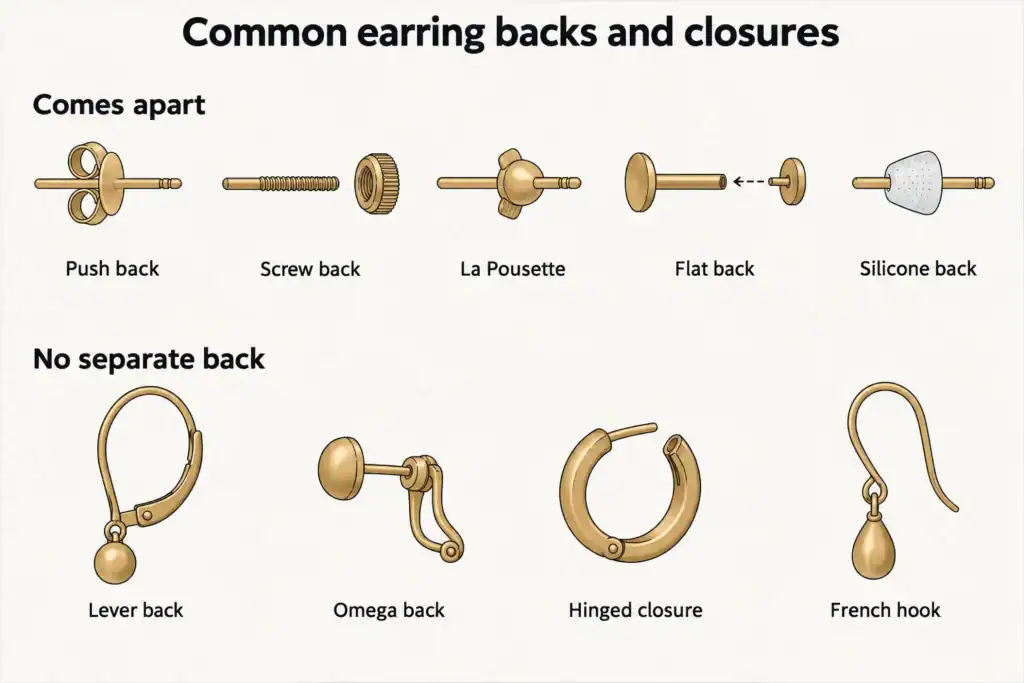
| Back (also called) | How it works | JA security rating | Usually on |
|---|---|---|---|
| Push back (butterfly or friction back) | Two curled tabs pinch the post and catch in its notches. | Medium | Most studs and drops with a post |
| Screw back (screw-on back) | It turns onto a threaded post. | High | Valuable diamond studs |
| La Pousette | Spring clips lock onto the post until you squeeze them. | High | Fine jewelry, such as diamond studs |
| Lever back | A curved wire fastens shut behind the ear. | Medium-high | Larger drops and some hoops |
| Latch back (the name varies) | The post locks into a hinged, slotted piece. | Medium-high | Larger drops and some hoops |
| Omega back (JA also calls it a French back) | A hinged loop folds down behind the lobe and catches the post. | Medium-high | Larger drops and some hoops |
| Hinged closure (click-top or snap) | A hinged bar on the hoop swings shut into a slot. | Not rated | Huggies and many hoops |
| French hook (fish hook or French wire) | A hook-shaped ear wire hangs through the piercing, usually with no lock. | Not rated | Drops and dangles |
| Kidney wire | The wire’s end hooks into a small catch at the front. | Not rated | Drops |
| Flat back (labret stud) | A flat disc sits behind the ear, and the top screws or pushes in from the front. | Not rated | Lobe and cartilage studs |
| Silicone back (rubber back or stopper) | A soft stopper, or a disc with a silicone pad, slides onto the post. | Not rated | Studs and other post earrings |
| Locking back | It grips the post until you press a button or squeeze tabs. | Not rated (La Pousette rates high) | Studs, often with a matching notched post |
Which earring back is most secure? On JA’s scale, screw backs and La Pousette backs rate highest. Lever, latch and omega backs come next, and push backs rate medium. Those ratings are an industry trade group’s guidance, not lab results: we found no published pull-force or loss-rate tests that compare earring backs.
What are flat back earrings? Flat back earrings, often sold as labret studs, have a post with a flat disc that sits against the back of your ear. On internally threaded jewelry, the decorative top screws into the hollow post on a tiny threaded pin, so the part that passes through your ear stays smooth. On threadless (press-fit) jewelry, the top’s slightly bent pin pushes into the post and is held by tension.
To take one out, hold the disc steady and turn the top counterclockwise. If it won’t turn, it may be threadless: those tops pull straight out. Manufacturers warn against bending a threadless pin back and forth, because the metal can weaken and break.
Are silicone backs secure? We couldn’t find any testing or medical guidance on how well they hold or how long they last, so replace any that feel loose, cracked or sticky.
Which backs suit babies and young children? A review in American Family Physician recommends locking or screw-on backs, because small earring parts can be swallowed or inhaled.
Why do the names get confusing? “French” can point to two different things: JA uses “French back” for the omega back, while many retailers use “French wire” for a hook-style ear wire. “Latch back” varies even more. In the guides we compared, it meant a lever back in one, an omega back in another and a hoop’s snap closure in a third, so the table follows JA’s description.
Is the back the same metal as the earring? Not always. As our guide to what the 925 stamp means notes, clasps and earring backs may be made of a different metal from the piece itself, so check the back, too, if your ears are sensitive.
What if an earring back is stuck? If it’s tight but not buried, follow the APP’s general advice: with clean hands, soak the area or use a little lubricant, but don’t force it, because forcing jewelry can tear the tissue. If it still won’t budge, see a piercer or a doctor. If the earring won’t move at all or the back has sunk into the skin, Cleveland Clinic says to contact a healthcare provider. Doctors usually remove embedded backs under a local anesthetic, sometimes through a small incision, and we found no reliable method for doing it yourself.
If the area is red, warm, swollen or leaking pus, see a doctor, and go right away if you also have a fever or red streaks spreading from the piercing. Until then, leave the earring in: the UK’s National Health Service advises keeping it in, and the APP notes that removing it can lead to an abscess.
How do you keep a back from getting stuck? Don’t overtighten it. In a study of 100 children treated for embedded earrings, the rear part of the earring was embedded in 68 cases. The APP says jewelry that’s too tight restricts blood flow and makes embedding more likely. So slide a push back on until it catches in the notch, then stop.
The next section turns to your own ears: sensitive skin, new piercings and everyday wear.
How to Choose Earrings for Sensitive Ears, New Piercings and Everyday Wear
Choosing a pair comes down to three questions: which metals will touch your skin, whether your piercing has healed and what your day involves.
| If you… | Consider | Check |
|---|---|---|
| Have nickel-sensitive ears | A metal dermatologists or piercers list, such as platinum, solid yellow gold or implant-grade titanium. | What the post and back are made of, not the word “hypoallergenic.” |
| Are about to get pierced | A professional piercer and starter jewelry from the APP’s list, not a piercing gun. | That the starter jewelry isn’t gold plated, gold filled or vermeil. |
| Sleep in your earrings | Small, flat studs or snug huggies, going by shape alone. | Whether a pointed post leaves the skin behind your ear sore. |
| Work out or play sports | Small studs or small hoops for workouts, but no fine jewelry for contact sports, as JA advises. | Your team’s or league’s jewelry rules. |
| Swim or use a hot tub | Taking earrings off first, since chlorine and salt water can damage metals. | Whether the piercing is new, in which case the jewelry stays in and you skip the soak. |
Which metals are best for sensitive ears? On a pierced earring, the parts that matter most are the post or ear wire inside the piercing and the back behind the lobe. Nickel is the main metal to watch. According to the American Academy of Dermatology (AAD), more than 18% of people in North America are estimated to be allergic to it, and it names earrings and earring backs among the biggest culprits. We found no U.S. legal definition of “hypoallergenic” for jewelry and no federal limit on nickel release.
The experts don’t fully agree on gold. The APP’s list for new piercings starts at 14K and the AAD’s at 18K, while DermNet, a dermatology reference site, says 12K or more should be safe. White gold can contain nickel. The AAD and DermNet also list stainless steel, but common 316L contains roughly 10–14% nickel, even though it releases very little in lab sweat tests. On plated earrings, the metal underneath reaches your skin once the gold wears through. We explain whether gold plated jewelry is hypoallergenic in our guide to plating.
What should go into a new piercing? Jewelry from the APP’s list, which includes solid 14K to 18K gold that’s nickel- and cadmium-free and alloyed for biocompatibility, niobium, platinum and specific grades of surgical steel and titanium. The APP rules out gold plated, gold filled and vermeil jewelry, because the thin gold can wear or chip off. It doesn’t prescribe one style for every lobe, but it criticizes piercing-gun studs as too short for some earlobes and most cartilage.
When can you switch styles? Once the piercing has healed, judged by signs of healing rather than the date. Cleveland Clinic says earlobe piercings usually take about six to eight weeks and cartilage piercings six months to a year. Aftercare advice conflicts, too: the American Academy of Pediatrics tells parents to turn a child’s starter earring daily, while the APP says not to rotate jewelry during healing. Follow the instructions from whoever pierced you.
Does face shape matter? Not much. JA suggests shapes that contrast with your face, such as long drops for a round face, but that’s styling advice, not science.
The last section is for jewelry brands.
For Jewelry Brands: Choosing Earring Styles and Writing the Spec Sheet
If you’re planning an earring line, the two questions behind this guide still apply: where does each pair sit, and what holds it in? A style name answers neither, so a brief that just says “gold huggie” leaves the size, the closure and the post to guesswork.
Which styles should a first collection include? Give each pair a job. Our guide to planning a first earring collection suggests a small stud for everyday wear, a huggie or compact hoop with more presence, and one drop or sculptural pair to lead the campaign photos. That covers three rows of the table at the top and three constructions: a post and back, a hinged closure, and a hook or post for the drop.
Write the spec by structure, not by name. Some items have a regulation or a recognized standard behind them. The rest, such as closure feel, weight on the ear and pair match, only show up on a physical pair, so agree on them in writing and check them on the approved sample. That’s what an earring sample should prove: once you approve it, production is judged against it.
| Spec item | What to write | Backed by |
|---|---|---|
| Post, wire and back metals | The grade of each part, such as 925 sterling silver or ASTM F138 steel, not “surgical steel.” | The FTC’s Jewelry Guides (sterling is at least 92.5% silver) and the ASTM grades the APP cites. |
| Plating | Karat, minimum thickness and whether the post is plated too. | FTC minimums: 0.175 µm for gold plated and 2.5 µm for heavy gold electroplate or vermeil. |
| Nickel release (EU) | An EN 1811 report on the finished, plated earring. | EU REACH limits, covered below. |
| Kids’ line (ages 12 and under) | Third-party lead testing and a Children’s Product Certificate. | CPSIA lead limits (100 ppm, or 90 ppm in paint and coatings), with cadmium covered by voluntary ASTM F2923. |
| Magnets | The magnet size and a flux index test. | 16 CFR part 1262: small magnets that can come loose need a flux index under 50 kG² mm². |
| Backs and closures | The back by name, how each hinge should open and line up, and the method and pass mark for any pull test. | No standard test, and JA’s ratings are guidance only. |
| Sizes, pair match and weight | Post diameter and length, hoop diameter (inside or outside) and thickness, pair tolerances and weight per earring. | No standard or medical weight limit. |
Selling in the EU? Under REACH, posts that go into a piercing must release less than 0.2 micrograms of nickel per square centimeter per week, and other parts in direct and prolonged contact with the skin no more than 0.5. Labs measure this with EN 1811, and coated parts other than the post go through EN 12472, a wear and corrosion simulation, first. So test the finished, plated earring, not the bare metal.
What we make. We make brass and sterling silver earrings in China for jewelry brands and provide gold-plating services. Our page on custom earrings made to your design shows the eight styles we make: studs, hoops, huggies, drops, dangles, clip-on earrings, ear cuffs and mismatched earrings. We can plate to the thickness in your spec, expressed as pure-gold equivalent, and use a nickel-free barrier layer instead of nickel. Brands can ask for proof such as an EN 1811 report. Our guide to choosing brass, 925 silver or steel for an earring line compares base metals, and our wholesale page covers minimums and lead times.
Frequently Asked Questions
What are the most popular earring styles?
Going by U.S. search interest, studs and hoops are the most popular earring styles. In Semrush’s U.S. data for August 2026, “stud earrings” gets about 33,100 searches a month and “hoop earrings” about 27,100, followed by clip-on earrings (18,100), ear cuffs (14,800) and huggie earrings (12,100). These figures count searches, not sales, and some clip-on and magnetic interest likely comes from people whose ears aren’t pierced.
What are earrings made of?
Common earring metals include solid gold, sterling silver, stainless steel, titanium and gold plated brass. With solid 14K or 18K gold, karat is the share of gold: 58.3% for 14K and 75% for 18K. Sterling silver earrings should be at least 92.5% silver under the Federal Trade Commission’s Jewelry Guides. Stainless steel earrings vary by grade. Gold plated brass jewelry has a thin layer of at least 10K gold over brass, and our guide explains how long gold plating lasts.
What earrings can you sleep in?
Going by shape alone, small flat studs and snug huggies work best, since they’re less likely to catch on bedding. We found little medical guidance: a review in American Family Physician notes that pointed posts can cause pressure sores behind the ear, and suggests another style first, then removing earrings at night. Don’t sleep directly on a healing cartilage piercing, the Association of Professional Piercers says.
What kind of earrings do men wear?
Men wear the same types of earrings as anyone else, since nothing in how an earring is built makes it a men’s or women’s style. U.S. searches lean toward studs, though: in Semrush’s August 2026 data, “stud earrings for men” gets about 5,400 searches a month, more than three times the biggest men’s phrase we found for magnetic, hoop or dangle earrings.
Are huggies the same as hoops?
Not quite. A huggie is a small hoop that wraps closely around the lobe, so every huggie is a hoop, but not every hoop is a huggie. To tell whether a pair will hug your ear, compare its inside diameter with the distance from your piercing to the bottom of your lobe.
Sources
- Gemological Institute of America (GIA), Bench Tip #4, on adjusting earring backs: https://www.gia.edu/bench-tip-how-to-adjust-earring-back
- Oxford Learner’s Dictionaries, “stud”: https://www.oxfordlearnersdictionaries.com/definition/english/stud_1
- Oxford Learner’s Dictionaries, “hoop”: https://www.oxfordlearnersdictionaries.com/definition/english/hoop_1
- Jewelers of America, Earring Style Guide: https://www.jewelers.org/buying-jewelry/jewelry-styles/earrings
- U.S. Federal Trade Commission, Guides for the Jewelry, Precious Metals, and Pewter Industries (16 CFR Part 23): https://www.ecfr.gov/current/title-16/chapter-I/subchapter-B/part-23
- ASTM B258, Standard Specification for Standard Nominal Diameters and Cross-Sectional Areas of AWG Sizes of Solid Round Wires Used as Electrical Conductors: https://store.astm.org/b0258-18.html
- American Society of Plastic Surgeons, A simple solution to torn and stretched earlobes: https://www.plasticsurgery.org/news/articles/a-simple-solution-to-torn-and-stretched-earlobes
- Sharma, H. K., Gupta, D., and Punj, S., Orifice Preserving Double Opposing Z-Plasty for Partial Split Ear Lobe Repair: A Review of 25 Cases, Dermatologic Surgery (2018): https://doi.org/10.1097/DSS.0000000000001271
- Gabriel, O. T., et al., Trends and Complications of Ear Piercing among Selected Nigerian Population, Journal of Family Medicine and Primary Care (2017): https://pmc.ncbi.nlm.nih.gov/articles/PMC5787947/
- Evans, H., et al., National Outbreak of Pseudomonas aeruginosa Associated with an Aftercare Solution following Piercings, July to September 2016, England, Eurosurveillance (2018): https://pmc.ncbi.nlm.nih.gov/articles/PMC6144469/
- Bhandari, P., et al., Daith Piercing: Wonder Treatment or Untested Fad?, Cureus (2020): https://pmc.ncbi.nlm.nih.gov/articles/PMC7075511/
- Uddin, S., and Terry, J., Migraine Symptoms Induced by an Auricular Piercing in a 27 Year Old Female: A Case Report, Case Reports in Neurology (2024): https://pmc.ncbi.nlm.nih.gov/articles/PMC10849747/
- Association of Professional Piercers, Jewelry for Initial Piercings: https://safepiercing.org/jewelry-for-initial-piercings/
- U.S. Consumer Product Safety Commission, Safety Standard for Magnets (16 CFR Part 1262), sections 1262.2 and 1262.3, via Cornell Law School’s Legal Information Institute: https://www.law.cornell.edu/cfr/text/16/1262.2 and https://www.law.cornell.edu/cfr/text/16/1262.3
- U.S. Consumer Product Safety Commission, Magnets safety education center: https://www.cpsc.gov/Safety-Education/Safety-Education-Centers/Magnets
- Suzuki, K., et al., Allergic Contact Dermatitis Caused by Tetrahydrofurfuryl Acrylate in the Adhesive of Clip-on Earrings, Contact Dermatitis (2020): https://doi.org/10.1111/cod.13412
- Association of Professional Piercers, Jewelry for Healed Piercings: https://safepiercing.org/jewelry-for-healed-piercings/
- Meltzer, D. I., Complications of Body Piercing, American Family Physician (2005): https://www.aafp.org/pubs/afp/issues/2005/1115/p2029.html
- Cleveland Clinic, Infected Ear Piercing: https://my.clevelandclinic.org/health/diseases/21503-infected-ear-piercing
- UK National Health Service, Infected piercings: https://www.nhs.uk/conditions/infected-piercings/
- Association of Professional Piercers, Body Piercing Troubleshooting for You and Your Healthcare Professional: https://safepiercing.org/troubleshooting/
- Timm, N., and Iyer, S., Embedded Earrings in Children, Pediatric Emergency Care (2008): https://doi.org/10.1097/pec.0b013e31815f6f59
- Jewelers of America, Jewelry Care: https://www.jewelers.org/buying-jewelry/jewelry-repair-and-care/jewelry-care
- American Academy of Dermatology, Nickel allergy: How to avoid exposure and reduce symptoms: https://www.aad.org/public/diseases/eczema/insider/nickel-allergy
- DermNet, Nickel allergy: https://dermnetnz.org/topics/nickel-allergy
- Haudrechy, P., et al., Nickel Release from Nickel-Plated Metals and Stainless Steels, Contact Dermatitis (1994): https://pubmed.ncbi.nlm.nih.gov/7842681/
- Association of Professional Piercers, Piercing Guns: https://safepiercing.org/piercing-guns/
- Cleveland Clinic Health Essentials, Ear Piercing 101: https://health.clevelandclinic.org/what-to-expect-when-getting-your-ears-pierced
- American Academy of Pediatrics (HealthyChildren.org), Avoiding Infection After Ear Piercing: https://www.healthychildren.org/English/health-issues/conditions/ear-nose-throat/Pages/Avoiding-Infection-After-Ear-Piercing.aspx
- Association of Professional Piercers, Aftercare: https://safepiercing.org/aftercare/
- EN 1811:2023, Reference test method for release of nickel from all post assemblies which are inserted into pierced parts of the human body and articles intended to come into direct and prolonged contact with the skin (SIS catalog): https://www.sis.se/en/produkter/precision-mechanics-jewellery/jewellery/ss-en-18112023/
- European Commission, Commission Regulation (EC) No 552/2009 amending REACH Annex XVII (entry 27: nickel): https://eur-lex.europa.eu/eli/reg/2009/552/oj
- U.S. Consumer Product Safety Commission, Total Lead Content: https://www.cpsc.gov/Business–Manufacturing/Business-Education/Lead/Total-Lead-Content
- ASTM F2923-20, Standard Specification for Consumer Product Safety for Children’s Jewelry: https://store.astm.org/f2923-20.html
- EN 12472:2020, Method for the simulation of accelerated wear and corrosion for the detection of nickel release from coated items (SIS catalog): https://www.sis.se/en/produkter/precision-mechanics-jewellery/jewellery/ss-en-124722020/
Search figures in the FAQ are U.S. monthly averages for exact phrases in Semrush’s August 2026 data, pulled October 4, 2026. They measure searches, not sales. The comparison of 11 earring style guides, the hoop-fit geometry and the ear jacket post-length point are our own analysis.