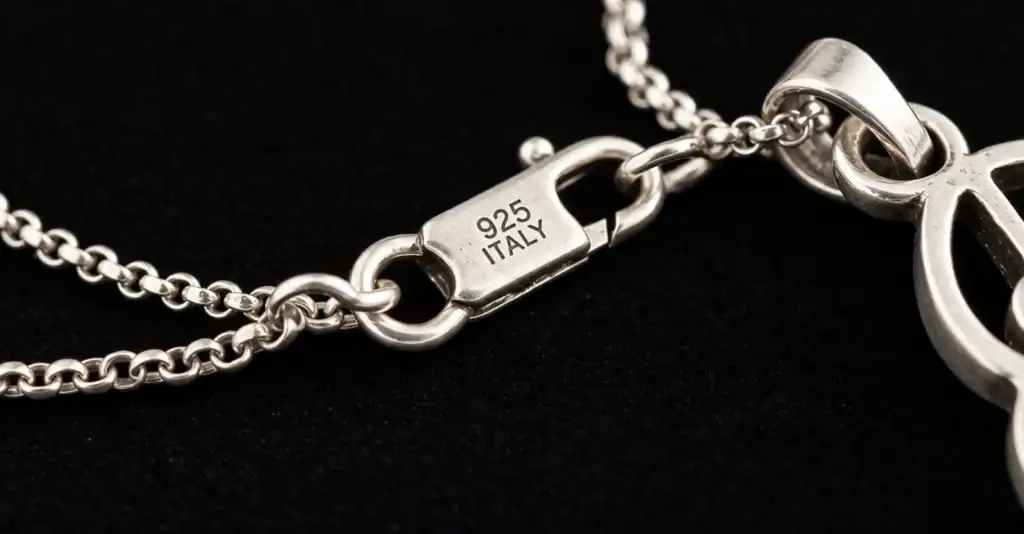
“925 Italy” is really two claims stamped side by side. “925” says the piece is sterling silver: at least 92.5% pure silver by weight. “Italy” says it was made in Italy. Neither part is a test result, and neither guarantees quality.
As a jewelry manufacturer, we mark metal of part of our work. Below, we break the stamp down first, then answer the questions that usually come next: Is it real? Why does mine look gold? What is it worth?
What “925” and “Italy” Each Tell You — and What They Don’t
This stamp pairs a numeral with the name of the country, as the two elements answer different questions: the numeral refers to the metal composition, while the country name indicates the item’s place of origin.
| Part | What it claims | What it doesn’t tell you |
|---|---|---|
| 925 | At least 925 parts per 1,000 are pure silver (92.5%), the standard known as sterling silver | Whether that’s true, or what the other 7.5% is (usually copper, but not always) |
| Italy | The piece was made in Italy | Who made it, how well it was made, or whether the silver is real |
Why 92.5% and not pure silver? Pure silver is too soft for most everyday jewelry: it scratches and bends easily. Mixing in a small share of other metal, usually copper, makes it harder.
The standard itself is centuries old. England’s hallmarking law of 1300 already required silver goods to meet it. In the U.S. today, the FTC’s Jewelry Guides say anything sold as sterling must contain at least 925 parts per 1,000 silver. That’s why “925” and “sterling” mean the same thing.
The stamp itself proves none of this, though. It’s put on by the company that makes or sells the piece. We mark jewelry for our own clients, so we’ll put it plainly: a stamp tells you what that company says the metal is. It isn’t a lab result.
Keep that in mind when you read claims like these:
| What you may read | What’s actually true |
|---|---|
| “925 Italy” is an official Italian hallmark | It isn’t. Italian law calls for a fineness number plus a star-shaped identification mark, and the word “Italy” is part of neither. |
| The stamp guarantees the silver is real | It’s a claim, not proof. Stamps can be wrong or faked, and only testing shows what a piece is made of. |
| “Italy” means purer silver or better craftsmanship | “Italy” names the country of origin, nothing more. 925 is the same 92.5% wherever a piece is made. |
| A certificate proves the piece is genuine | A certificate is only as reliable as whoever issued it. One from the seller is still the seller’s claim. |
So if “Italy” is just a country name, why is it on the stamp at all? And why not “925 USA” or “925 Africa”?
Why Italy — and Why Not “925 USA” or “925 Africa”?
It comes down to origin labeling. Under U.S. law, imported goods must name their country of origin in English. For most jewelry, either a stamp in the metal or atag will do, so a stamped “Italy” is one way to meet the rule.
That also explains the other two:
| Stamp | As an origin mark | Why |
|---|---|---|
| 925 Italy | Works if the piece was made in Italy | Italy is a country, and imported jewelry must name its country of origin. |
| 925 USA | Not required on U.S.-made jewelry | The marking rule covers imports. A “Made in USA” claim must mean all or virtually all made in the U.S. |
| 925 Africa | Doesn’t work | An origin mark must name a country, and Africa is a continent. |
| 925 Mexico | Works if the piece was made in Mexico | Mexican silver is often marked MEXICO with a number such as 925. Italy isn’t a special case. |
It also helps to know that Italy’s jewelry industry is built for export. Confindustria Federorafi, its national federation, describes Italy as one of the world’s top five jewelry exporters and Europe’s largest, and says the industry exports almost 90% of what it makes.
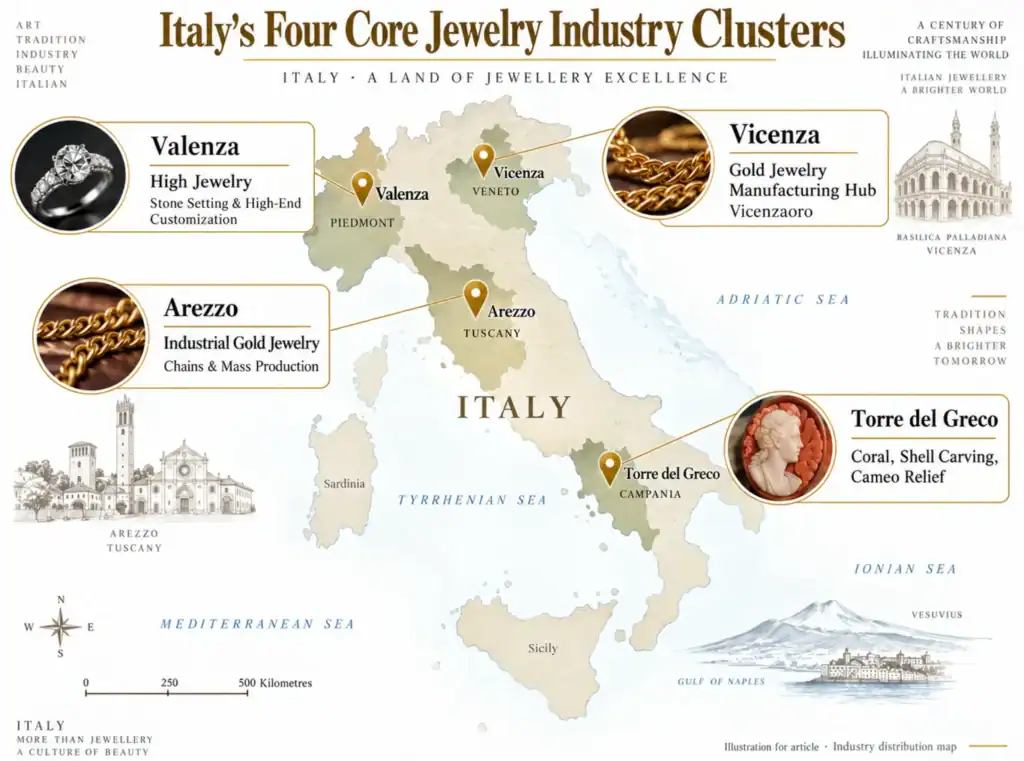
Italy also has a long history of regulating these marks:
| Year | What changed |
|---|---|
| 1872 | Testing was voluntary, and silver often carried an unofficial “800.” |
| 1934 | An official mark arrived: a lozenge with the fasces symbol, a registration number and a province code. The fasces were dropped in 1944. |
| 1968 | A new law added a star to the registration number and province code. |
| 1999 | Legislative Decree 251/1999, still in force, set today’s legal silver standards: 925 and 800. |
None of this changes what the word means: where the piece was made. Under U.S. customs rules, that’s where the jewelry was actually made, not where itsdesign, silver or machinery came from. If a piece made elsewhere carries “Italy” in a way that could mislead buyers, its real country of origin, such as “Made inChina,” has to appear close by.
We make our jewelry in China, so we don’t stamp “Italy” on it, even on Italian-style designs.
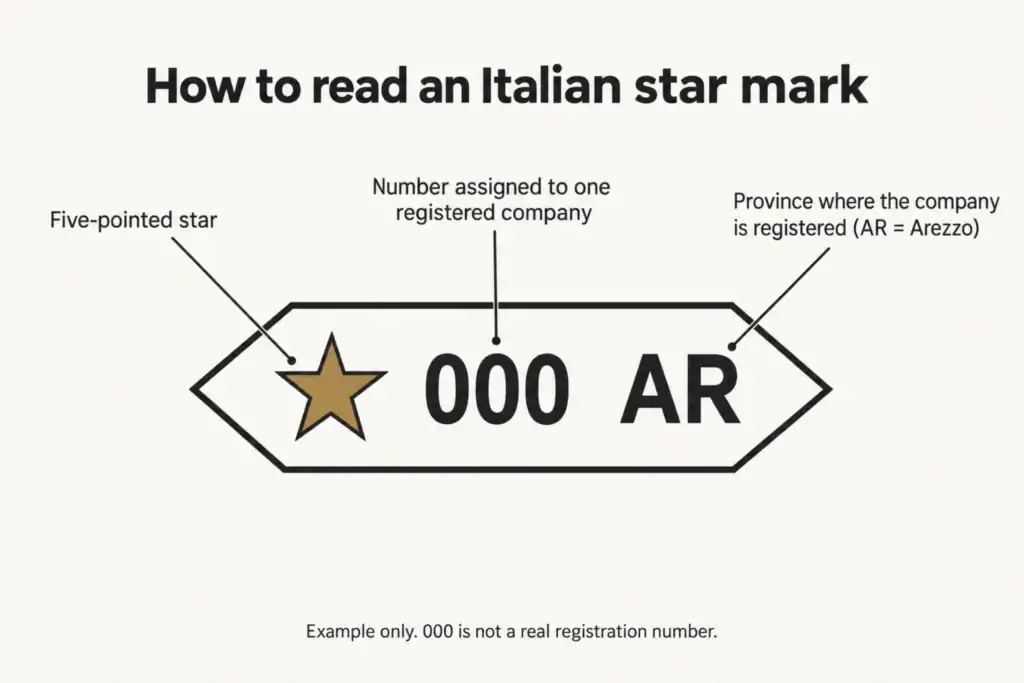
Next to the number, you may also find a small star with a code. That’s Italy’s official mark, and it’s easy to misread.
Besides the common “925 Italy” mark, what other markings are typically found?
The official Italian mark features a five-pointed star accompanied by a number and a provincial abbreviation (such as “AR” for the province of Arezzo). Manufacturers or importers selling precious metal products in Italy are required to register such marks and stamp them onto their products. These marks identify the business and the province where it is registered; importers and sellers may also have their own marks. Consequently, the presence of the star mark does not guarantee the jewelry was made in Italy, nor does its absence imply the item is a fake.
It is very common to see a brand name or logo stamped alongside the “925” mark. U.S. law generally requires that jewelry bearing a fineness mark like “925” must also display a registered trademark or company name when sold across state lines or imported; Italian manufacturers may also add brand logos alongside the official mark. For instance, the “Milor” in “925 Italy Milor” is one such name—it is the brand of a Milan-based jewelry company that claims to have been established in 1955.
To take our own business as an example: when we manufacture jewelry for other brands, the mark next to “925” might be that brand’s logo rather than our own. The mark indicates the brand to which the jewelry belongs, not necessarily the factory that actually produced it.
The following outlines the information that the various types of markers can and cannot provide:
| Mark | What it tells you | What it can’t prove |
|---|---|---|
| Star, number and province code | Which registered company the mark belongs to, and the province where it’s registered | That the piece was made in Italy |
| Brand name or logo, such as MILOR | Whose name is on the piece | Which factory made it, or that it’s genuine, since logos can be copied |
| 926, 923, 825 or 325 | Nothing reliable: none is a legal silver or gold standard in Italy, and we found no trustworthy explanation | What the piece is made of |
| PT, GLO, IXS, 925C1, SU, BS or PM | Nothing reliable: we found no trustworthy explanation for these letters | What the piece is made of |
Rather than relying on guesswork, we prefer to be straightforward. After all, certain terms can be inherently confusing—such as “silver” appearing on labels with vastly different meanings, even though some of those products contain no silver at all.
There are so many markings on silver jewelry—such as “925”—on the market; which ones actually indicate genuine silver?
“925” is one of the many numbers and markings commonly found on silver jewelry, yet not all such markings indicate that the piece is made of silver. In the United States, the Federal Trade Commission (FTC) has established standards through its Guides for the Jewelry, Precious Metals, and Pewter Industries: items labeled as “sterling silver” must contain at least 925 parts silver per 1,000; “coin silver” must contain at least 900 parts silver per 1,000; and silver jewelry with a lower silver content should be marked with its specific fineness, such as “800 silver.”
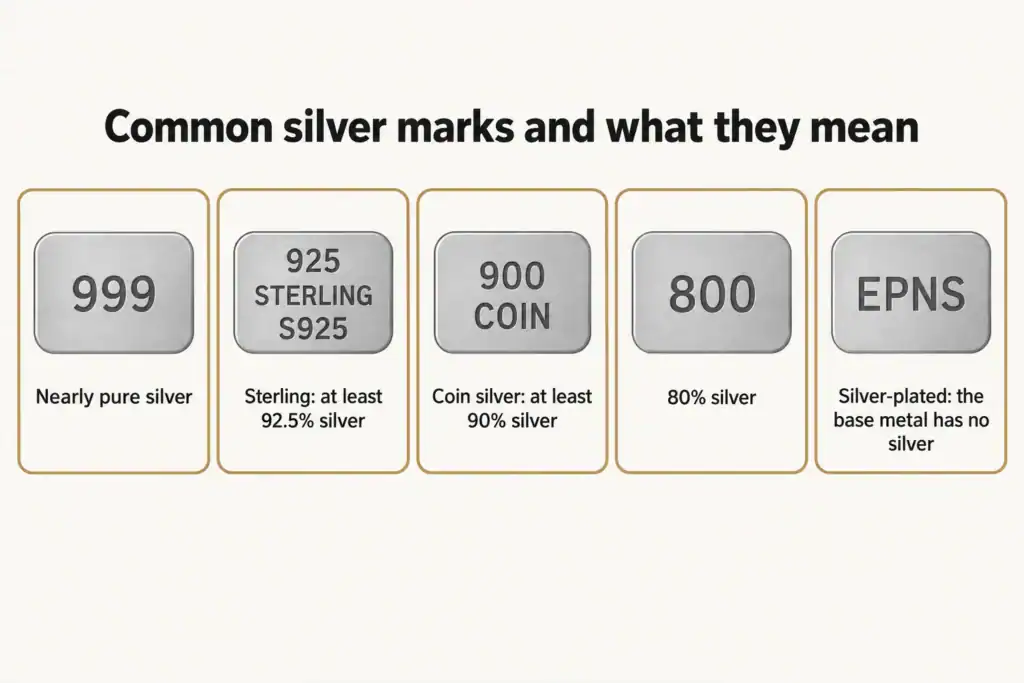
| Label | Silver content | Is it silver? | Good to know |
|---|---|---|---|
| 999 | 99.9% | Yes, nearly pure | Very soft, so it scratches and bends easily |
| 925, Sterling, S925 | At least 92.5% | Yes | All three mean the same standard. S925 is a sterling mark, not a sign of where a piece was made |
| 900, Coin silver | At least 90% | Yes | Less silver than sterling |
| 800 | 80% | Yes, lower grade | One of Italy’s two legal silver standards, and often seen on older Italian silver. It can’t be sold as sterling |
| Silver-plated, EPNS | A thin surface layer | Only the surface | Can’t be stamped “sterling” or “coin” in the U.S., and has almost no melt value. EPNS means the base is nickel silver |
| German silver, Nickel silver | None | No | A copper, nickel and zinc alloy named for its color. It contains nickel, a common skin allergen |
| Tibetan silver | Usually little or none | Usually not | A trade name for various white metal alloys, which may contain nickel |
| Silver tone | None implied | No | Describes the color, not the metal |
Labels are a form of declaration, and color is much the same. We provide jewelry plating services; regardless of the base metal, the plated surface looks identical. Therefore, to determine the true material of the jewelry, testing is essential—it is impossible to tell simply by looking at it.
How can I tell if my 925 Italy silver is real? Is it reliable to test it myself at home?
The question “Is this real?” actually carries two meanings: Is it made of silver? And is it made in Italy? Metal testing helps answer the first question but cannot answer the second; testing reveals the material composition but not the place of origin. To confirm the origin, the most reliable evidence comes from documentation—such as a label indicating the country of manufacture or information from the seller or brand verifying where the item was produced.
Regarding the question of whether an item is silver, one point must be clarified: while I understand the desire to find a reliable way to verify this online, there is unfortunately no at-home test that can conclusively prove an item is 925 silver. Although certain tests can rule out specific metals, silver-plated items or other metals can sometimes pass these tests as well.
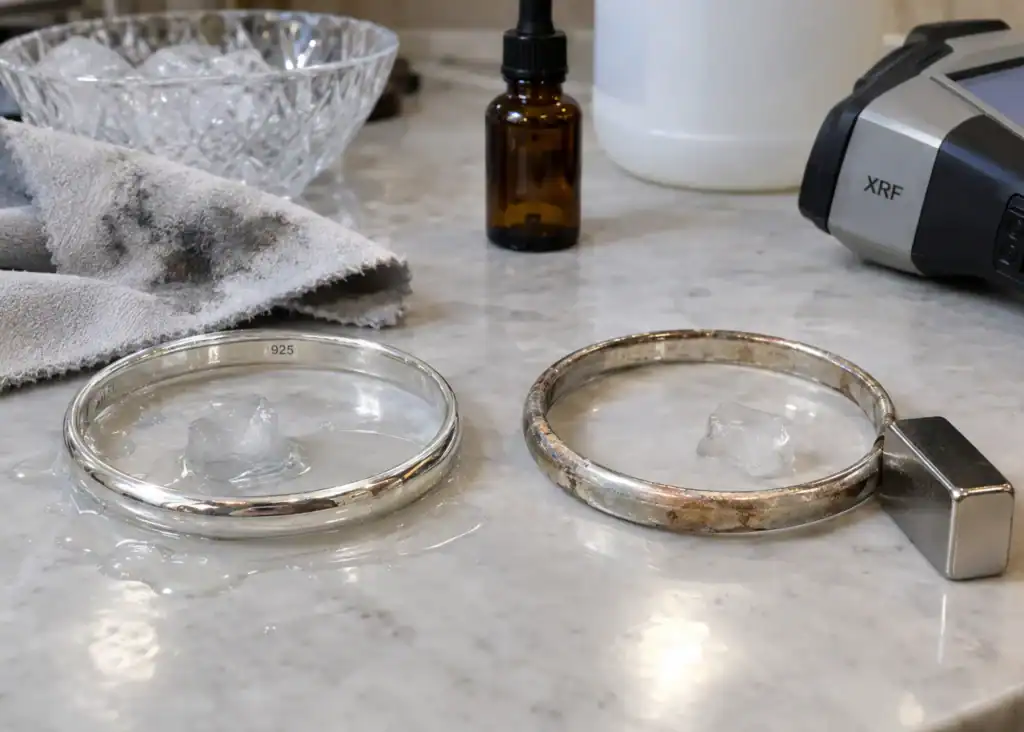
| Test | What it can tell you | What it can’t | Safe to try at home? |
|---|---|---|---|
| Magnet | If it clings to a strong magnet, it isn’t solid silver | Not sticking doesn’t mean silver: copper, many kinds of stainless steel and plated pieces with a non-magnetic base don’t stick either. A steel spring in the clasp can stick even on real silver | Yes, with a strong neodymium magnet |
| Ice cube | Very little on small jewelry | Silver conducts heat better than any other metal, but copper comes close, so silver-plated copper passes too | Yes, but keep water away from stones and hollow parts |
| Polishing cloth | Black residue is consistent with silver | Plated pieces and nickel silver darken too, and a clean piece may leave no mark | Yes on solid silver; it wears plating away |
| Bleach | Whether there’s silver on the surface | Solid silver from plated: both turn black | No. It leaves black marks |
| Acid test | A rough purity range, in trained hands | What’s under plating, unless the surface is filed through | No. It uses corrosive acid and scratches the piece |
| XRF analyzer | The metals on the surface and their proportions, in seconds, without damage | What’s under thick plating, or what the piece is worth | Not at home. Ask a jeweler, a precious-metal buyer or an assay lab |
This is not merely a theoretical issue. According to the industry publication JCK, the UK’s Sunday Times commissioned the Birmingham Assay Office in 2026 to test jewelry purchased on Amazon and TikTok Shop. One ring, marketed as 925 silver, was found to contain approximately 92% cadmium—a level exceeding the UK’s limit for cadmium in jewelry by 9,000 times.
At Jinnuo Jewelry, verifying the 925 silver material is a distinct step in the quality control process. Stamping is a separate procedure, and the act of stamping itself does not serve to verify the material composition.
Why Does My 925 Italy Chain Look Gold?
A gold-colored chain stamped “925 Italy” looks like a contradiction, but it isn’t. The 925 still describes silver: it claims a sterling silver base, and the gold color is a layer on top. Solid gold is marked differently, with karats or its own fineness numbers.
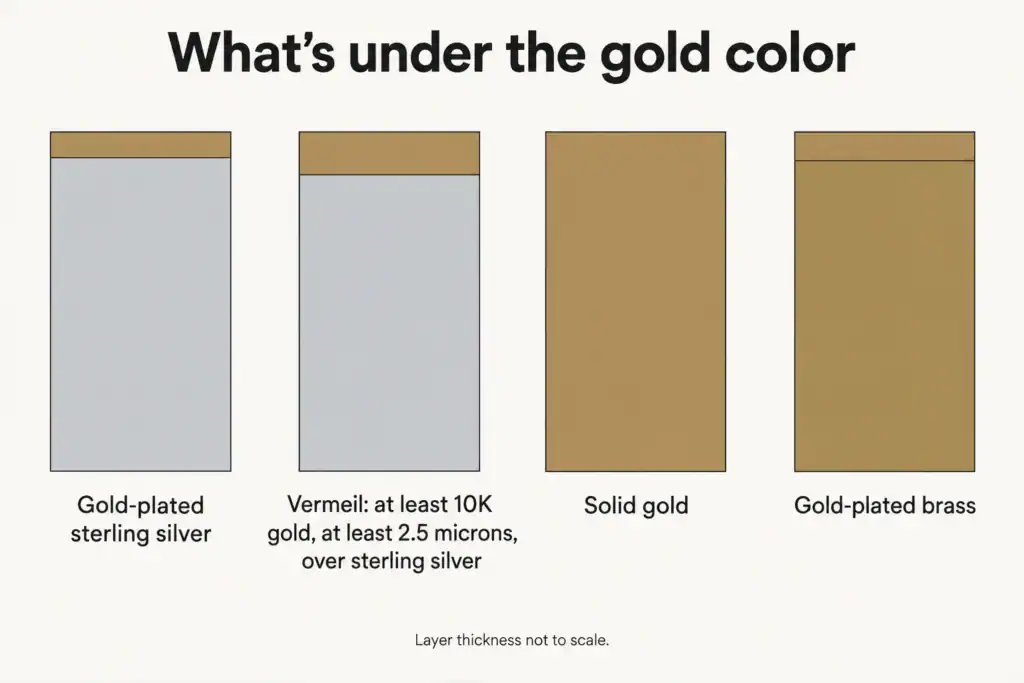
| Type | What it’s made of | Typical marks | Melt value comes from |
|---|---|---|---|
| Gold-plated sterling silver | Sterling silver with a thin layer of gold plating | 925 | Mostly the silver |
| Vermeil (U.S. definition) | Sterling silver plated with gold of at least 10K, at least 2.5 microns thick | 925, but the stamp can’t show it meets the vermeil standard | Mostly the silver |
| Solid gold | Gold alloy all the way through | Karat marks such as 10K, 14K or 18K, or fineness numbers such as 585 or 750 | The gold |
| Gold-plated base metal | Brass or another base metal with a thin layer of gold plating | No precious-metal mark; a 925 stamp here would be false | Almost nothing |
So, is that gold-colored 925 silver chain simply gold-plated, or is it “Vermeil” (gold-plated sterling silver)? You cannot tell just by looking at the hallmark or examining it with the naked eye. According to the U.S. Federal Trade Commission (FTC) guidelines for the jewelry industry, Vermeil requires a sterling silver base coated or plated with gold of at least 10 karats, with a plating thickness equivalent to 2.5 microns of pure gold.
Testing presents a challenge as well: XRF (X-ray fluorescence) analyzers read surface data. Consequently, if the gold plating is thick, the instrument might misidentify the item as solid gold, even if the core consists of base metal (non-precious metal).
The reverse is also true: you might encounter a silver-colored chain stamped “14K Italy.” It could be 14K white gold (which is typically rhodium-plated), but this, too, requires testing to confirm.
We offer gold-plating services for sterling silver; in such cases, the gold serves merely as a surface finish, while the “925” hallmark indicates the underlying silver base.
Regardless of the color, the ultimate question comes down to value.
How Much Is 925 Italy Silver Worth?
Start with melt value, the worth of the silver itself. Weigh the piece in grams, multiply by 0.925 to get the pure silver, then price that at today’s spot rate. Spot prices are quoted per troy ounce, which is 31.1035 grams.
For example, a 20-gram sterling chain holds about 18.5 grams of pure silver, or roughly 0.59 troy ounces. Leave out anything that isn’t silver, such as stones or a steel clasp.
| Price | What it’s based on | What to expect |
|---|---|---|
| Melt value | Silver weight × spot price | Nobody pays all of it, because refiners deduct refining losses |
| Buyer’s offer | A share of melt value | Varies widely from buyer to buyer, so get several quotes |
| Retail price | The metal, plus making, finishing, packaging and selling the piece | Not a guide to what a buyer will pay you |
Weight is what moves the number. A hollow chain can look identical to a solid one but weighs noticeably less at the same length and width, so it’s worth less as scrap. It also dents more easily and is harder to repair. Hollow doesn’t mean fake, though. And “diamond cut” means small flat facets cut into the metal to catch the light; there are no diamonds in it.
“Italy” doesn’t change melt value either: 925 is the same 92.5% wherever a piece was made. Whether a buyer pays more for a design or a brand is a separate question.
As a manufacturer, we can tell you the silver is only part of what a finished piece costs; making, finishing and packaging it cost money too. A scrap buyer pays for the silver alone.
Is it pawnable? Call before you go: many pawnshops in the Philippines, for example, accept only gold.
Whatever it’s worth, you’ll want it to keep looking good, and that starts with understanding tarnish.
Tarnish, Worn Plating and Skin Marks: Everyday Care Tips
Silver darkens because it reacts with sulfur compounds in the air, forming silver sulfide, better known as tarnish. That doesn’t prove a piece is real silver: silver-plated pieces tarnish too. Rhodium plating keeps silver bright only while the plating is intact. The layer is very thin, and where it wears through, the silver underneath can tarnish again.
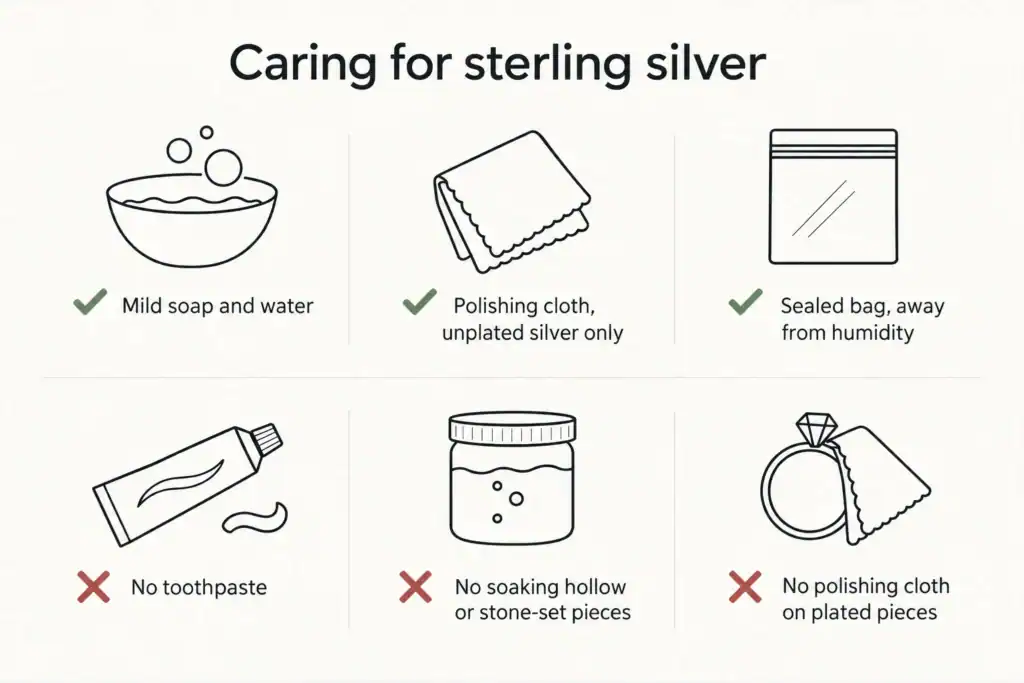
Here’s how to tell what you’re looking at:
| What you see | What it usually is | What to do |
|---|---|---|
| A gray or black film on the silver | Tarnish | Wash with mild soap and water, then use a silver polishing cloth |
| A different color showing through a gold or bright white finish | Plating wearing through | Polishing won’t bring it back and removes more plating; ask a jeweler about replating |
| Green or dark marks on your skin | A harmless deposit from copper, sweat, lotion or makeup | Wash it off with soap and water, and put jewelry on after lotion or powder |
| An itchy, red or blistering rash | Possibly an allergic reaction, most often to nickel | Stop wearing the piece and see a dermatologist |
And when you clean it:
| Do | Don’t |
|---|---|
| Wash with mild soap and water first | Use toothpaste or multi-purpose metal polish, which are more abrasive |
| Use a silver polishing cloth for light tarnish, on unplated silver only | Use a polishing cloth on plated or rhodium-plated pieces; it wears the plating away |
| Polish only when needed, since every polish removes a little silver | Soak hollow pieces or stone-set pieces in dips or cleaning baths |
| Store pieces in a sealed plastic bag or with an anti-tarnish cloth, away from humidity and rubber | Leave silver out in a humid room if you want it to stay bright |
For the brands we make silver jewelry for, we plan tarnish control before production: the finish, anti-tarnish packaging and a care card. You can see those options on our 925 sterling silver jewelry page.
Frequently Asked Questions
My jewelry says 925 but not Italy. Is something wrong?
No. The 925 is the silver claim; “Italy” only names where a piece was made. Plenty of silver jewelry is made elsewhere, U.S.-made pieces don’t have to name a country at all, and imported pieces can show their origin on a tag instead of the metal.
Does real silver have to be Italian?
No. Sterling silver means at least 925 parts per 1,000 silver wherever it’s made, and the country name doesn’t change that. We make our sterling silver jewelry in China, to the same 925 standard. What matters is whether the metal really meets it, and only testing can show that.
Can I wear 925 Italy jewelry every day?
Yes. The 7.5% of other metal in sterling makes it harder than pure silver, which is too soft for everyday wear. Expect some tarnish, which cleans off, and gradual wear on any gold or rhodium plating. Hollow chains dent more easily than solid ones, so treat them gently.
Is 925 Italy silver hypoallergenic?
Not guaranteed. The American Academy of Dermatology lists sterling silver among the metals people with a nickel allergy can usually wear, but clasps and earring backs may be made of a different metal. If you get an itchy, red rash, stop wearing the piece and see a dermatologist.
Is 925 Italy silver a good investment?
Not in the usual sense. Its scrap value follows the silver price, but buyers pay only part of melt value, and a retail price also covers making, finishing and selling the piece. What you’d get back is based on the silver, not on what you paid.
Key takeaways
- “925” means at least 92.5% silver, and “Italy” names the country of origin. Both are claims, not test results.
- “925 Italy” isn’t an official Italian hallmark. Italy’s official mark is a star with a number and a province code, and even that doesn’t prove a piece was made in Italy.
- No home test can prove a piece is 925 silver; professional testing is the reliable route. No metal test can show where a piece was made.
- On a gold-colored piece, 925 still means a sterling silver base with gold on top.
- Melt value is weight × 0.925 × the spot price, and buyers pay only part of it.
Sources
- U.S. Federal Trade Commission, Guides for the Jewelry, Precious Metals, and Pewter Industries (16 CFR Part 23): https://www.ecfr.gov/current/title-16/chapter-I/subchapter-B/part-23
- 19 U.S.C. § 1304, marking of imported articles: https://www.law.cornell.edu/uscode/text/19/1304
- 19 CFR Part 134, country of origin marking: https://www.ecfr.gov/current/title-19/chapter-I/part-134
- 15 U.S.C. § 297, quality marks and trademarks on gold and silver articles: https://www.law.cornell.edu/uscode/text/15/297
- U.S. Federal Trade Commission, Complying with the Made in USA Standard: https://www.ftc.gov/business-guidance/resources/complying-made-usa-standard
- Italy, Legislative Decree 251/1999: https://www.normattiva.it/uri-res/N2Ls?urn:nir:stato:decreto.legislativo:1999-05-22;251
- Vicenza Chamber of Commerce, precious-metal identification marks: https://www.vi.camcom.it/it/servizi/metrologia/registro-assegnatari-marchio-identificazione-metalli-preziosi
- Confindustria Federorafi, Italian jewelry exports in 2025: https://www.federorafi.it/gioielleria-calo-di-quasi-un-quinto-dellexport-2025-e-peggioramento-nel-2026/
- The Assay Office London, history of hallmarking: https://www.assayofficelondon.co.uk/about-us/history-of-hallmarking
- GIA, choosing a white metal: https://4cs.gia.edu/en-us/blog/pick-right-white-metal-engagement-wedding-ring/
- Canadian Conservation Institute, Care of Silver (CCI Note 9/7): https://www.canada.ca/en/conservation-institute/services/conservation-preservation-publications/canadian-conservation-institute-notes/care-silver.html
- American Academy of Dermatology, nickel allergy: https://www.aad.org/public/diseases/eczema/insider/nickel-allergy
- Indian Dermatology Online Journal (2018), case report on black marks from silver jewelry: https://pmc.ncbi.nlm.nih.gov/articles/PMC5956881/
- JCK, cadmium in jewelry bought on Amazon and TikTok Shop (2026): https://www.jckonline.com/editorial-article/cadmium-amazon-tiktok-jewelry/
- Encyclopaedia Britannica, silver processing: https://www.britannica.com/technology/silver-processing
- Italian silver hallmarks, silvercollection.it: https://www.silvercollection.it/italianhallmarks.html

Carol
Carol is a jewelry manufacturing expert with first-hand experience across materials, surface finishes, production processes and quality control. He brings critical thinking and rigor to his work, questioning common assumptions and testing them against industry standards and real production results. He looks at every issue from the point ofview of the people who buy and wear jewelry, turning technical details into clear, practical answers to real-world problems.