
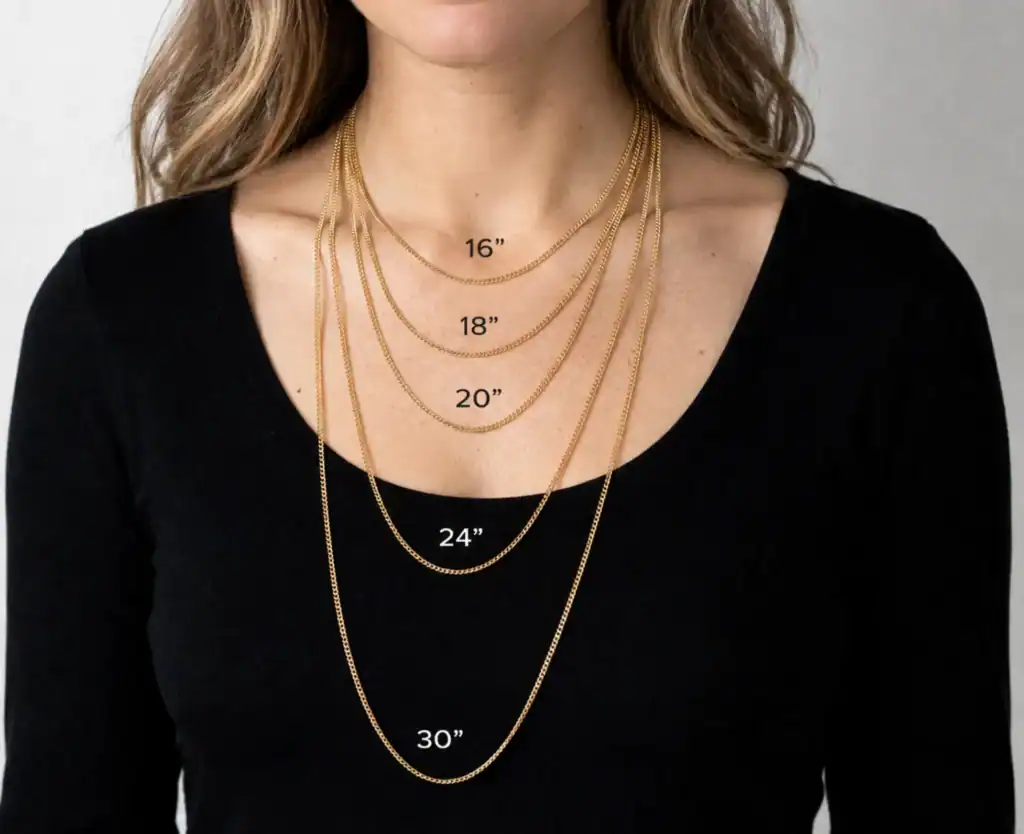
Ask ten people whether a 16- or 18-inch necklace is “right,” and you’ll get ten different answers. There’s a reason: a necklace is a loop, so where it lands depends on your neck as much as on the number on the tag.
This guide gives you a length chart that works for every neck. We’ll start with what to check before you buy any necklace, show where each length from 14 to 36 inches usually falls, then help you measure yourself, even without a tape measure, and settle 16 vs 18 for good. We make necklaces for jewelry brands, so we’ll also flag the details that are easy to get wrong when you order.
Before You Pick a Necklace: What to Check, and Why Length Comes First.
A necklace is more than its length. Each part changes how it looks and wears:
| What to check | What it changes | What to look for |
|---|---|---|
| Length | Where the necklace sits, how it feels, and whether your neckline shows it or hides it | Decide this first. The rest of this guide shows you how |
| Chain style and width | How bold it looks and how it drapes | Width is usually listed in millimeters. If you’ll add a pendant, its bail has to fit over the chain |
| Material and finish | How it wears day to day, whether it tarnishes, how it feels on sensitive skin | Match it to how often you’ll wear it |
| Clasp | How easy it is to put on and how secure it feels | Make sure you can open and close it on your own |
| Pendant | How low the necklace hangs and how it moves | A pendant hangs below the chain, so it adds to the drop |
| Adjustability | Whether one necklace can work at more than one length | An extender chain or a sliding clasp gives you a range instead of a single length |
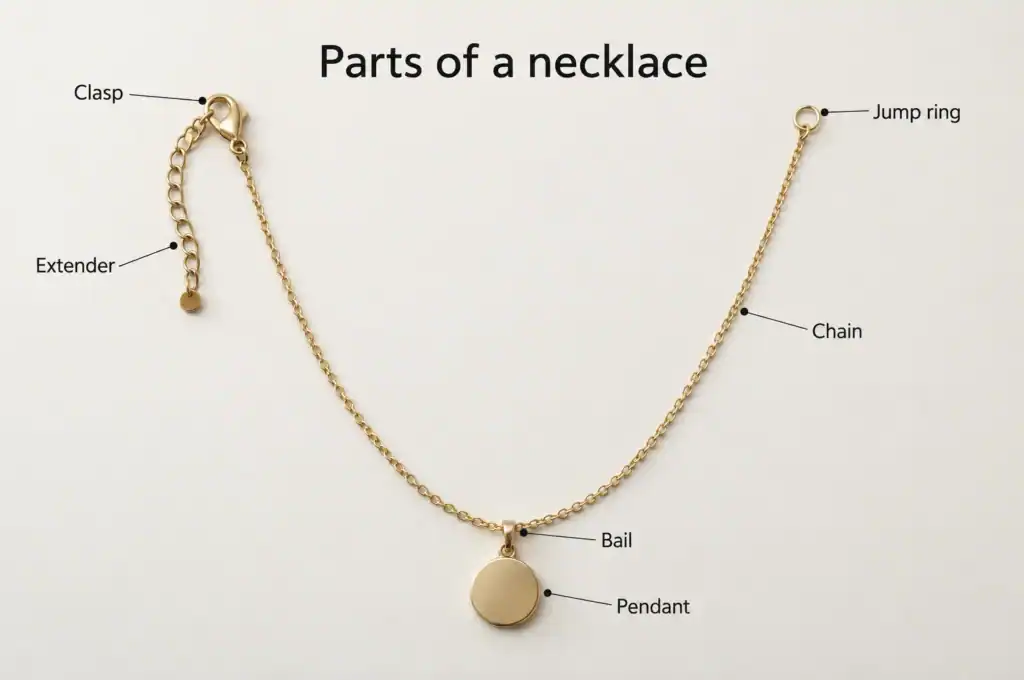
Length is the primary consideration, as it determines three key factors: where the necklace sits when worn, how comfortable it feels, and whether it is concealed by a collar or perfectly displayed. Furthermore, other choices are all based on this fundamental length. Since pendants hang from the chain and extender chains supplement the overall length, the base length of the necklace must be established before considering these accessories.
So, what kind of look do necklaces of different lengths create when worn?
Necklace Length Chart: Where Each Length Sits
Necklace length refers to the total length of the chain, including the clasp (i.e., the full span from end to end). Terms such as “choker,” “princess,” and “matinee” are based on industry convention rather than official standards; consequently, the specific length ranges defined in different charts may vary slightly.
The following describes where necklaces of various common lengths typically sit when worn by a woman of average neck size:
Here’s where each common length usually sits on a woman with an average-size neck:
| Length | In cm | Name | Where it usually sits |
|---|---|---|---|
| 14 in | 35.6 cm | Collar / choker | Up on the neck. It’s shorter than most women’s neck base, so it can’t drop to the collarbone |
| 16 in | 40.6 cm | Choker | At the base of the neck |
| 18 in | 45.7 cm | Princess | At or just below the collarbone |
| 20 in | 50.8 cm | Matinee | An inch or two below the collarbone |
| 22 in | 55.9 cm | Matinee | Between the collarbone and the bust |
| 24 in | 61.0 cm | Matinee (some charts say opera) | At the top of the bust |
| 30 in | 76.2 cm | Opera | Mid-chest |
| 36 in | 91.4 cm | Opera / rope | Below the bust, and long enough to wear doubled |
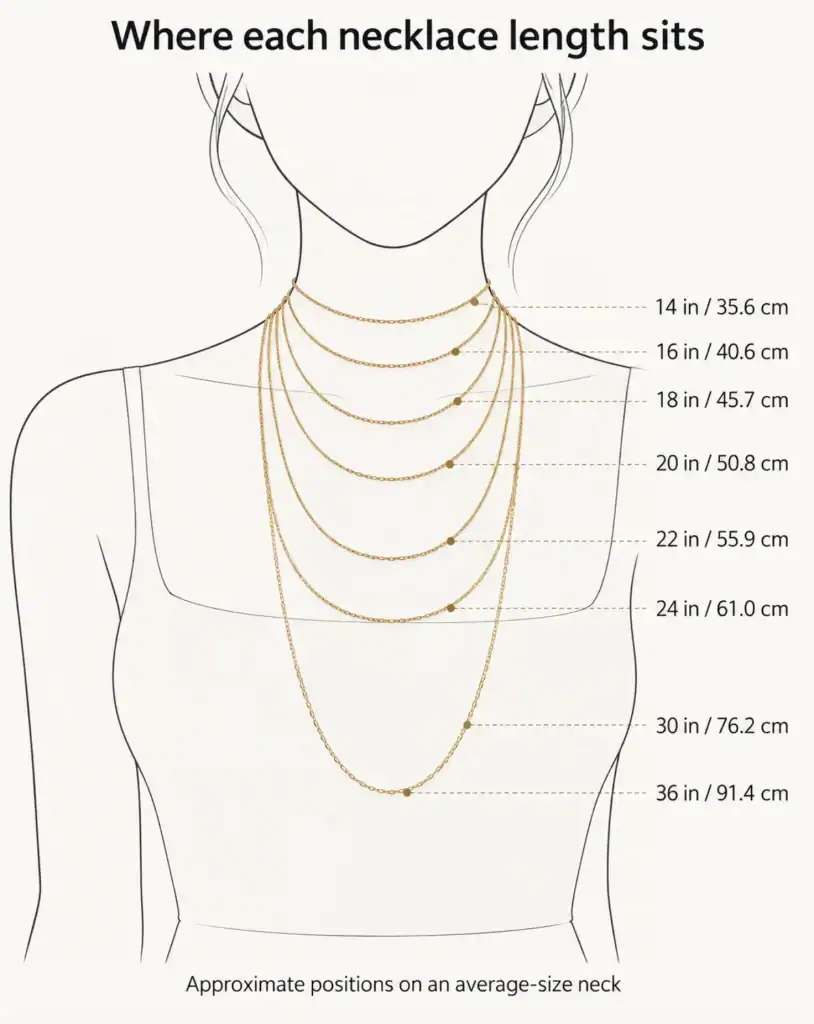
These designations follow the size ranges published by Jewelers of America, a U.S. trade association: collar (12–14 inches), choker (14–16 inches), princess (17–19 inches), matinee (20–25 inches), opera (26–36 inches), and rope (37 inches or longer). While most size charts agree on the mid-range lengths, there are discrepancies in the categories exceeding 24 inches; for instance, the starting length for an “opera” necklace can vary between 24 and 28 inches.
Men typically wear necklaces ranging from 20 to 24 inches, primarily due to their larger neck size. According to U.S. Army anthropometric data, the median circumference at the base of the neck is approximately 2.5 inches larger for men than for women.
Please note that these classifications are based on average neck sizes. Your neck may be thinner or thicker, which is why the way a necklace sits on you may differ from how it appears in product photos. It is recommended that you measure your neck size before selecting a style.
How to Measure Necklace Length (3 Easy Ways)
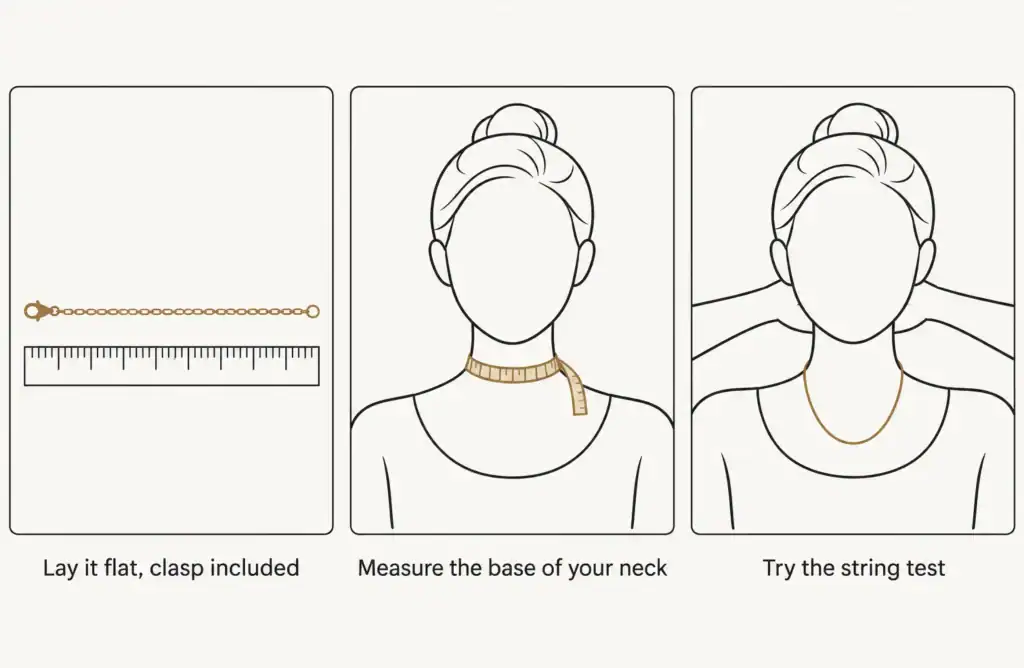
You can find your number in three ways. Use whichever fits what you have on hand.
- Measure a necklace you already own and like. Unfasten the clasp, lay the necklace flat and straight, and measure from one end to the other (including the clasp). This is how necklace lengths are specified. If the necklace has a pendant, exclude the pendant’s length from your measurement.
- Measure the base of your neck. Wrap a soft measuring tape around the base of your neck—the area where your neck meets your shoulders and chest. Avoid measuring higher up (where a shirt collar would sit), as that circumference is usually about 1.5 inches (approx. 3.8 cm) smaller; using that measurement could result in buying a necklace that is too short. You will use this figure in the next section to estimate where necklaces of various lengths will sit. For chokers, the standard practice is to add about 2 inches (5 cm) to your neck measurement, though some jewelers add only 1 to 1.5 inches for a snugger fit. When worn, you should be able to slip a finger underneath the necklace without feeling constricted when you turn your head.
- Try the “string test.” Wrap a piece of string around your neck and hold the ends together at the back of your neck (simulating the clasp position). Adjust the string until the lowest point sits exactly where you want the necklace or pendant to hang. Mark the point where the ends meet, then measure the length of the string from one end to that mark.
Don’t have a soft measuring tape handy? Read on. Everyday items can work just as well; we explain how below.
Before you order, watch for these easy mistakes:
| Easy to get wrong | What’s actually true |
|---|---|
| “The pendant counts toward the length.” | It doesn’t. The listed length covers the chain and clasp only; the pendant hangs below, so add its height, bail included, to see where it will end. |
| “A 16-in chain always fits like 16 in.” | Thick chains wear shorter. Closing a chain into a loop uses up about π × its thickness, so a 6 mm chain loses roughly ¾ in of usable length. |
| “45 cm and 18 in are the same size.” | 45 cm is 17.7 in, about 7 mm shorter. You won’t notice it when you wear it, but it matters when you compare brands or write an order. |
| “An adjustable necklace has one length.” | Look for its full range, such as 16–18 in, and check which end of the range suits you. |
Next, we’ll cover something most length guides overlook: what your neck size actually reveals.
Why the Same Necklace Sits Differently on You?
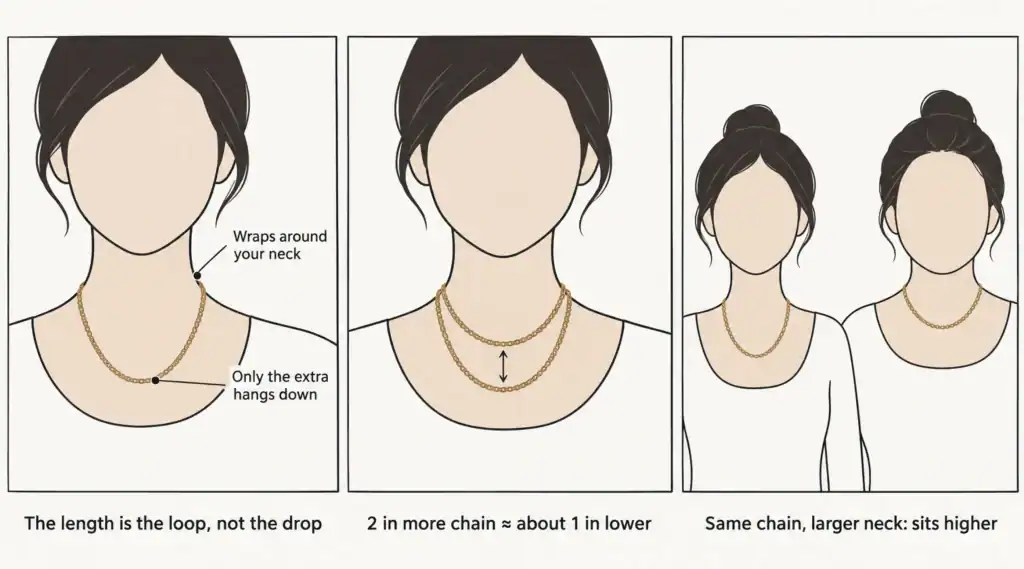
Most necklace length charts overlook a crucial point: the stated length refers to the total circumference of the chain, not the length of the drop. As Pearl Paradise notes, “The stated measurement represents the circumference of the loop, not the drop length.” Since part of the chain wraps around the back of the neck, only the excess length actually hangs down across the chest.
This fact explains three phenomena:
For every 2-inch increase in chain length, the necklace’s drop position lowers by approximately 1 inch. Because the added length is distributed across both sides of the chain, only half of that length contributes to the drop height. This is why a 20-inch necklace sits about an inch lower than an 18-inch one. This rule applies best when the chain is at least 2 to 3 inches longer than the neck circumference; once the length significantly exceeds the neck size, the change in drop height becomes more pronounced.
The same necklace will sit higher on a thicker neck. For every 1-inch increase in the circumference at the base of the neck, the lowest point of the necklace shifts upward by approximately 0.5 inches. To achieve the same drop position, the chain length would need to increase by about 1 inch.
This also explains why men’s necklaces are typically longer. According to data from the U.S. Army Anthropometric Survey (ANSUR II), the median neck circumference at the base is about 2.5 inches larger for men than for women. Consequently, a man requires a chain of approximately 20 inches to achieve the same drop position that an 18-inch chain provides for a woman.
Build your own length chart. The chart above describes an average neck, about 14.6 in around the base for the women in that survey. To adjust it for yours, take your neck-base measurement from the previous section and add:
| To have it sit… | Add to your neck-base measurement | If your neck base is 13.5 in | If your neck base is 16 in |
|---|---|---|---|
| At the base of the neck | about 1.5 in | 15 in | 17.5 in |
| At the collarbone | about 3.5 in | 17 in | 19.5 in |
| An inch or two below the collarbone | about 5.5 in | 19 in | 21.5 in |
| Between the collarbone and the bust | about 7.5 in | 21 in | 23.5 in |
| At the top of the bust | about 9.5 in | 23 in | 25.5 in |
Most chains come in the common lengths from the chart, so round to the nearest one, or choose an adjustable chain that covers both. These figures come from a simple geometric model and are good to about an inch. A pendant hangs below the chain, and very long chains drape over the chest, so treat them as a starting point.
What about height? People often ask: “How long should a necklace be for someone who is 5 feet 4 inches (approx. 163 cm) tall?” While this height is close to the average for American women (approximately 5 feet 3.5 inches, according to CDC data), height alone is not a reliable indicator for determining the right necklace length. According to ANSUR II data, the difference in median neck-base circumference between women shorter than 5 feet 2 inches (approx. 157 cm) and those 5 feet 6 inches (approx. 168 cm) or taller is less than one inch; conversely, the variation in neck size within a single height group can exceed two inches. Therefore, neck size—rather than height—should be the primary factor when choosing a necklace. Height mainly influences how the necklace looks on the body, which is more a matter of styling than fit.
This leads to the question almost everyone asks: Should you choose 16 inches or 18 inches?
16-inch, 18-inch, and 20-inch Necklaces: How to Choose?
Both 16-inch and 18-inch necklaces have their pros and cons; neither is inherently better than the other. An 18-inch necklace is the most common length for daily wear and is a safer choice for gifting. A 16-inch necklace sits higher up—resting at the base of the neck—which may feel a bit tight for individuals with a thicker neck. For most women, a 20-inch necklace is not overly long; it typically falls about 1 to 2 inches below the collarbone.
You can make your decision based on the measurement of the base of your neck. Referring to the chart in the previous section, a 16-inch necklace is roughly the neck-base measurement plus 1.5 inches, while an 18-inch necklace is roughly the neck-base measurement plus 3.5 inches.
| Choose | If… |
|---|---|
| 16 in | You want the necklace at the base of your neck, and your neck base is under about 15 in. On a larger neck, 16 in sits tight at the base and can feel snug |
| 18 in | You want it at the collarbone, or you’re buying a gift and don’t know the wearer’s size |
| 20 in | Your neck base is around 16 in or more and you want the look of an 18 on the chart, or you’d like the necklace an inch or two below the collarbone |
| 16–18 in adjustable | You’re torn between the two. A chain with a 2-in extender covers both |
Is a 20-inch necklace considered too long for women? For most women, no. It falls into the shorter end of the “matinee length” category. However, factors such as a slender neck or the addition of a long pendant can cause the necklace to hang lower, so the pendant itself should be taken into account.
Is a 22-inch necklace considered long? Not really. It still falls within the matinee length range; on most women, it hangs somewhere between the collarbone and the bust. Necklaces typically classified as “long” (or “opera length”) generally range from 24 to 28 inches (depending on the specific reference chart used).
Planning to wear a pendant? Pay attention to where the pendant will actually sit, not just the length of the chain itself. Stated lengths usually exclude the pendant, so you need to add the height of the pendant (including the bail) when calculating the drop position. Additionally, a heavier pendant will pull the chain into a more pronounced V-shape, causing it to hang slightly lower.
Want to layer two necklaces? A combination of 16-inch and 18-inch chains is a classic choice. Keep in mind that while there is a 2-inch difference in length, the actual gap between the two chains when worn is only about 1 inch; if the gap is smaller than this, the chains may look cluttered and tend to tangle with each other.
For men, the size standards should be adjusted upward by approximately 2 inches: the look of 18-inch and 20-inch necklaces on men is roughly equivalent to that of 16-inch and 18-inch necklaces on women.
How to measure a necklace without a tape measure? A quick tip.
You can estimate the approximate size without professional tools. You can use the “string method” mentioned earlier (using a shoelace or a piece of ribbon works fine), then measure the length of the string using your hand or an object of known size, or by comparing it to a necklace you already own.
Measuring with your hand yields only a rough estimate. Lay the string flat on a table and measure along it using your hand—spanning the distance from your wrist to your fingertips. In the same U.S. Army survey (ANSUR II), the average hand measurements recorded were as follows:
| Hand measurement | Women | Men |
|---|---|---|
| Length, from the wrist to the tip of the middle finger | 7.1 in (18.1 cm) | 7.6 in (19.3 cm) |
| Width across the knuckles, thumb not included | 3.1 in (7.8 cm) | 3.5 in (8.8 cm) |
| Thumb width (from the Army’s earlier 1988 survey) | about 0.8 in (2.1 cm) | about 0.95 in (2.4 cm) |
For the average woman, an 18-inch necklace is roughly equivalent in length to two and a half times the width of her palm. Please note the following two limitations:
Hand sizes vary by as much as 10% among individuals; consequently, estimating based on averages can result in a margin of error of up to 2 inches for an 18-inch necklace. While this level of precision is sufficient to distinguish between 16-inch and 20-inch necklaces, it is not accurate enough to discern the subtle difference between a 16-inch and an 18-inch chain.
The rule of thumb equating “one thumb-width” to “one inch” applies better to men than to women. If an average woman were to measure an 18-inch necklace using her thumb width, she would count approximately 22 thumb-widths, leading to an estimation error of about 4 inches.
Common everyday objects often have precise dimensions. The following items come in fixed, standard sizes:
| Use | Exact length | How it compares |
|---|---|---|
| Three US bills, end to end | 18.4 in (46.8 cm) | Just over an 18-in chain |
| Letter paper (8.5 × 11 in): one long side + one short side | 19.5 in (49.5 cm) | Half an inch short of a 20-in chain |
| A4 paper: one long side + one short side | 20.0 in (50.7 cm) | Almost exactly a 20-in chain |
| A bank card, moved end to end | 3.37 in (8.56 cm) per step | 16 in ≈ 4¾ cards, 18 in ≈ 5⅓ cards, 20 in ≈ 6 cards |
Every US bill is 6.14 in long, whatever its value. Bank cards are made to an international standard (ISO/IEC 7810), so the same card works anywhere in the world.
Better still, combine the two. Measure your hand once against a card or a bill, remember the number, and your hand becomes a ruler you always carry.
Now you know where a necklace will sit. What those numbers can’t tell you is how it will feel.
The Impact of Necklace Length on Wearing Comfort
Length changes how a necklace feels as well as where it sits. Most comfort problems come down to two things: how much slack the chain has, and where its weight ends up.
Too short, and you feel it whenever you move. A chain that’s no more than about an inch longer than the base of your neck has almost no slack. Turn your head or swallow, and your neck changes shape underneath it, so it presses. That snug fit is the point of a choker, and the one-finger test from earlier will tell you whether it’s comfortable. For a chain you can forget you’re wearing, give yourself more room.
Too long, and it drags and swings. A necklace hangs from the back of your neck, so everything below that point pulls on it. A longer chain also carries more metal: in the same style, an 18-in chain weighs about 12% more than a 16-in one, and a 24-in chain about 50% more. Add a heavy pendant, and a long necklace can feel like it’s dragging on your neck. The lower a pendant hangs, the more it swings as you walk, and when you lean over a desk or pick up a child, it swings out and gets in the way. For everyday wear on a long chain, choose a lighter pendant.
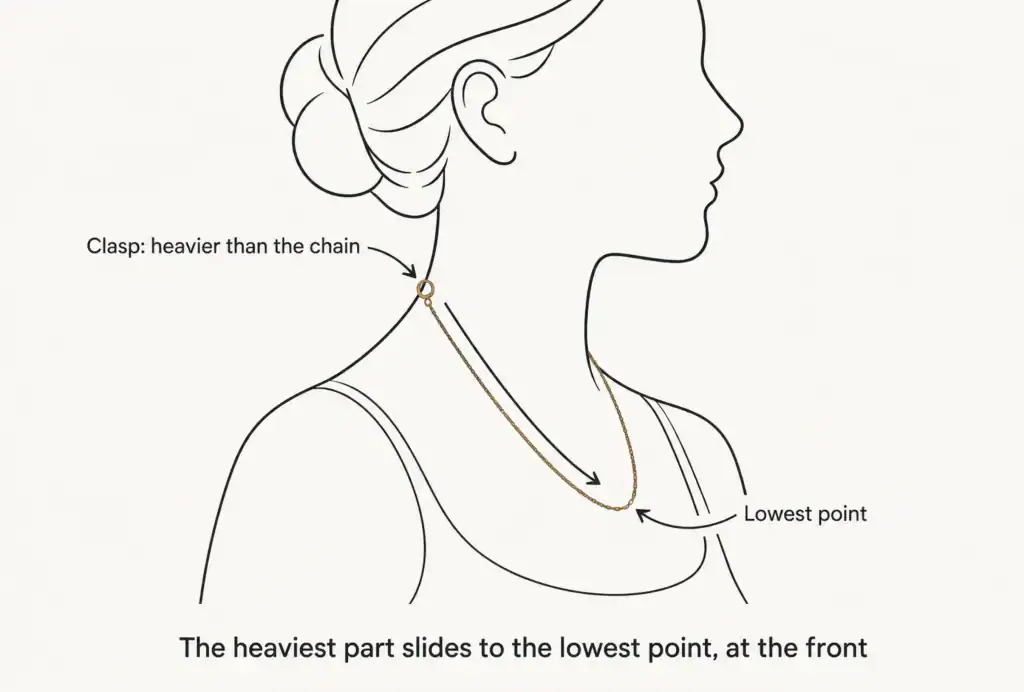
Why does the clasp keep sliding to the front? It isn’t a defect. The heaviest part of a loose loop keeps working its way to the lowest point, and on your body, the lowest point of a necklace is at the front. Each step shifts the chain a little, and a clasp that’s heavier than the chain around it slides a little further down each time. It happens most with long, fine, smooth chains, and with pendants that slide freely, because nothing stops the chain from turning through the bail.
Why does the pendant flip over? A heavy pendant on a very fine chain, or on a bail much larger than the chain, has room to twist, and everyday movement turns it over. A chain that rests right on the edge of a crew neck flips more, because the fabric keeps rubbing against it. That’s one reason to keep a necklace clearly above or below a neckline, as the next section explains.
Below Are Some Tips Might Works
| Fix | Why it works |
|---|---|
| A pendant fixed to the chain on both sides, like a bar or nameplate | It can’t slide, so the chain can’t turn through it |
| A slightly thicker chain | The clasp is no longer much heavier than the chain around it, and a heavy pendant has less room to twist |
| A flat chain, such as herringbone | It lies flat against the skin and doesn’t roll as easily |
| A bail closer in size to the chain | The pendant has less room to turn |
| A flat pendant, or one finished on both sides | Flat shapes turn over less, and a double-sided pendant looks right either way |
| A small counterweight near the clasp | It gives the back of the chain its own low point to settle into |
Comfort decides whether you keep wearing a necklace. What you wear it with decides whether anyone sees it.
How to Choose Necklace Length Based on Neckline
A necklace only works if it can be seen. The same chain can look right with one top and disappear under another, so check your length against the necklines you actually wear.
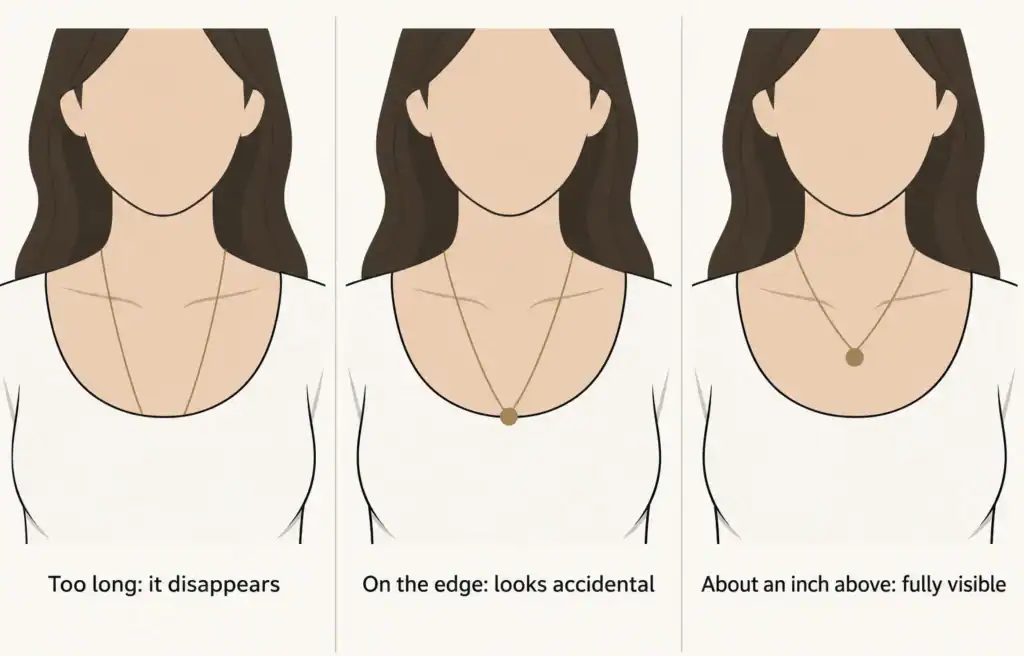
Keep it clearly above or clearly below the neckline. This is the one rule most styling guides agree on. A necklace that rests right on the edge of the fabric looks accidental, and as the last section explained, it flips more. A common guideline is to leave about an inch between the neckline and the necklace or pendant.
If you wear it against your skin, it has to clear the neckline. Check where the bottom of the pendant will land, not just the chain. If it falls below the neckline, it slips under the fabric and no one sees it. With a high neckline, such as a crew neck, a turtleneck or a buttoned-up shirt, wear the necklace over the top instead, and let it hang clearly below the neckline.
Starting points for common necklines:
| Neckline | What works | Common starting point |
|---|---|---|
| V-neck | A pendant that follows the V and sits inside it. The deeper the V, the longer the chain can be | 16–18 in |
| Scoop neck | Short, rounded necklaces. A longer chain should stop above the edge, not slip under it | 14–18 in |
| Crew neck | Clearly above the neckline, or clearly below it over the fabric. A crew neck sits near the base of the neck, right where a 16-in chain lands on many people, so check that the two don’t overlap | Charts disagree, so test it |
| Turtleneck | A long chain or pendant worn over the fabric | 24 in and longer |
| Collared or button-down shirt | A mid-length chain that doesn’t compete with the collar | 20–24 in |
Why do size recommendations vary, and how can you verify the right fit yourself? Advice regarding the pairing of necklines with necklace lengths often differs; for instance, regarding boat necks, three well-known jewelers suggest lengths of 14–16 inches, 18 inches, and 20–24 inches, respectively. None of these suggestions are incorrect: as previously mentioned, where a necklace sits depends on your neck’s proportions, while the neckline’s position depends on the specific garment. Therefore, treat these measurements merely as a starting point and determine the ideal length by trying it on. Put on a top you wear frequently and use a piece of string to measure: position the string so its lowest point rests about an inch above the neckline (or clearly below the neckline if you intend to wear the necklace over the garment). If you plan to wear a pendant, allow extra space, as the pendant will hang below the chain itself. Finally, measure the length of the string; this indicates the necklace length best suited for that top.
If you typically wear tops with the same type of neckline, simply choose a length that complements it. However, if you frequently switch between different necklines—such as high necks and low cuts—an adjustable chain or an extender chain offers greater versatility. Additionally, if you have already purchased a necklace that is the wrong length, adding an extender chain is the simplest solution.
Bought the Wrong Length? How to Lengthen or Shorten a Necklace
How easy a wrong length is to fix depends on three things: how far off it is, the style of the chain, and the metal.
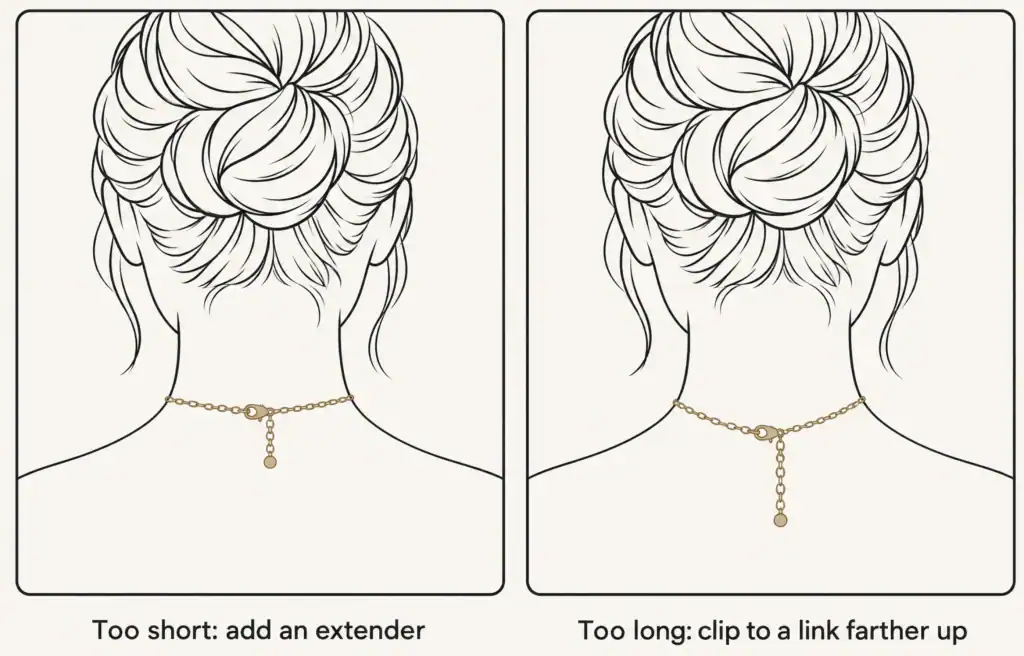
Too short by an inch or two: add an extender. An extender is a short piece of chain with its own clasp that hooks onto your necklace at the back, where it rarely shows. They most often come in 2- or 3-in lengths. By the loop rule from earlier, a 2-in extender lowers a necklace by about an inch: your 16-in chain becomes an 18. Pick one in the same metal and color as your necklace.
Too long: try a no-tool fix first. If the chain has open links, like a cable chain, and a lobster or spring-ring clasp, clip the clasp to a link farther up and let the extra length hang at the back. That won’t work on snake or herringbone chains, which are too smooth and tightly woven for a clasp to catch. A very long chain can also be wrapped twice: a 36-in The worn chain sits roughly like two 18-in strands. Avoid knots in snake, herringbone and omega chains. They kink easily, and kinks are hard to fix.
For a bigger change, a jeweler can alter the chain, but the style and metal decide how cleanly:
| Your necklace | What a jeweler can do |
|---|---|
| Simple link chains, such as cable or Figaro | Cut it to length, or add a matching section, then solder the joint closed |
| Rope or thick Cuban chains | Shortening means cutting through the pattern, and the piece that comes off can’t be added back. Lengthening is harder: a rope pattern gets disrupted, and a thick Cuban may need custom-made links |
| Snake chains | There are no links to remove. The jeweler takes off the end cap, cuts the chain and solders the cap back on |
| Herringbone chains | Among the hardest chains to alter. They kink easily, and a repair usually shows |
| Hollow chains | The thin walls can be crushed where the jeweler works, and a repair may not stand up to years of daily wear |
| Gold-plated, vermeil or rhodium-plated chains | Soldering and polishing strip the plating at the repair, so the chain usually needs replating to look even. A laser welder can sometimes avoid that. For thinly plated fashion jewelry, repair shops often suggest replacing it instead |
| Stainless steel | It’s very hard and difficult to solder, and many jewelry stores aren’t equipped for it. Shops that take the job often use a laser or tack welder |
| Titanium | It can’t be joined with ordinary jewelry solder. It has to be welded in a protective gas, usually with a laser, or joined mechanically |
| Pearls and beads | Restrung to the new length |
Ask for a soldered joint. On gold, silver and platinum chains, a jump ring that isn’t soldered shut is only a temporary fix, and it can work open with wear.
Notice what the extender and the clasp trick have in common: neither one cuts the chain, so both work on any metal. It also means that getting the length right the first time matters most for stainless steel, titanium, hollow and plated chains, the ones that are hardest to alter later.
For Jewelry Brands: Planning Necklace Lengths
If you’re developing a necklace line, three points from this guide carry straight over:
- List length the way it’s measured: end to end, clasp included, pendant excluded, in inches and exact centimeters. 45 cm is 17.7 in, not 18.
- Cover the two most-asked lengths with one piece: a 16–18 in adjustable chain, or a 16-in chain with a 2-in extender. For men’s styles, shift up about 2 in, to 20, 22 and 24 in.
- Add an extender to stainless steel, titanium, hollow and plated chains. Your customers can’t easily have them altered later.
Sourcing chains for your brand? See our custom chains.
Frequently Asked Questions
What is the most common necklace length?
For women, 18 in. It sits at or just below the collarbone on an average neck, which also makes it the safer choice for a gift. If you don’t know the wearer’s size, a 16–18 in adjustable chain is safer still. There’s no official standard, though, and men usually wear 20–24 in.
Does necklace length include the clasp?
Yes. Length is measured end to end with the necklace open, clasp included. A pendant isn’t included: it hangs below the chain, so add its height, bail included, to see where it will end. For an adjustable necklace, check the full range, such as 16–18 in.
How long is a choker necklace?
Usually 14–16 in, and a collar 12–14 in, going by the ranges published by Jewelers of America. For fit, a common retail rule is to measure your neck and add about 2 in (5 cm). You should be able to slide one finger underneath.
What length and width of chain should a man wear?
Most men wear 20–24 in. On most men, 18 in sits close to the base of the neck, and 24 in is a popular length for a pendant. There’s no standard width: Brilliant Earth, for example, says most men’s chains are 2–6 mm wide and suggests 4–6 mm for a pendant. Whatever the width, the chain has to fit through the pendant’s bail.
Sources:
- Jewelers of America, Necklace Style Guide: https://www.jewelers.org/buying-jewelry/jewelry-styles/necklaces
- Gordon, C. C., et al., 2012 Anthropometric Survey of U.S. Army Personnel: Methods and Summary Statistics (ANSUR II), NATICK/TR-15/007: https://tools.openlab.psu.edu/publicData/ANSURII-TR15-007.pdf
- Penn State OPEN Design Lab, ANSUR II data: https://www.openlab.psu.edu/ansur2/
- 1988 Anthropometric Survey of U.S. Army Personnel (ANSUR), data archived by the University of Michigan Transportation Research Institute: http://mreed.umtri.umich.edu/mreed/downloads/anthro/ansur/
- U.S. Centers for Disease Control and Prevention, FastStats: Body Measurements: https://www.cdc.gov/nchs/fastats/body-measurements.htm
- ISO/IEC 7810:2019, Identification cards — Physical characteristics
- U.S. Bureau of Engraving and Printing, History Fact Sheet: Federal Reserve Notes
- Pearl Paradise, Necklace Lengths: https://www.pearlparadise.com/pages/learn-about-necklace-lengths
- Brilliant Earth, Men’s Necklace Length Guide: https://www.brilliantearth.com/guides/best-chain-length-for-men/
- Jewelers of America, Jewelry Repair: https://www.jewelers.org/buying-jewelry/jewelry-repair-and-care/jewelry-repair
- Brepohl, E., The Theory and Practice of Goldsmithing, on working titanium (via Ganoksin): https://www.ganoksin.com/article/understanding-the-working-titanium/
- MJSA Journal, Laser Welders Impacting the Jewelry Industry (via Ganoksin): https://www.ganoksin.com/article/laser-welders-impacting-jewelry-industry/

Carol
Carol is a jewelry manufacturing expert with first-hand experience across materials, surface finishes, production processes and quality control. She brings critical thinking and rigor to her work, questioning common assumptions and testing them against industry standards and real production results. Carol looks at every issue from the point of view of the people who buy and wear jewelry, turning technical details into clear, practical answers to real-world problems.