

Yes, gold plated jewelry can tarnish and fade, but usually not because of the gold. Pure gold doesn’t tarnish. The discoloration usually comes from the metal underneath, either creeping up through the gold layer and its tiny pores or showing through once that layer wears away.
As for how long it lasts, there’s no fixed answer. Online you’ll see estimates anywhere from under a year to five years or more, but none of the sources we checked backed up its numbers with test data. It really comes down to three things: how much gold is on the piece, what’s underneath it and how you wear it. This guide takes them one at a time, so you can judge the piece in your hand, keep it looking good longer, and know what to buy next time.
Key takeaways
- Gold plated jewelry can tarnish and fade, but usually not because of the gold. The cause is typically the metal underneath, a film on the surface or bare spots where the gold has worn through.
- There’s no fixed lifespan: it depends on how thick the gold is, what’s underneath it and how you wear it.
- The karat on the label isn’t the thickness. Under the FTC’s Jewelry Guides, a piece labeled gold plated should have at least 0.175 microns of pure-gold equivalent; heavy gold electroplate and vermeil, at least 2.5.
- Put jewelry on after lotion and sunscreen, and take it off to shower, swim or work out.
- Polishing can’t bring back worn gold; only replating can.
- If you order jewelry for a brand, write the gold thickness, base metal, barrier layer and required proof into your spec sheet.
What Does Gold Plated Mean? How Much Gold You Actually Get
Gold plated jewelry is made of another metal, such as brass, copper, sterling silver or stainless steel, with a thin layer of gold electroplated onto the surface.
Is it real gold? The layer is, but only the layer. That’s why labels matter. In the U.S., the Federal Trade Commission (FTC) spells out in its Jewelry Guides which jewelry claims it considers misleading. Under the Guides, the word “gold” on its own, with no karat number or other qualifier, can mislead unless the piece is 24K all the way through. A plated piece should make clear that the gold is only on the surface, and the plating itself should be pure gold or an alloy of at least 10 karats (10K).
How thin is thin? The Guides set the minimums below. Thickness is given as pure-gold equivalent: only the pure gold in the layer counts, so a 14K or 18K layer has to be physically thicker than the number shown.
| Label | FTC minimum | What it tells you | What it doesn’t tell you |
|---|---|---|---|
| Gold plated / gold electroplate | 0.175 microns of pure-gold equivalent, at least 10K | There’s a real gold layer | How far above the minimum it is, or what’s underneath |
| Heavy gold electroplate | 2.5 microns of pure-gold equivalent, at least 10K | A minimum about 14 times the 0.175 microns required for gold plated | How far above the minimum it is, or what’s underneath |
| Vermeil | 2.5 microns of pure-gold equivalent, at least 10K, over sterling silver | What’s underneath (sterling silver) and the minimum thickness | How far above the minimum it is |
| Gold filled | At least 10K gold alloy, mechanically bonded, making up at least 1/20 of the total metal weight | How much of the metal, by weight, is gold | A thickness in microns |
| 14K or 18K yellow gold (no “plated”) | The whole piece is karat gold | It’s the same gold alloy all the way through, so wear can’t expose a different metal | That it will never discolor (lower-karat gold alloys can) |
On a label, “gold plate” can also mean a gold alloy of at least 10K mechanically bonded to the base and making up at least 1/40 of the metal weight, which may also be called “gold overlay” or “rolled gold plate.” This guide is about electroplated jewelry.
For scale, a micron is a thousandth of a millimeter, so even a “heavy” 2.5-micron layer is 0.0025 mm thick. A World Gold Council technical paper puts typical jewelry plating at about 0.5 to 5 microns, and notes that very thin “flash” coats may be used when cost matters more than quality.
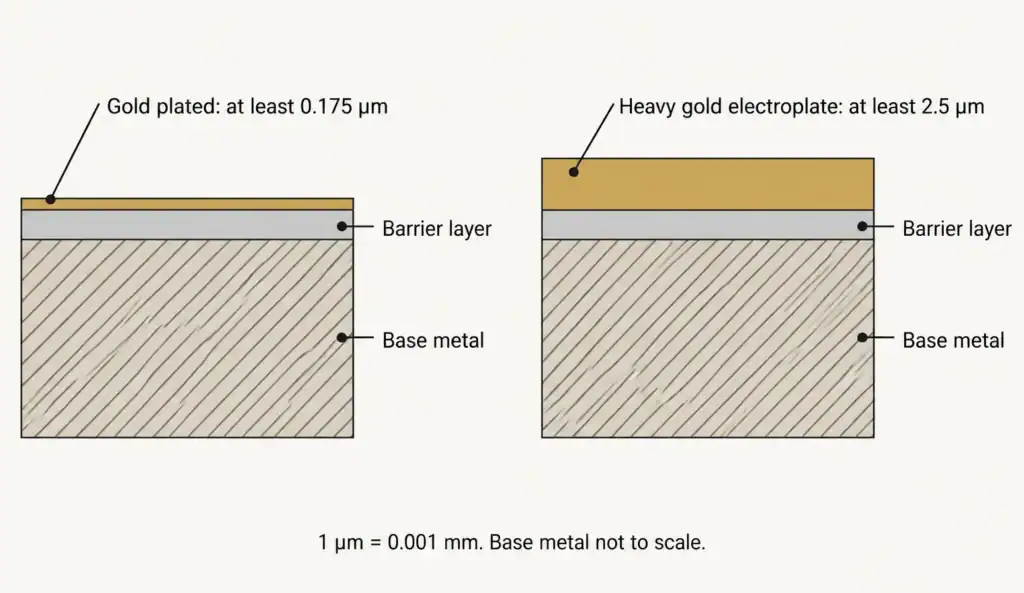
The karat mark is not the thickness. The 18K in “18K gold plated” tells you the purity of the plating alloy, not how thick the layer is. Because only the pure gold counts toward the FTC minimums, 1 micron of 12K plating counts the same as half a micron of 24K. So a 14K layer has to be about 0.3 microns thick to meet the 0.175-micron minimum, and about 4.3 microns to reach 2.5.
Two outdated claims you’ll still see. Some sites still say the FTC requires 0.5 microns for gold plated jewelry. That was the threshold before the FTC revised its Jewelry Guides in 2018; today it’s 0.175 microns. The revision also dropped the old provision that let electroplated pieces with less than 0.175 microns of pure-gold equivalent be labeled “gold flashed” or “gold washed.”
So the label tells you there’s real gold on the piece and sets a floor for how much. How long that gold actually lasts depends on the rest: how far above that floor the layer goes, what’s underneath it and how you wear it.
How Long Does Gold Plated Jewelry Last?
Gold plating does wear off, but there’s no standard lifespan for it, and the FTC doesn’t set one. Beyond the minimum thicknesses above, its Jewelry Guides ask only that plating be of “reasonable durability,” meaning thick enough everywhere to provide the coverage a reasonable buyer would expect. Because some areas get more wear than others, the thickness doesn’t have to be the same all over.
Plating usually fails in one of two ways: the gold wears through, or the metal underneath discolors the piece while the gold is still there. The next section covers discoloration. This one covers wear, which comes down to what the piece rubs against and what it’s exposed to.
Friction does most of the work. Every time a piece rubs against skin, fabric or a tabletop, it loses a little gold. Rings get some of the heaviest wear. Back in 1997, FTC staff used them as the example, writing that items subject to a great amount of wear, such as rings, need a coating thicker than the half-micron minimum the Guides set at the time. The rest follows where each piece rubs: a bracelet wears on its underside and at the clasp, and a necklace at the clasp and where the pendant hangs on the chain. Earrings usually rub far less. On any piece, sharp edges can show wear sooner.
Makeup, chlorine and salt water add to the damage. Some makeup contains minerals harder than gold, such as zinc oxide. Where makeup rubs against a piece, those minerals can slowly scrub off tiny bits of metal. Jewelers of America tells people to take off all jewelry before getting in a hot tub, pool or the ocean, because chlorine and salt water can damage and discolor metals, including solid gold and platinum. That advice is written for fine jewelry, and a thin plated layer has far less to lose.
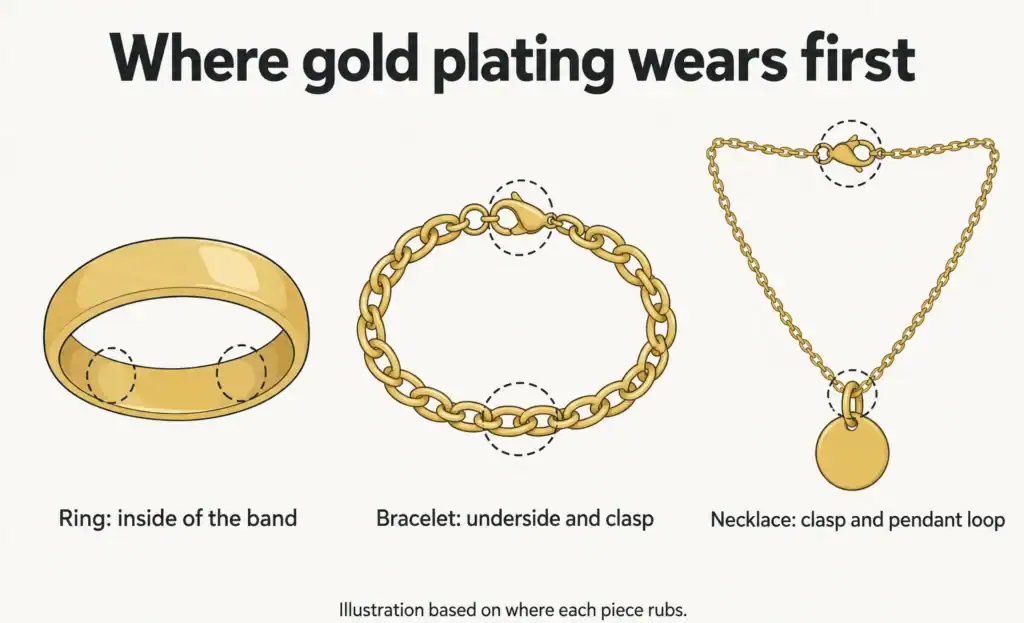
Put it together, and you can judge your own piece. The same plating can still look new on a pendant long after it has worn through on the inside of a ring you wear every day. A piece labeled heavy gold electroplate or vermeil has to meet a minimum thickness about 14 times that of one labeled simply gold plated. Comparing minimums, that’s far more gold to wear through before the base shows. We couldn’t find reliable data on how much longer that makes it last in practice. The 18K or 14K on the label won’t help here, since it describes the alloy, not the thickness.
Because wear varies so much from piece to piece, we’d be wary of any seller who promises a set number of years. A durability claim means little unless it comes with a test method and the conditions of use.
But a piece doesn’t have to wear through to change color.
Why Does Gold Plated Jewelry Tarnish?
If a piece darkens, dulls or turns reddish while the gold is still there, one of three things is usually behind it, and only one of them sits on the surface.
- Copper from underneath creeps up. Copper beneath the gold, in the base metal or in the thin copper coat often plated on first, can migrate into the gold layer and turn it redder. That’s what a barrier layer is for. When a piece has one, it sits between the base and the gold and holds the copper back. The World Gold Council paper cited earlier, from 2002, lists nickel, bronze or tin for this layer, and notes that EU limits on nickel were pushing platers toward bronze, tin or palladium.
- Tiny pores let the base corrode. Plating isn’t always a perfect seal. The same paper warns that plating with tiny pores or cracks could let the piece corrode or tarnish as it’s worn. Sweat and air can get through those openings to the metal underneath. Sweat can corrode brass: in a 2012 study in the Journal of Forensic Sciences, sweat with more chloride in it was linked to more zinc loss from the brass surface. Sulfur compounds in the air can darken copper alloys as well.
- A film builds up on top. Lotion and sunscreen leave a film that makes jewelry look dull, which is why Jewelers of America says not to wear jewelry while you put them on, or in the shower. This is the only one of the three you can simply clean off.
The plating alloy matters too. A 14K layer is only 58.3% gold. Pure gold doesn’t corrode, but the silver and copper in a gold alloy can darken when exposed to sulfur in the air, and sweat can attack them as well. So a lower-karat layer can darken on its own, across the whole surface rather than in spots. What people call fading is usually one of these causes, or the base metal starting to show where the gold has worn through.
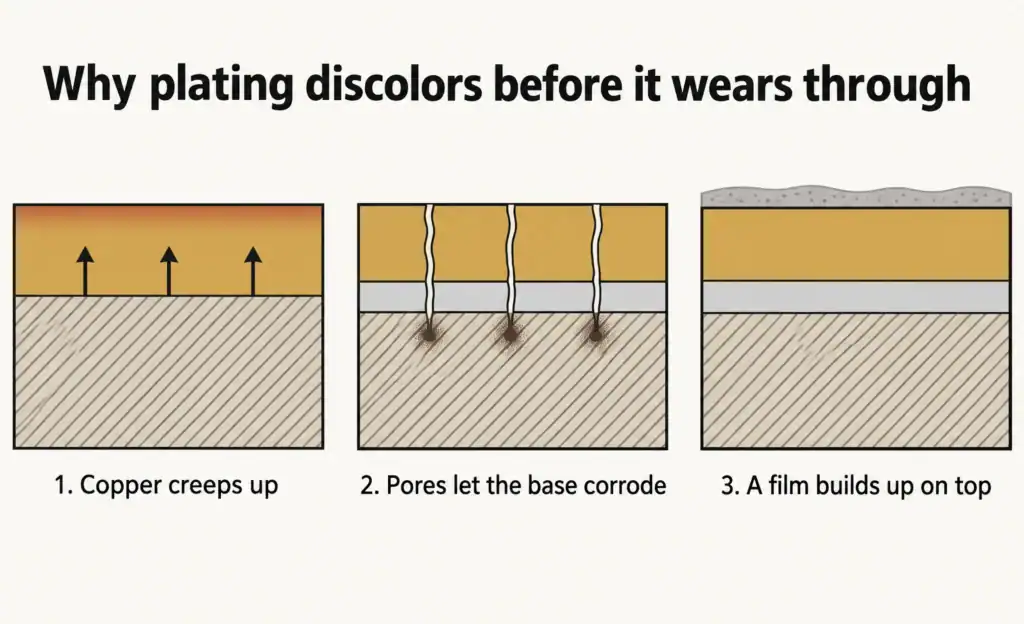
Use this table to figure out which one you’re dealing with:
| What you see | Likely cause | Can you fix it? |
|---|---|---|
| A dull, hazy film over the surface, with the gold color itself unchanged | Lotion or sunscreen buildup | Usually, with gentle cleaning (see the care section below) |
| A reddish or pinkish cast across the gold, not just in worn spots | Copper from underneath creeping into the gold | Not by cleaning; the change is inside the gold itself |
| Dark spots or specks on gold that is otherwise intact | The base metal corroding through tiny pores in the plating | Not by polishing; that also removes gold |
| Patches where the piece rubs most that look paler, pinker, darker or silver-gray | The gold has worn through | Only by replating |
That last row isn’t tarnish; it’s wear. Once the gold is gone, what you see depends on the metal underneath.
What’s Under the Gold: Brass, Sterling Silver or Stainless Steel
Here’s what brass, sterling silver and stainless steel look like once they’re exposed, and which of them can turn your skin green.
| Base metal | When the gold wears through | Good to know |
|---|---|---|
| Brass or copper | Worn spots usually turn darker or coppery, and the exposed copper can leave a green mark on your skin | More on gold plated brass below |
| Sterling silver (vermeil or gold plated 925 silver) | The silver tarnishes the way any silver does, turning gray and then black from sulfur in the air | Store it sealed and dry, as you would silver, but skip silver polishing cloths: they take off the remaining gold too |
| 316L stainless steel | The steel’s own silver-gray color shows, and it doesn’t turn skin green the way copper does | 316L releases very little nickel in lab sweat tests, but it isn’t nickel-free |
About those marks on your skin. A green mark comes from copper reacting with sweat, salt and sulfur. The Royal Society of Chemistry explains that these copper compounds form a thin layer that rubs off easily, which is what leaves the green on your skin. A dermatologist at Nebraska Medicine notes that the green residue isn’t harmful and washes off with soap and water. It’s a stain, not an allergic reaction; an itchy, red or blistering rash is a different matter. A black smudge usually has a different cause: tiny bits of metal scrubbed off by hard minerals in makeup, the same ones mentioned earlier. Particles that fine look black no matter which metal they came from.
Not sure what’s underneath? On a gold-colored piece, a 925 stamp says the base is sterling silver, with the gold on top. Like any stamp, it’s the maker’s or seller’s claim, not a test result. For more, see what 925 means on gold-colored jewelry.
Gold plated brass, up close. Brass is affordable, and it can be cast, formed and assembled into detailed shapes with curves, relief details and custom charms. We make brass jewelry for brands and provide gold-plating services. Apart from how a piece is worn and cared for, three layers in the finish affect how long the gold holds up on gold plated brass jewelry:
- The barrier layer. As covered above, it holds back copper from the brass. Without one, copper can work its way into the gold and turn it redder before the gold has worn through.
- The gold layer. The thicker it is, the longer it takes to wear through.
- The clear coat. Some pieces get a thin clear coating, such as lacquer or e-coat, over the gold to slow tarnish. It helps, but it wears away with friction just as the gold does.
Check the surface, too: scratches, casting marks and pits in the brass can stay visible under a shiny gold finish.
Whatever the base, the way to keep it hidden longer is the same: slow down the wear.
How to Make Gold Plated Jewelry Last Longer
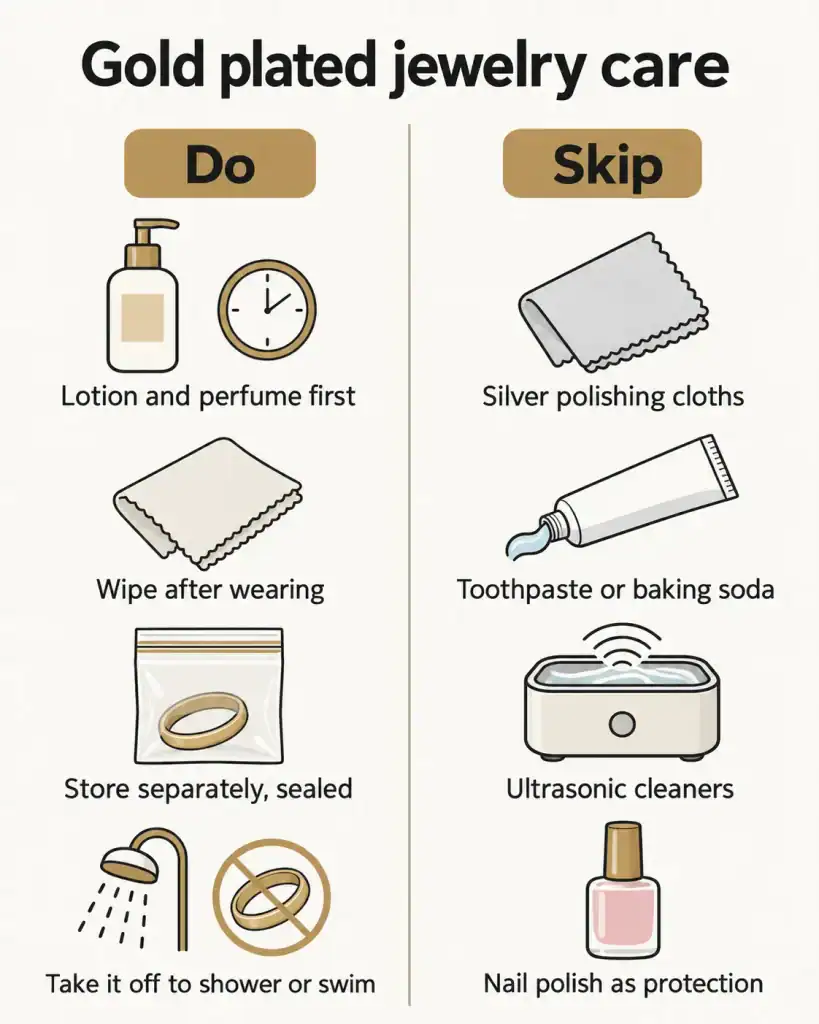
Every habit below does one of two things: it cuts down on friction, or it keeps chemicals off the plating.
Can you shower with gold plated jewelry? It’s better not to. Jewelers of America says not to wear jewelry in the shower or while putting on sunscreen and lotion, because these products leave a film that makes jewelry look dull. It also recommends taking off all jewelry before you get in a pool, hot tub or the ocean, because of the chlorine and salt water. We found no reliable source saying plated jewelry is safe to shower or swim in.
Put it on last. Apply lotion, sunscreen, perfume and hair spray first, and let them dry before you put on your jewelry, so less of them ends up on the plating. The Gemological Institute of America (GIA) notes that chemicals can damage or discolor precious metals, and plating is only a thin layer of one.
Take it off for the gym. There are two reasons. Jewelers of America points out that rings and bracelets can get snagged, scratched or chipped on equipment. And as covered above, salty sweat can reach a brass base through tiny pores in the plating and corrode it.
Wipe it after you wear it. Jewelers of America suggests wiping jewelry with a soft, slightly damp cloth after each wear to remove lotion. On plated pieces, it also takes off sweat that would otherwise sit on the plating.
Clean it gently. We couldn’t find an authoritative cleaning method written specifically for plated jewelry. For lotion or sunscreen buildup, we’d borrow the gentle method GIA gives for most colored gemstones: warm water with a little mild dish soap. Wash the piece with a soft cloth rather than a brush, then rinse off all the soap and dry it completely.
Store it on its own. Store each piece separately in a dry place so the pieces don’t scratch each other. A sealed bag or an anti-tarnish pouch helps too, since sulfur in the air is what darkens copper and silver.
Not all the care advice online is good for plating. Some tips wear it down faster, and others aren’t backed by anything:
| You may hear | What’s actually true |
|---|---|
| “Polish it with a silver polishing cloth” | A seller of the popular Sunshine cloth says each one is impregnated with micro-abrasives; abrasives take thin gold off along with the tarnish, so save it for unplated silver |
| “Toothpaste or baking soda brings back the shine” | Both clean teeth because they’re abrasive, which is exactly why they don’t belong on gold plating |
| “An ultrasonic cleaner is fine” | Jewelers of America warns these machines can be too harsh for delicate pieces; a thin, already-worn layer has little gold to spare, so we’d skip them |
| “Clear nail polish keeps plating from fading” | The American Academy of Dermatology mentions clear nail polish only as a barrier on clothing fasteners such as belt buckles, and says it has to be reapplied often; we found no source showing it protects gold plating |
| “Water ruins gold plating” | Nothing we found backs this up; the problems sources do name are the film left by lotion and sunscreen, plus chlorine and salt water |
Good care buys time, but it can’t stop the wear. Sooner or later the gold wears through, and then you’ll have to choose between replating the piece and replacing it.
Can You Restore Gold Plated Jewelry? When to Replate and When to Replace
At home, you can only remove what sits on top of the gold. A dull film from lotion or sunscreen usually comes off with the gentle cleaning described above. Gold that has worn away is a different story. Polishing can’t bring it back and only rubs off more of what’s left.
Replating is a job for a jeweler. Worn plating can usually be replated. First the piece is cleaned. For a brass or other copper-based piece, a barrier layer such as palladium or nickel is often added next. Then the piece is electroplated with gold again. We couldn’t find a consistent answer on whether the old plating is stripped first, or reliable pricing, so ask the shop about both.
Changing a chain’s length can mean replating, too. If a jeweler cuts and solders a plated chain to shorten or lengthen it, soldering and polishing strip the plating at the joint, so expect to have it replated, though a laser welder can sometimes avoid that. An extender, or clipping the clasp to a link farther up on an open-link chain, changes the length without cutting anything. Our necklace length guide explains how to lengthen or shorten a necklace, including the fixes that work on plated chains.
Is replating worth it? Ask yourself three questions:
- What’s underneath? Most of the metal value in gold plated sterling silver is in the silver, while plated brass is worth almost nothing as metal, so a silver piece makes a stronger case for replating.
- Does the piece mean something to you? If it does, keeping the original may matter more than the cost.
- What would a new one cost? Replating can be expensive, and the price goes up with the thickness and karat of gold you ask for. On an inexpensive piece, buying a new one may cost less.
To put off this choice as long as possible, it pays to know what to look for before you buy.
Is Gold Plated Jewelry Worth It? What to Check Before You Buy
To recap the downsides: the gold eventually wears through, the piece can discolor before that happens, the barrier layer underneath may be nickel, polishing can’t bring back gold that has worn away, and a plated base-metal piece has almost no scrap value.
None of that makes it a bad buy. Gold plating gives you the look of gold for much less than solid gold, and it makes the most sense for pieces you’ll wear now and then or replace as styles change. If you’ll wear a piece every day or nickel bothers your skin, look past the karat on the label: the base metal, the gold’s thickness and the barrier layer matter far more.
To find out what you’re getting, ask the seller four questions:
- How thick is the gold, in pure-gold equivalent? A label gives a minimum at most. Under the FTC’s Jewelry Guides, a piece labeled heavy gold electroplate should have at least 2.5 microns of pure-gold equivalent, and vermeil needs the same over sterling silver.
- What’s the base metal? It decides what shows when the gold wears through.
- Is there a barrier layer, and is it nickel-free? A barrier layer keeps copper from creeping into the gold, but it may be nickel, which matters if nickel bothers your skin.
- Is there a clear coat? It slows tarnish, but it wears away too.
Which kind of piece fits depends on how you’ll wear it:
| If you want | Consider | Why | Check first |
|---|---|---|---|
| A trend piece you’ll wear now and then | Gold plated | Usually the least expensive of these options, and occasional wear means less friction | The base metal |
| An everyday necklace or pair of earrings | Heavy gold electroplate or vermeil | Has a much higher minimum thickness, and these pieces usually rub less than rings and bracelets | The gold thickness |
| An everyday ring or bracelet | Solid 14K or 18K yellow gold, or the thickest plating you can find | These pieces usually get some of the heaviest wear, and solid yellow gold is the same alloy all the way through, so wear can’t expose a different metal | The gold thickness, if plated |
| Something for nickel-sensitive skin | Jewelry made entirely of 18K, 22K or 24K yellow gold; pure sterling silver; platinum; or surgical-grade stainless steel | The American Academy of Dermatology lists these as safer choices; on a plated piece, whatever is underneath touches your skin once the gold wears | If plated, a nickel-free barrier layer and base metal |
| A gift or keepsake | Vermeil or solid yellow gold | A sterling silver base makes a stronger case for replating later; solid yellow gold has no plating to wear through | The label: vermeil, or 14K or 18K with no “plated” |
What about PVD gold? PVD, short for physical vapor deposition, is a coating method used on stainless steel jewelry, and “PVD gold” can mean two different things. Some PVD coatings, such as titanium nitride, are naturally gold-colored and contain no gold at all. Others put a thin layer of real gold on top of a titanium nitride base. Titanium nitride is much harder than electroplated gold, but when the top layer is real gold, that gold still wears first. We couldn’t find reliable data on whether PVD gold outlasts electroplated gold, or by how much. If you’re shopping for PVD gold on stainless steel, ask whether the top layer contains real gold and, if it does, what karat it is.
If you order jewelry for a brand, the four questions above belong in your spec sheet.
For Jewelry Brands: How to Specify Gold Plating That Lasts
Most of what decides how long plating lasts never appears on a retail label, so put it in writing. Besides thickness, base metal, barrier layer and clear coat, your spec sheet should cover the plating process, karat and color, proof, and label wording.
| Spec item | How to write it | Why it matters |
|---|---|---|
| Base metal | Name one, such as brass, 925 sterling silver or 316L stainless steel | It decides what shows, and what touches skin, once the gold wears |
| Plating process | Electroplating or PVD; for PVD, whether the top layer is real gold, and its karat | Some gold-colored PVD coatings, such as titanium nitride, contain no gold at all |
| Barrier layer | “Nickel-free,” with the material named, such as pure palladium (not palladium-nickel) or bronze; for hardened gold, a nickel-free hardener too | Once the gold wears, the barrier touches skin, and some palladium and hard-gold platings contain nickel. The FTC Guides also call for disclosing a nickel layer under vermeil |
| Gold thickness | A minimum in pure-gold equivalent that applies at every point, set by how the piece will be worn. For example (format only, not a recommendation): “18K, at least 1.0 µm pure-gold equivalent throughout” | FTC minimums apply throughout the piece, and an average can hide thin spots in high-wear areas |
| Karat and color | The plating karat, plus a color matched to a physical sample approved under agreed lighting | Screens and photos shift color, and the approved sample becomes the reference for production |
| Clear coat | Whether you want one, and which type, such as lacquer or e-coat | It slows tarnish, but it wears away too |
| Thickness proof | XRF readings (ASTM B568 or ISO 3497) at agreed points, including high-wear areas, on the approved sample and on production lots | XRF doesn’t damage the piece. The report should say whether readings are actual thickness or pure-gold equivalent, since an 18K layer is physically thicker than its pure-gold equivalent |
| Nickel proof (EU) | An EN 1811 nickel release report; for plated pieces other than piercing posts, run after EN 12472 | EN 1811 is the reference test for the REACH nickel limits below |
| Label wording | Only a term your spec supports. For “gold plated” or “heavy gold electroplate,” put the plating karat immediately before the term, just as prominent, as in “18K gold plated” | FTC minimums, as pure-gold equivalent throughout and at least 10K: gold plated 0.175 µm; heavy gold electroplate 2.5 µm; vermeil 2.5 µm over sterling silver |
Selling in the EU? Under the EU’s REACH rules, jewelry meant for direct and prolonged contact with the skin can’t release more than 0.5 micrograms of nickel per square centimeter per week (0.5 µg/cm²/week) from the parts that touch the skin. Posts inserted into pierced ears or other piercings must release less than 0.2 µg/cm²/week. For pieces other than piercing posts, a non-nickel coating such as gold plating has to keep nickel release within the 0.5 limit for at least two years of normal use. To check this, labs first put coated pieces through EN 12472, an accelerated wear and corrosion test, then measure nickel release with EN 1811, which soaks them in artificial sweat for a week. That two-year rule covers nickel release, not how long the gold color lasts.
Be careful with marketing words. Claims like “long-lasting,” “tarnish-free” or “hypoallergenic” mean little without a named test and the conditions of use behind them. If you plan to make one, write that test into your spec. If you can’t back it up, leave it out.
What we can do. We plate to the minimum thickness in your spec, expressed as pure-gold equivalent, and we can use a nickel-free barrier layer instead of nickel. Write both into your spec at the sampling stage, along with the proof you want to see, such as XRF readings or an EN 1811 report. Once approved, the sample becomes the reference for bulk production. For brass pieces, see our gold plated brass jewelry.
Frequently Asked Questions
Is gold plated jewelry real gold?
Only the plating is. Gold plated jewelry is another metal with a thin layer of real gold on top, and under the FTC’s Jewelry Guides, that layer should be at least 10K gold. So “18K gold plated” means the plating is an 18-karat gold alloy, not that the piece is 18K gold. Calling it fake isn’t accurate either: the gold on it is real, there’s just very little of it.
Does 14K or 18K gold plated jewelry tarnish?
Yes, both can. The karat describes the plating alloy, not its thickness, and most discoloration comes from the metal underneath, either creeping up through the gold layer or showing where the gold has worn through. The karat on the label doesn’t tell you about either one. The alloy does make some difference: an 18K layer is 75% gold and a 14K layer is 58.3%, and the other metals in the alloy, such as silver and copper, can darken. So a lower-karat layer is more likely to darken on its own. How long either one lasts depends mainly on the gold’s thickness, the base metal and how you wear it.
Can you wear gold plated jewelry every day?
Yes, but the more often you wear it, the sooner the gold wears through. Earrings and necklaces usually rub less than rings and bracelets, which get some of the heaviest wear. For an everyday necklace or earrings, look for heavy gold electroplate or vermeil, which have a much higher minimum thickness. For a ring or bracelet you’ll wear daily, consider solid 14K or 18K yellow gold or the thickest plating you can find. Either way, take plated pieces off before you shower, swim or work out.
Is gold plated jewelry hypoallergenic?
Not necessarily. What matters is every metal that can touch your skin, and nickel is the main one to watch: it may be in the barrier layer or the base metal, and it can reach your skin once the gold wears through. We found no U.S. legal definition of “hypoallergenic” for jewelry, so the word on a label tells you little. According to the American Academy of Dermatology, more than 18% of people in North America are estimated to be allergic to nickel.
For a new piercing, skip plated jewelry altogether. The Association of Professional Piercers says gold plated, gold filled and vermeil jewelry isn’t acceptable for fresh piercings, because the thin gold can wear or chip off. Its list of materials for a new piercing includes solid 14K to 18K gold that is nickel- and cadmium-free and alloyed for biocompatibility (it calls gold above 18K too soft for body jewelry); specific grades of surgical steel and titanium; niobium; platinum; and certain types of glass.
Is gold plated jewelry worth anything?
Very little as metal. The gold layer is too thin to be worth recovering, so any metal value comes from what’s underneath: gold plated sterling silver is worth mostly its silver, while plated brass is worth almost nothing as scrap.
By our calculation, each square centimeter of plated surface holds only about 0.34 milligrams (mg) of pure gold at the FTC minimum of 0.175 microns, and about 4.8 mg at the 2.5 microns required for heavy gold electroplate or vermeil. A round pendant about 1 inch (2.5 cm) across, plated on both faces, would hold roughly 3.3 mg of gold at 0.175 microns and 47 mg at 2.5 microns. Gold is priced by the troy ounce, and those amounts are about 1/9,400 and 1/660 of one. Even at 5 microns, the top of the range the World Gold Council gives for typical jewelry plating, it would hold less than a tenth of a gram. A gold recycling report published by the LBMA, the London Bullion Market Association, says the gold plating on costume jewelry “will never come back for refining,” and some U.S. refiners don’t accept plated items at all.
Sources
- U.S. Federal Trade Commission, Guides for the Jewelry, Precious Metals, and Pewter Industries (16 CFR Part 23): https://www.ecfr.gov/current/title-16/chapter-I/subchapter-B/part-23
- Corti, C., Electroplating Jewellery, Gold Technology No. 35 (World Gold Council, 2002), via Ganoksin: https://www.ganoksin.com/article/electroplating-jewellery/
- U.S. Federal Trade Commission, Guides for the Jewelry, Precious Metals, and Pewter Industries: adoption of revised guides, 83 FR 40665 (August 16, 2018): https://www.federalregister.gov/documents/2018/08/16/2018-17454/guides-for-the-jewelry-precious-metals-and-pewter-industries
- U.S. Federal Trade Commission, Guides for the Jewelry, Precious Metals, and Pewter Industries, 16 CFR Part 23 (2017 edition, before the 2018 revision): https://www.govinfo.gov/content/pkg/CFR-2017-title16-vol1/pdf/CFR-2017-title16-vol1-part23.pdf
- U.S. Federal Trade Commission, Bureau of Consumer Protection, staff comment to Industry Canada on the Canadian Precious Metals Marking Regulations (October 31, 1997): https://www.ftc.gov/sites/default/files/documents/advocacy_documents/ftc-staff-comment-canadas-consumer-products-directorate-concerning-canadian-precious-metals/v970007.pdf
- Gardam, D. E., and Fisher, A. A., Why Jewelry Sometimes Blackens the Skin or Clothing (1969), via Hoover & Strong: https://technical-articles.hooverandstrong.com/wordpress/why-jewelry-sometimes-blackens-the-skin-or-clothing/
- Jewelers of America, Jewelry Care: https://www.jewelers.org/buying-jewelry/jewelry-repair-and-care/jewelry-care
- Meekins, A., Bond, J. W., and Chaloner, P., Effect of Chloride Ion Concentration on the Galvanic Corrosion of α Phase Brass by Eccrine Sweat, Journal of Forensic Sciences (2012): https://pubmed.ncbi.nlm.nih.gov/22329398/
- Canadian Conservation Institute, Caring for Metal Objects: https://www.canada.ca/en/conservation-institute/services/preventive-conservation/guidelines-collections/metal-objects.html
- Royal Society of Chemistry, Why does copper jewellery turn your skin green? (2024): https://edu.rsc.org/everyday-chemistry/why-does-copper-jewellery-turn-your-skin-green/4020461.article
- Gemological Institute of America (GIA), Tips on Caring for Jewelry: https://www.gia.edu/gia-news-research-tips-caring-jewelry
- SunshinePolishingCloth.com (reseller of Sunshine cloths), Frequently Asked Questions: https://sunshinepolishingcloth.com/frequentlyaskedquestions.html
- Haudrechy, P., et al., Nickel Release from Nickel-Plated Metals and Stainless Steels, Contact Dermatitis (1994): https://pubmed.ncbi.nlm.nih.gov/7842681/
- Nebraska Medicine, Why does some jewelry turn my skin green? (2021): https://www.nebraskamed.com/dermatology/why-does-some-jewelry-turn-my-skin-green
- American Academy of Dermatology, Nickel allergy: How to avoid exposure and reduce symptoms: https://www.aad.org/public/diseases/eczema/insider/nickel-allergy
- Zawar, V., Kumavat, S., and Pawar, M., Black Dermographism: An Uncommon Cause of Skin Discoloration, Indian Dermatology Online Journal (2018): https://pmc.ncbi.nlm.nih.gov/articles/PMC5956881/
- American Dental Association, Toothpastes: https://www.ada.org/resources/ada-library/oral-health-topics/toothpastes
- Hara, A. T., and Turssi, C. P., Baking soda as an abrasive in toothpastes: Mechanism of action and safety and effectiveness considerations, Journal of the American Dental Association (2017): https://pubmed.ncbi.nlm.nih.gov/29056187/
- MJSA Journal, Laser Welders Impacting the Jewelry Industry (via Ganoksin): https://www.ganoksin.com/article/laser-welders-impacting-jewelry-industry/
- Oerlikon Balzers, BALINIT A (titanium nitride coating): https://www.oerlikon.com/balzers/global/en/portfolio/balzers-surface-solutions/pvd-and-pacvd-based-coating-solutions/balinit/tin-based/balinit-a/
- Longines, Understanding PVD: https://www.longines.com/en-us/universe/blog/understanding-pvd
- Umicore, Electrolytes for decorative applications: https://mds.umicore.com/storage/mds/flyer-dekorative-anwendungen-en-210×297.pdf
- ASTM B568-98(2021), Standard Test Method for Measurement of Coating Thickness by X-Ray Spectrometry: https://store.astm.org/b0568-98r21.html
- ISO 3497:2000, Metallic coatings — Measurement of coating thickness — X-ray spectrometric methods: https://www.iso.org/standard/20319.html
- EN 1811:2023, Reference test method for release of nickel from all post assemblies which are inserted into pierced parts of the human body and articles intended to come into direct and prolonged contact with the skin (SIS catalog): https://www.sis.se/en/produkter/precision-mechanics-jewellery/jewellery/ss-en-18112023/
- EN 12472:2020, Method for the simulation of accelerated wear and corrosion for the detection of nickel release from coated items (SIS catalog): https://www.sis.se/en/produkter/precision-mechanics-jewellery/jewellery/ss-en-124722020/
- European Commission, Commission Regulation (EC) No 552/2009 amending REACH Annex XVII (entry 27: nickel): https://eur-lex.europa.eu/eli/reg/2009/552/oj
- Association of Professional Piercers, Jewelry for Initial Piercings: https://safepiercing.org/jewelry-for-initial-piercings/
- National Institute of Standards and Technology, X-Ray Mass Attenuation Coefficients, Table 1 (density of gold): https://physics.nist.gov/PhysRefData/XrayMassCoef/tab1.html
- National Institute of Standards and Technology, Handbook 44, Appendix C (troy ounce): https://www.nist.gov/document/2026-nist-handbook-44-appendix-c
- Metals Focus for the LBMA, Spotlight on Gold Recycling (2022): https://cdn.lbma.org.uk/downloads/Publications/2022/LBMA-Spotlight-on-Gold-Recycling.pdf
- Northern Refineries, FAQ: https://www.northernrefineries.com/FAQ.htm
- Elemetal, Gold Filled vs. Gold Plated vs. Solid Gold: Why Refining Value Matters: https://www.elemetal.com/knowledge-center/gold-filled-vs-gold-plated-vs-solid-gold-why-refining-value-matters
The gold content figures in the FAQ are our own estimates for the thicknesses given, counting each layer as pure gold at a density of about 19.3 g/cm³. They leave out edges, bails and chains, and actual plating may be thicker than the FTC minimums.