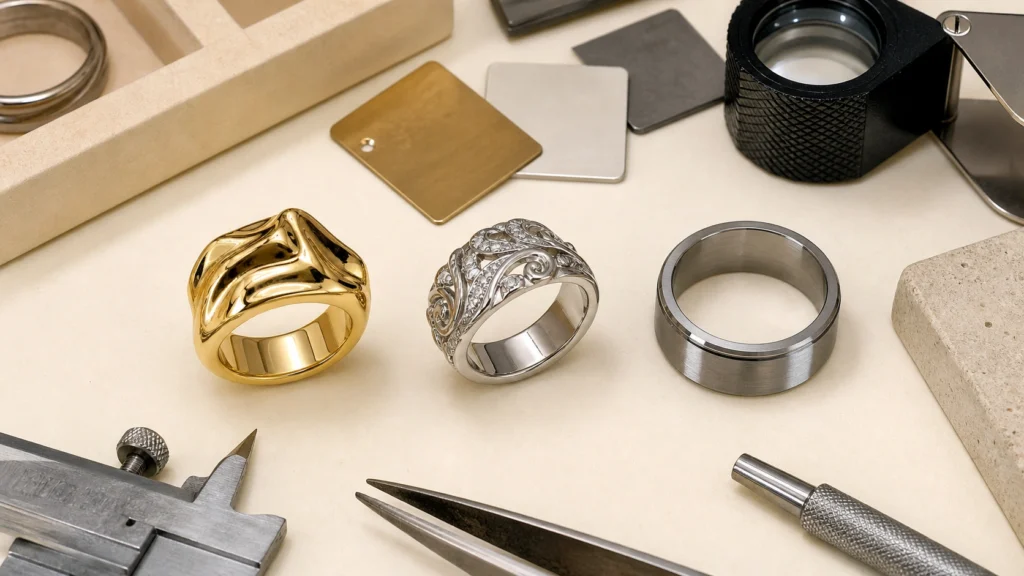
The best material for a custom fashion ring depends on the ring’s hardest feature. Brass is often useful for detailed, finish-led fashion designs. 925 sterling silver suits brands that need a recognized precious-metal base and accept its care needs. Stainless steel can suit durable, clean forms, but it uses a different production route and must be confirmed for the specific design.
No material name alone proves wear performance, skin suitability, or compliance. Select the base metal together with the shank geometry, size plan, stone setting, finish system, target market, and finished-sample evidence. Jinnuo Jewelry’s verified primary materials are brass and 925 sterling silver; steel scope is conditional.
Let the Hardest Feature Choose the Material
Identify the feature with the smallest margin for error. It may be a thin prong, a deep logo, a wide shank, a sharp signet edge, a stone channel, or an adjustable opening. That feature should lead the material discussion.
Use this short decision map:
| Buyer priority | First route to investigate | Main tradeoff to verify |
|---|---|---|
| Detailed cast form with decorative finish | Brass | Surface wear, edge quality, and finish system |
| Precious-metal product position | 925 sterling silver | Tarnish, deformation, weight, and care communication |
| Clean, durable form with limited post-production forming | Stainless steel, if confirmed | Tooling, forming, setting, resizing, and finish feasibility |
A wide band and a narrow stone-set ring may need different answers even within one collection. Request feasibility by SKU architecture, not by a single collection label.
Use Brass for Detail and Finish Flexibility
Brass is relevant for brands developing cast shapes, relief, texture, or decorative plated finishes. It can support a broad fashion vocabulary, but the finished ring is a system of base metal, preparation, color layer, protective layer if used, and wearer contact.
Ask how the ring will be formed, cast, joined, polished, finished, and inspected. A deep texture may retain polishing compound. A sharp edge may expose finish wear sooner. An adjustable brass ring also needs a defined adjustment range; repeated bending should not be assumed safe.
Brass is best considered when finish appearance and form are important, and the brand can give clear care guidance. It is not evidence of a particular wear life or skin response.
Use 925 Sterling Silver for a Precious-Metal Position
Sterling silver gives the product a recognized metal identity and supports many cast, polished, textured, and stone-set designs. Its value is strongest when the brand wants the base metal to remain part of the product story.
The tradeoffs are practical. Silver can tarnish and can deform in sections that are too light for the design. A high, top-heavy ring may rotate. A very thin shank may change shape. A plated silver ring adds a surface system whose color and wear must still be approved.
For silver, define the ring weight or critical dimensions only where they help control the approved design. Confirm marking, composition, and destination-market requirements with qualified parties rather than assuming a universal rule.
Treat Stainless Steel as a Different Production Route
Stainless steel is often compared with brass and silver as if only the material price changes. In practice, forming, machining, polishing, welding, stone setting, and resizing can be different. Some details or post-production adjustments may be less practical.
Before choosing steel, ask whether the proposed geometry, size range, logo, setting, finish, and quantity fit the confirmed production or partner-supported scope. This route can suit simple bands, signet forms, and clean surfaces when feasibility is established. It may be less suitable when the design depends on delicate cast detail or later resizing.
Jinnuo Jewelry should not be assumed to offer every steel construction. Confirm the exact project scope before CAD or sampling.
Approve the Finished Ring, Not a Material Name
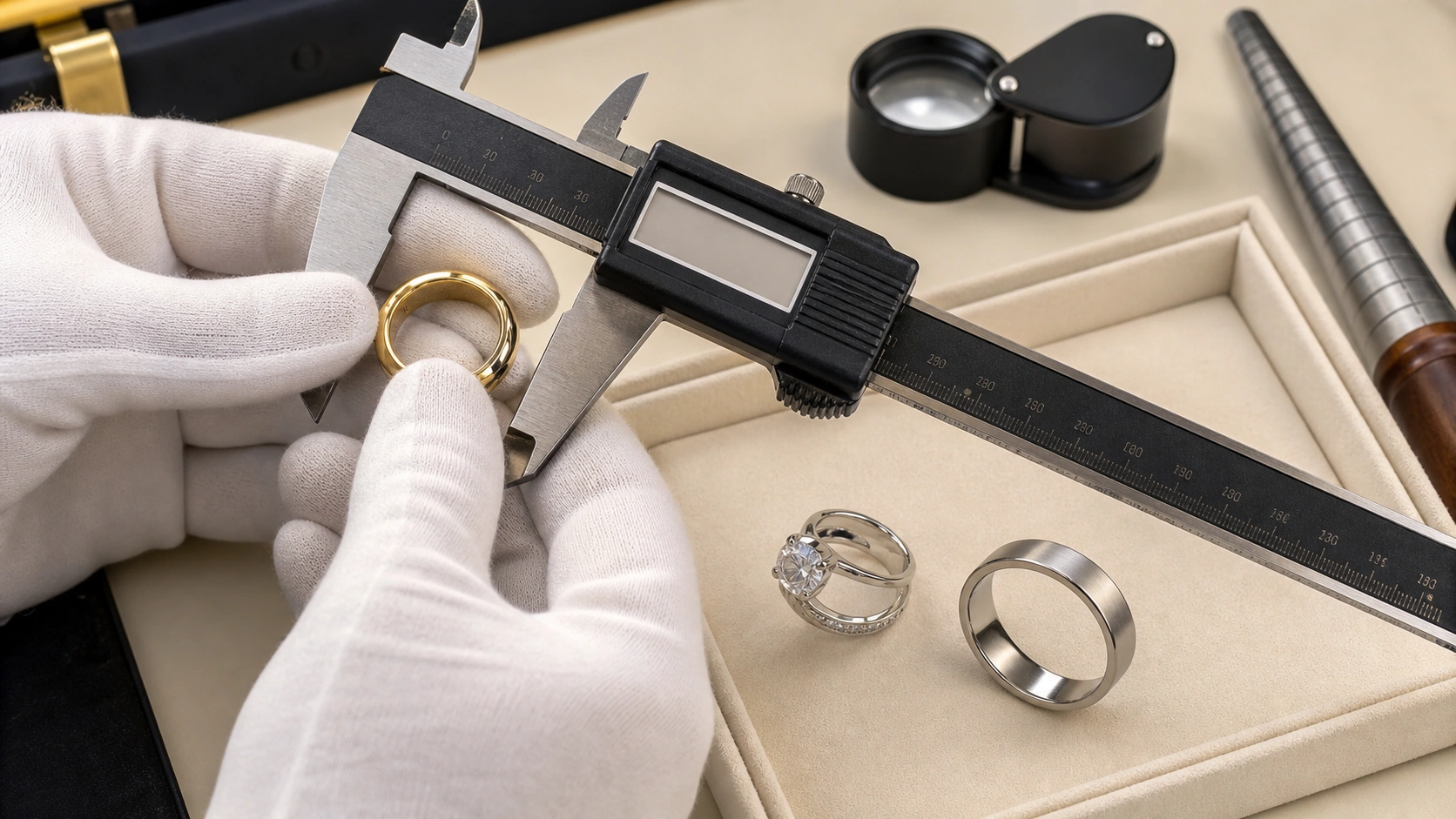
Compare samples in the final size, construction, stone setting, and finish. Check the inside edge, shank roundness, top alignment, stone security, logo clarity, surface consistency, color, and contact points. For wide bands, also review how the ring feels across finger movement.
Record lighting, reference sample, inspection method, and any accepted natural variation. If the collection uses several materials, compare their finished colors together instead of approving each in isolation.
Send the supplier a dimensioned design, target size range, intended material, finish reference, stone information, use conditions, packaging contact points, and destination market. Exact MOQ, price, testing, and lead time depend on the approved route and should follow feasibility review.

Carol
Carol is a jewelry manufacturing expert with first-hand experience across materials, surface finishes, production processes and quality control. He brings critical thinking and rigor to his work, questioning common assumptions and testing them against industry standards and real production results. He looks at every issue from the point ofview of the people who buy and wear jewelry, turning technical details into clear, practical answers to real-world problems.