Ring size planning for a wholesale jewelry order is an inventory decision, a product-fit decision, and a production-control task. The goal is not to order every possible size equally. It is to choose one documented sizing standard, define a commercially useful range, allocate quantities using the best available demand evidence, and make every size identifiable from sampling through packing and reorder.
The safest approach is to avoid generic “average size” assumptions. Use the brand’s sales history, customer geography, channel, ring design, intended finger, and return data wherever possible. When the brand has no history, begin with a controlled test assortment and record results before expanding.
Quick Ring Size Planning Framework
| Decision | What to define | Why it matters |
|---|---|---|
| Size system | The exact national, regional, or internal standard used | Prevents ambiguous labels and incorrect conversions |
| Size range | Smallest, largest, and increment offered | Controls SKU count and customer coverage |
| Size curve | Quantity allocated to each size | Reduces overstock and missed demand |
| Design exceptions | Wide bands, open rings, signets, stacking sets | Fit can change with geometry |
| Sample sizes | Sizes physically reviewed before production | Confirms comfort, proportion, and construction |
| Identification | SKU, size mark, label, bag, tray, and carton records | Prevents mixing during production and fulfillment |
| Reorder data | Sales, returns, exchanges, and stockouts by size | Improves the next purchase |
This guide does not provide a universal conversion chart because conversion tables can differ in rounding, measuring method, and naming convention. The exact standard should be agreed between the buyer and manufacturer.
Choose One Primary Ring Size Standard
Confusion begins when a purchase order says only “size 7” or mixes several systems without identifying them. The manufacturing specification should state the primary size system; whether sizes use whole, half, quarter, or another increment; the measurement basis; any approved conversion reference; the tolerance; and how size appears on labels and order records.
If the brand shows several systems to customers, keep one manufacturing standard as the source of truth. Customer-facing conversions should map back to that standard and be checked against finished products. Do not rely on an unreferenced chart copied from another seller.
Define the Size Range by Customer and Channel
A useful range depends on the customer base rather than the manufacturer’s default. Consider primary markets, intended wearer and finger, ring category, sales channel, historical sales and returns, customer inquiries, the brand’s extended-size promise, inventory budget, and replenishment speed.
A narrow range is easier to stock but excludes more customers. A broad range improves coverage but spreads inventory across more SKUs. For a new brand, consider a core range plus a limited test of edge sizes. Record both sales and stockouts.
Build a Size Assortment from Evidence
Use the strongest available data in this order:
- Sales by design and size
- Returns and exchanges by original and replacement size
- Stockout and wait-list records
- Retailer or distributor preorders
- Customer survey or fitting-event data
- Comparable product history
- A controlled initial test when no direct evidence exists
Avoid using one size curve for every design without review. A slim stacking ring, wide signet, adjustable ring, and statement ring may attract different customers or fit differently.
A practical allocation method
Separate the range into core sizes with the strongest expected demand, support sizes that extend coverage with lower opening depth, and test sizes included to learn demand. Document why each group exists.

Account for Ring Width and Interior Profile
Size labels do not tell the whole fit story. Width, thickness, inner curvature, edges, weight, and top-heavy construction can change how a ring feels.
Wide bands
A wide band covers more of the finger and can feel tighter than a slim band with the same nominal size. Establish any fit adjustment through physical samples rather than a universal rule.
Comfort-fit interiors
A rounded interior may feel different from a flat interior. If a collection uses both, sample and describe them separately.
Signet and statement rings
A heavy ring head can rotate even when the inside size is correct. Review shank shape and weight distribution.
Stacking rings
Several slim rings worn together create a wider combined fit. Test intended stacks as units.
Plan Sizes Across the SKU Matrix
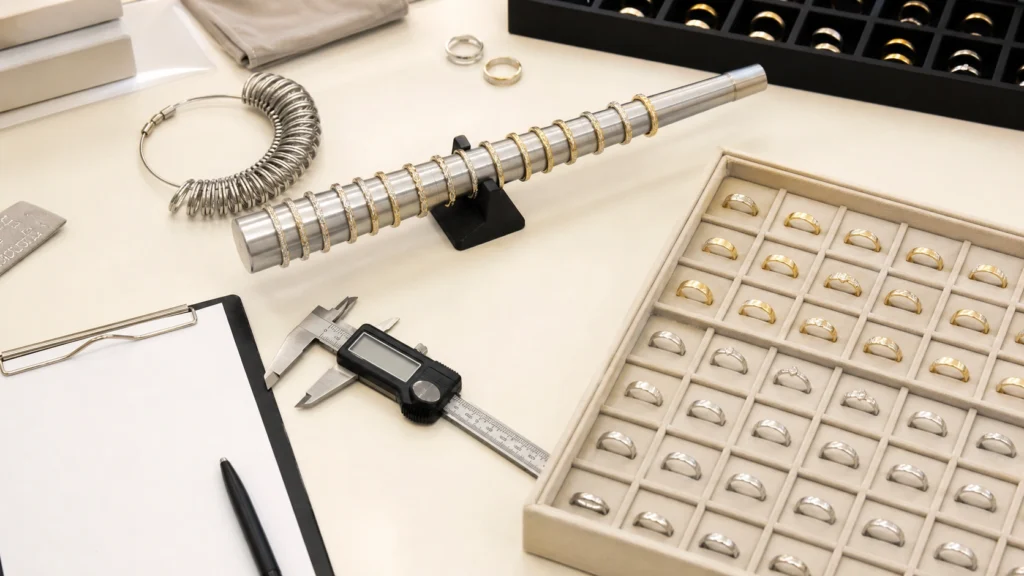
Wholesale complexity grows quickly: base designs × ring sizes × materials × finishes × stone colors. Build a complete matrix listing parent design, size, material, finish, stone option, SKU, ordered quantity, unit packaging, label, and carton allocation.
Reduce combinations without a clear commercial purpose. MOQ, price, tooling, and production timing vary by design, material, size range, quantity, finish, and packaging. Confirm them after review of the final matrix.
Decide Which Sizes to Sample
Sampling only one middle size may miss problems at the smallest and largest ends. Representative sampling can include a central core size, smallest planned size, largest planned size, wide-band or special construction, and any version where a pattern, logo, or stone count changes.
Review inside size, width, thickness, profile, comfort, roundness, symmetry, settings, logo position, finish, and packaging fit.
Protect Design Proportions Across Sizes
Scaling is not always a simple change to inside diameter. Decide which elements remain constant and which scale: signet face, stone size and count, pattern repeat, band width and thickness, logo size, openings, and weight.
If stone count or pattern spacing changes by size, treat those versions as controlled variants with specific drawings or CAD files.
Treat Adjustable Rings as a Separate Fit Strategy
An open or adjustable ring does not eliminate size planning. Specify the intended fit range, starting inside dimension, opening width and position, minimum metal sections, adjustment owner and method, and effect on stones, enamel, plating, or coating.
Repeated bending can distort the ring, damage finishes, or loosen settings. Do not describe an adjustable ring as suitable for every finger unless supported.
Establish a Size Measurement and Inspection Method
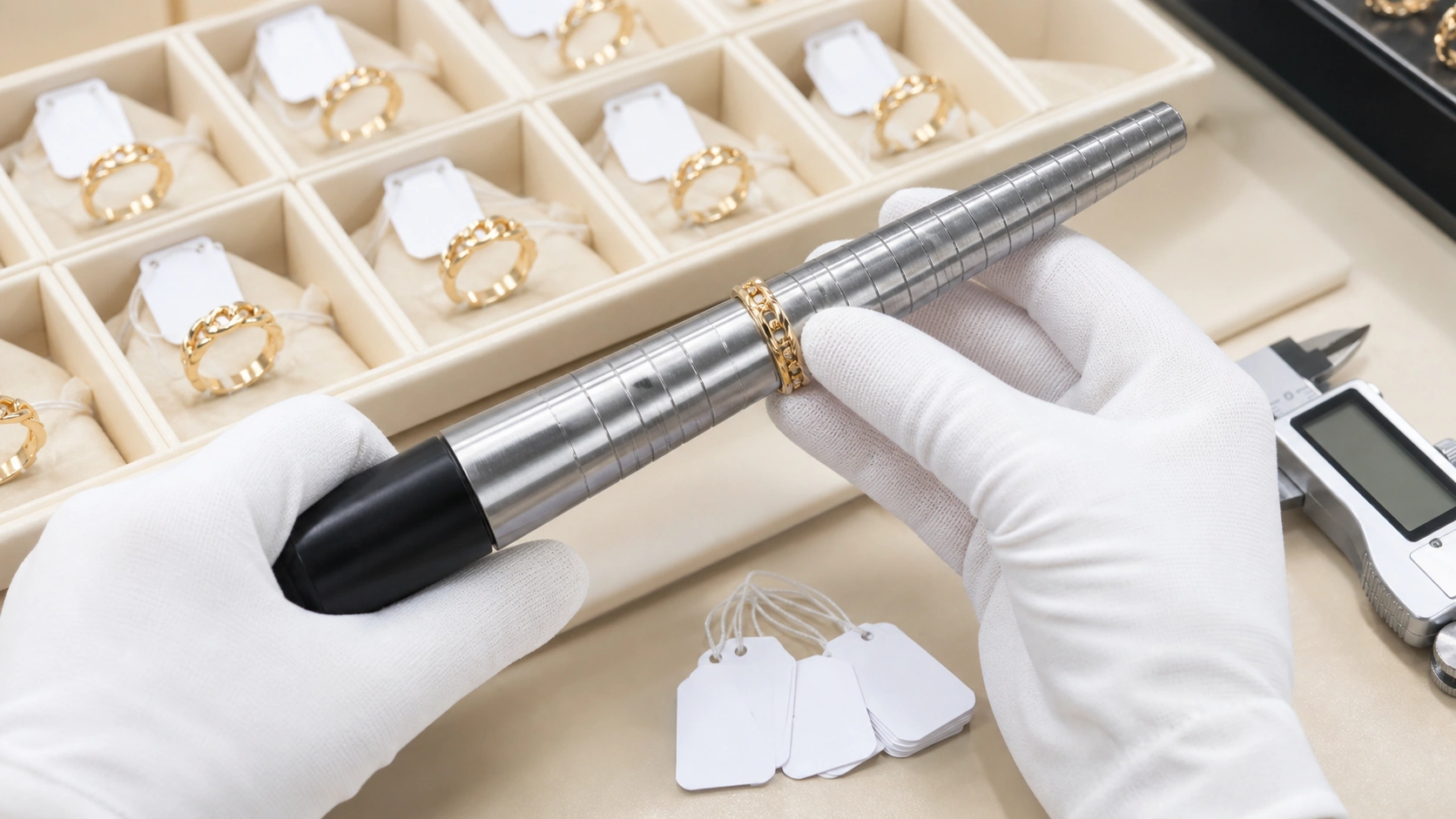
The buyer and manufacturer should agree how finished rings will be checked using ring mandrels, master gauges, internal measurement tools, or approved references.
Control the tool reference, measurement point, handling of non-round or open designs, tolerance and rounding, sampling frequency, borderline pieces, recording, and corrective action. Do not compare measurements from unrelated tools without confirming the same standard.
Keep Sizes Identifiable Through Production and Packing
Size mixing is an operational risk. Use a consistent system across work-in-process trays, product bags, SKU labels, cards or boxes, pick lists, inner cartons, master cartons, packing lists, and invoices.
Barcode or SKU data must be supplied and approved by the brand or retailer. Do not invent unverified codes during packing.
Create a Reorder-Ready Data Structure
Track performance by design, size, material, finish, channel, and period. Useful measures include units sold, starting inventory, days out of stock, returns, exchanges, requested replacement size, cancelled orders caused by missing sizes, partner feedback, and remaining stock.
Use this evidence to adjust the next curve. Do not interpret a stockout as low demand or slow sales as excess demand without considering availability.
Common Wholesale Ring Size Planning Mistakes
Ordering equal quantities of every size
An even split is simple but rarely reflects demand. Use an intentional core-support-test structure.
Mixing size systems on the purchase order
Select one manufacturing standard and identify every conversion source.
Using the same curve for every ring
Different widths, categories, and customers can produce different fit and demand patterns.
Sampling only the center size
Small and large versions may reveal proportion, setting, marking, or weight problems.
Treating adjustable rings as one-size-fits-all
Define and validate a real fit range and adjustment method.
Ignoring size identification in packaging
Accurate production is not enough if sizes are mixed during packing or fulfillment.
Wholesale Ring Size Planning Checklist
- Primary size standard and measurement basis
- Customer-facing conversion reference
- Size range and increments
- Core, support, and test sizes
- Quantity by design, size, material, and finish
- Design-specific fit exceptions
- Representative sample sizes
- Size-dependent CAD or pattern changes
- Inspection tool, tolerance, and method
- SKU and label ownership
- Individual and carton-level size identification
- Data to collect for reorder planning
Final Recommendation
Use one documented manufacturing size standard, build the assortment from real market and sales evidence, and treat ring geometry as part of fit. Sample representative sizes, control the full variant matrix, and maintain size identification from production tray to final carton.
For a new wholesale range, begin with a manageable core assortment and a deliberate test of edge sizes. Let sales, stockouts, returns, and replacement-size requests improve the next order rather than relying indefinitely on generic averages.
Jinnuo Jewelry supports OEM, ODM, and private-label jewelry development. The exact size range, sampling plan, tolerance, quantity allocation, production timing, and packaging depend on the project.
Buyers can explore custom rings, review the jewelry sampling service, or submit the size matrix, designs, materials, finishes, and quantities through the quote request page.