

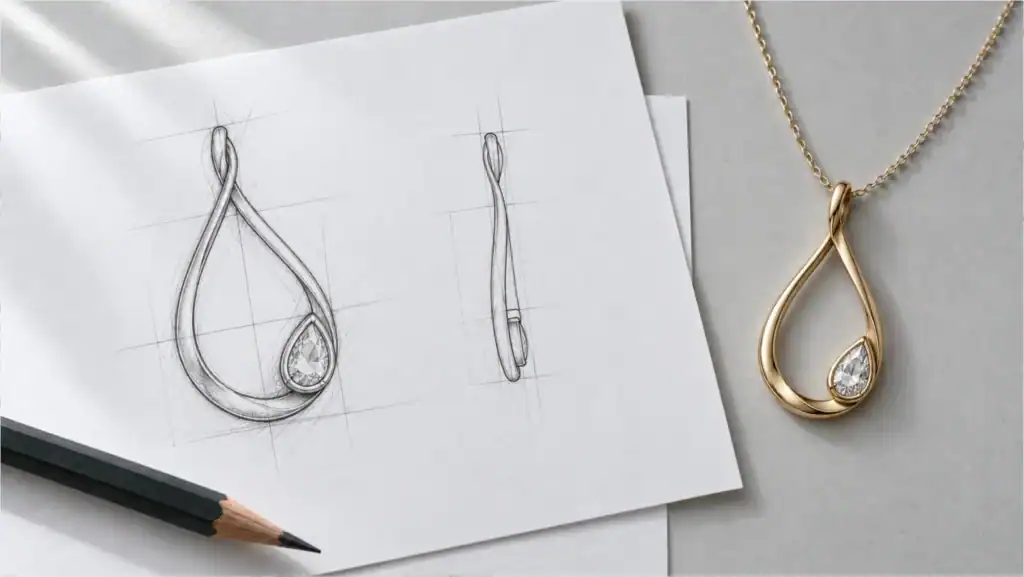
“Please create a gold pendant based on this sketch. It needs to be lightweight, and a sample should be produced first.”
You may already have a clear vision of the finished piece in your mind, yet there are still details to clarify with the manufacturer: the choice of base metal, the design of the back, and exactly what is meant by a “sample”—whether it is a model for checking proportions or a finished metal prototype. Even when working from the same sketch, differences in these choices can lead to vastly different results.
You do not need to resolve every technical detail before making contact. At Jinnuo Jewelry, you can start a sampling discussion with a sketch, reference photos or an existing sample. The next step is to separate what you have decided from what you want the factory to recommend, then confirm the requirements before work on the sample begins.
This guide maps everyday requirements to the various choices available. You will find common options, the pros and cons to consider, and examples of how to articulate specifications clearly. We will walk through a specific case study (with notes on other jewelry types) and provide a reference requirements document that you can adapt to your own projects. The goal of this guide is not to turn you into a manufacturing engineer, but to help you identify key points, ask insightful questions, and evaluate proposed solutions before giving your approval.
What You Mean vs. What the Factory Still Needs to Know
Start by separating the result you want from the technical decisions still open. The examples below are illustrative, not customer case records. They show how to state your priorities and ask the factory for recommendations.
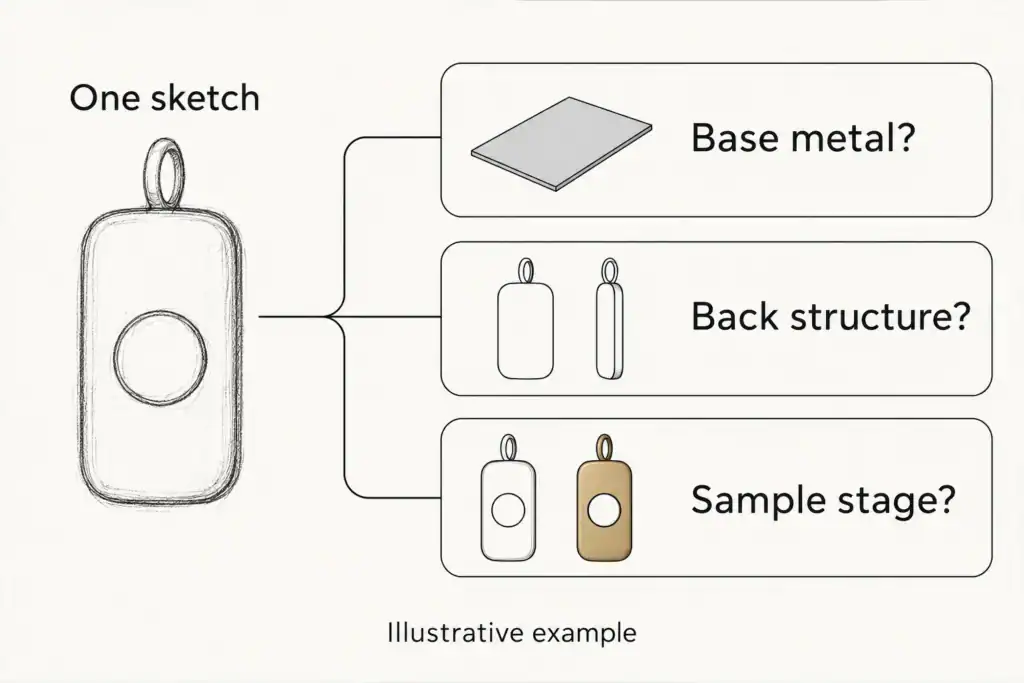
| Your request | What you may mean | What still needs confirming | A clearer way to say it |
|---|---|---|---|
| “Make it like my sketch.” | Preserve the design you have drawn. | The side profile, back structure, dimensions and attachment details may be missing. | “Keep the front outline and stone positions as drawn. Please propose the side and back structure for approval.” |
| “Make it gold-colored.” | Match the gold appearance you have in mind. | Base metal, finish method, color tone and surface texture are separate choices. | “The target is a polished gold-colored finish. Please recommend the base metal and finish method, then provide a physical color reference for approval.” |
| “Make it lighter.” | Reduce weight without changing the look you like. | Which dimensions or structural features may change, and what those changes affect. | “Keep the front outline. Please suggest ways to reduce weight and explain how each option would affect the appearance, structure or function.” |
| “Make the quality better.” | Avoid the problems that matter to you. | Whether the priority is appearance, smooth closure operation, secure connections, finish durability or consistency. | “Prioritize secure connections and smooth closure operation. Please propose inspection criteria for us to agree before sampling.” |
| “Make a sample first.” | Receive a piece you can review before ordering. | Whether this stage includes a model, a metal sample or a finished piece, and which materials and processes are included. | “This round should include a finished metal sample with the agreed finish and components. Please list anything excluded.” |
You do not have to choose every technical solution yourself. Instead, separate the brief into fixed requirements, preferences and open questions. For example:
“The pendant’s front outline is fixed. Low weight is a preference, but I have not chosen the back structure. Please propose suitable options and show what each would change before I approve one.”
This gives the factory an opportunity to propose solutions without treating every design detail as negotiable. You are soliciting options rather than approving a specific construction you have not yet seen.
Once you receive a proposal, document the solution you have adopted. Be sure to incorporate this decision into the current drawings or written specifications, rather than leaving the information scattered across various records of communication. If a sketch determines the shape while a separate sample determines the color, clearly label both references and their respective scopes of control. Jinnuo’s earring prototyping guidelines employ this same approach, clearly defining fixed details, the scope for permissible changes, and the hierarchy of references.
Next, we will apply these principles of distinction to the sketch itself, starting with views, dimensions, and wearability requirements.
How to Mark Dimensions and Wearing Requirements on Your Sketch
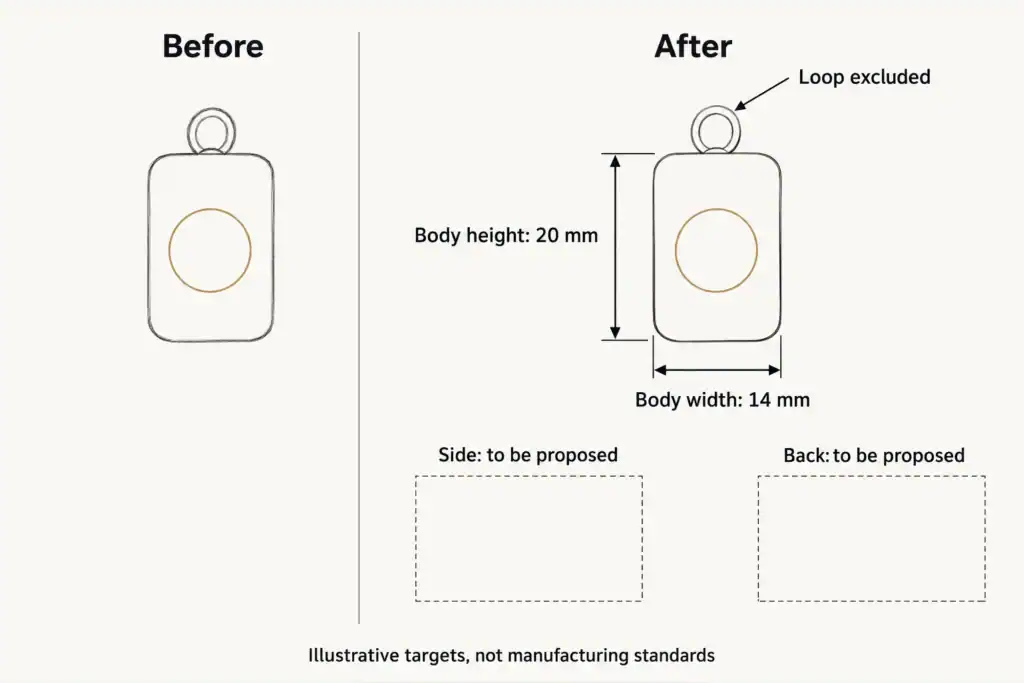
Specifying that the pendant should be “20 millimeters” leaves an unresolved question: does this refer to the height of the pendant body itself, or the total height including the bail? A specific measurement is meaningful only when both parties clearly understand the starting and ending points.
Add the views needed to explain the design. They can be simple annotated sketches, not polished technical drawings:
- Front: show the outline and stone positions. Mark the body height and width. Label any undecided front details “to be proposed.”
- Side: show the profile and mark the endpoints of any thickness measurement. Indicate how far raised details should project. Mark undecided dimensions as “to be proposed.”
- Back: show any required rear details and attachment positions. If the back structure is undecided, label it “to be proposed” rather than drawing it as though it were approved.
Use arrows with clear endpoints. Keep drawing dimensions in one unit, such as millimeters, and state whether they refer to the intended finished sample. Separate overall dimensions from component dimensions: a pendant’s body height is not its total hanging height, and a hoop’s outside diameter is not its inside diameter.
Regarding the pendant we are using as an example, the more specific requirements should be:
“Target finished pendant body: 20 mm high × 14 mm wide, excluding the attachment loop. Keep the front outline and stone position as drawn. Show the total height including the loop separately. Please propose body thickness and the back structure after we agree on the base metal.”
These figures serve only as target references and do not represent recommended dimensions applicable to all pendants. Before producing samples, please clarify which target parameters constitute strict specifications and ask the factory to propose appropriate dimensional tolerances (i.e., the permissible range of size deviation); you do not need to set engineering tolerances yourself.
Additionally, please specify how the piece is intended to be worn. Relevant details should be selected based on the specific product; do not generalize across all types of jewelry or treat them as having identical dimensional requirements.
| Jewelry type | Dimensions and wearing details to clarify | Ambiguity to avoid |
|---|---|---|
| Earrings | Total height when worn, including any hook or other attachment. Specify width, post or hook position and whether the pair is identical or mirrored. | “Small earrings” without an overall size or a clear left/right arrangement. |
| Pendant necklaces | Pendant body height and total height, chain length and how it is measured, extender length and whether the pendant must come off the chain. | Including the extender in one length figure without saying so. |
| Rings | Ring-size system, band width, flat or rounded inside profile and fixed-size or adjustable construction. | “Size 7” without naming the sizing system. |
| Bracelets and bangles | Bracelet length and measurement method; a circular bangle’s inside diameter or an oval bangle’s inside length and width; slip-on or opening construction. | Treating wrist circumference, a bangle’s inside dimensions and its opening as interchangeable. |
Ring sizing illustrates why these details matter. CEN-CENELEC describes different national numbering and lettering systems, and a standard intended to make measurement and size designation unambiguous. Name the system you are using and agree on the measurement reference. CEN-CENELEC: Ring-size standard
For finger sizing, GIA recommends wide sizing gauges for ring bands wider than 4 mm. This guides gauge selection; it is not a finished-product specification. GIA: Accurate Determination of Finger and Ring Sizes
Do not rely only on a size obtained for a narrow ring when discussing a wide-band design, or apply an automatic “one size larger” rule. Ask how the intended width and inside profile will be checked.
For a quick visual check, print the front outline at actual size, verify a marked dimension with a ruler and cut it out. This can help you judge scale; it cannot establish final weight, strength or comfort.
Finally, do not turn “lightweight” into “as thin as possible.” GIA’s jewelry design curriculum treats comfort and durability as engineering goals alongside size and manufacturing constraints. State the wearing goal and ask the factory to explain the proposed thickness and structure. Save the approved dimensions and remaining questions in the same dated drawing version. GIA: Jewelry Design & Technology
Which Metal Should You Specify for Your Jewelry Sample?
“Gold” refers to the appearance, not the underlying metal material. Please specify the base material and the surface finish separately, or list the materials you wish for the factory to evaluate.
If the product specifications already mandate the use of sterling silver or karat gold as the base material, that serves as a fixed starting point; however, if only the final color is specified, there is greater flexibility in selecting the base material. Even when a lightweight design goal is established, a concrete material strategy for the entire product is still required.
Please use this table to screen potential materials rather than to rank them. Be sure to verify which material options the supplier can accommodate for your design. If the supplier offers karat gold, this can be explored as an alternative option.
| Material option | When to discuss it | Trade-offs and details to confirm |
|---|---|---|
| Brass | You want a plated piece and are comparing metals for the body. | Brass is a family of copper-zinc alloys. Ask which alloy the factory proposes and how the parts will be made and joined. Confirm any design changes that would affect thickness, weight or cost. Copper Development Association |
| 925 sterling silver | The product needs a sterling silver body, whether its final appearance is silver-colored or plated. | Sterling specifies a minimum silver content of 92.5%, not a maintenance-free surface. It can tarnish; agree on the finish and care expectations rather than promising it will stay bright indefinitely. FTC silver-content guidance, GIA |
| Stainless steel, with an agreed grade | You want to evaluate a corrosion-resistant steel design. | Specify the steel grade (the particular alloy), not just “stainless.” Ask whether the factory can preserve your design details, attachment points and intended finish. Corrosion-resistant does not mean corrosion-proof. Outokumpu |
| Karat gold, such as 14K or 18K | You need a gold-alloy body rather than gold plating over another metal. | Specify karat and alloy color, and ask the supplier to confirm availability. Gold content and solid or hollow construction are separate decisions. “18K gold body” is not interchangeable with “18K gold plated.” FTC |
| Zinc casting alloy | A supplier proposes a casting route for decorative parts. | Ask for the named alloy, tooling requirements and finishing route. Zinc casting alloys include different families; “zinc alloy” alone leaves the material choice unresolved. International Zinc Association |
| Titanium, with an agreed grade | Low weight is a key goal and you want a titanium proposal evaluated. | Titanium has a lower density than steel, but compare the estimated weight of your actual design rather than assuming a lighter finished piece. Confirm the grade and how the parts will be made and joined. TIMET |
316L contains nickel; the “L” means low carbon, not low nickel. The grade alone does not tell you whether the finished piece meets your nickel-related requirements. Outokumpu datasheet
The American Academy of Dermatology advises people with nickel allergy to avoid nickel exposure. If this is a concern for your project, state your requirements in the brief and agree on the evidence needed to support claims about the finished piece. Do not treat “316L,” “925” or a material certificate alone as proof that the whole piece is hypoallergenic. This does not mean every nickel-containing alloy causes a reaction. AAD: Nickel allergy
If the material is undecided, do not replace that uncertainty with “use better metal.” For our illustrative pendant, write:
“Please compare brass and 925 sterling silver for this pendant’s front design and target dimensions. These are options to evaluate, not approved materials. For each option, explain how you would make the piece. Give the recommended thickness and estimated finished weight, then list suitable surface finishes. Explain any required design changes and cost differences before I choose.”
This requests a comparison on the same brief. If a proposal needs a thicker body or a changed connection, you can decide whether that trade-off is acceptable instead of discovering the change in the sample.
Once you choose, record the material by component. For example:
“Pendant body: 925 sterling silver. Please list the attachment loop, chain and clasp materials separately. Do not substitute materials without written approval. The surface finish will be confirmed separately.”
A requirement for the body should not remain ambiguous about the rest of the necklace. If all metal components must meet the same material requirement, say so explicitly. Otherwise, identify which differences you accept and which still need approval.
How Do You Specify Color, Texture and Coating Separately?
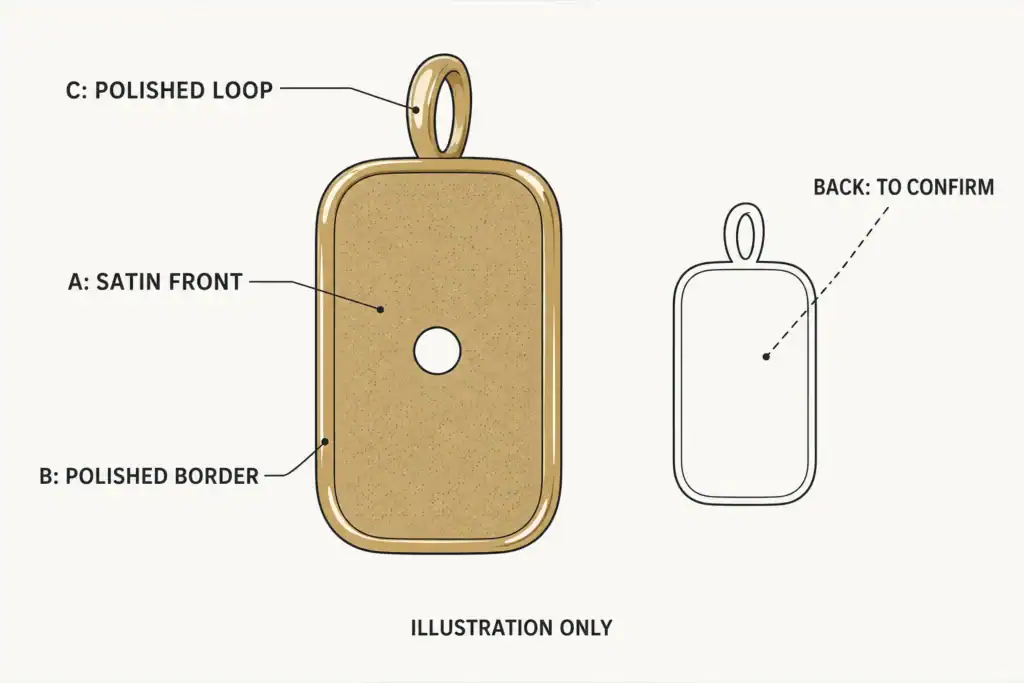
“18K gold, matte, and water-resistant” sounds like a specific description, yet it actually leaves some ambiguities: does the “18K” refer to a gold plating layer, or is it merely a color designation defined by the supplier? Should the surface texture exhibit a soft satin sheen, a distinct brushed finish, or a granular quality? And precisely what level of water resistance should the item possess?
Separate the appearance you want from the process used to create it. GIA treats texture, polish and electroplating as distinct finishing skills. A useful brief makes those choices visible instead of hiding them in one phrase. GIA
Use these descriptions as appearance directions, not standardized finish grades:
| What you might say | Choices still left open | A clearer instruction |
|---|---|---|
| “Gold like this photo” | Pale or warm yellow, rose gold or another tone; a color target versus an actual gold layer. | Identify the reference for the tone. State separately whether the coating must contain gold. Do not use “silver-colored” to mean silver plating either. |
| “Make it shiny” | Mirror-like reflections, which surfaces are polished and how the edges should look. | Mark the polished areas. Ask to inspect those areas on a physical finish sample rather than approving a reflection in a render. |
| “Make it matte” | A soft satin appearance, a grainier frosted look or a surface with visible brush lines. | Show the intended texture and whether lines should be visible. Choose this direction when you want a less reflective appearance, but approve the actual texture. |
| “Use a brushed finish” | Fine or coarse lines, their direction and where they stop. | Draw arrows for the line direction on each relevant surface. A front-to-back description alone does not define the direction on a curved hoop or ring. |
| “Give it an antique look” | Which recesses are darker, which raised areas stay brighter and how strong the contrast should be. | Mark the darker and brighter zones. Request a finish sample; do not leave the entire effect to the word “antique.” |
| “Use 18K gold plating” | Its shade, the minimum gold-layer thickness and any other layers. | Specify the plating karat separately from the color reference. Ask for a proposed minimum gold-layer thickness and an explanation of how it will be specified and checked. |
PVD is a process name, not proof of gold content. Ionbond’s decorative PVD portfolio includes titanium nitride and zirconium nitride coatings, and its “Gold 18K” product lists that term as a color. The practical lesson is that a gold-like color name alone does not establish an 18K gold layer. Ask what the proposed coating actually contains; do not assume all PVD coatings contain gold or that none do. Ionbond coating portfolio, Gold 18K technical data
Ask the factory which route suits the selected metal and design. Request the proposed layers, including any barrier layer beneath the color coating and any clear topcoat. If you have nickel-related requirements, include those when assessing the whole coating system. Do not approve a process before its material compatibility and required underlayers are explained.
For gold electroplating, karat and thickness are separate specifications. The FTC’s US Jewelry Guides use pure-gold-equivalent thickness in their electroplating examples: a thickness adjusted for the gold content of the alloy. Ask whether the supplier’s thickness figure refers to the actual gold-alloy layer thickness or its pure-gold equivalent. Also ask which layer will be measured and where. A total coating-stack thickness is not the gold-layer thickness. FTC §23.3
Color approval also needs a comparison method. X-Rite explains that colors can match under one light but look different under another. Apply that principle to your brief: agree on the physical reference and lighting used to compare it with the sample. Photos can communicate a direction, but do not make a screen image the sole final reference. If several references conflict, say which one takes priority. X-Rite
For our illustrative pendant, an appearance request could read:
“Target color: pale yellow gold. Front area A: fine satin, without visible directional brush lines. Border B and attachment loop C: polished. Back finish: please recommend; not approved yet. Photos show the direction only. Please propose a physical finish sample with a reference ID and specify the lighting to use for approval.”
Then request the manufacturing proposal separately:
“If we select brass, please propose a gold electroplated finish. State the gold alloy’s karat and recommend a minimum gold-layer thickness in microns. Explain how that thickness is defined and where it will be measured. List any barrier layer and clear topcoat. If you recommend PVD instead, state the coating materials and whether it contains gold. Submit it as an alternative for approval, not an automatic substitution.”
Finally, replace “waterproof” or “never fades” with the intended use: occasional splashes, daily showering, swimming or another exposure. Ask what evidence and care limits support the proposed finish under those conditions. A process name or thickness number should not be accepted as a promise of a fixed wear life.
You do not need to formulate engineering specifications yourself. Simply define the aesthetic requirements and non-negotiable performance parameters, then ask the factory to recommend a suitable coating system. You must both approve the written technical specifications and verify the actual physical appearance; both steps are essential and cannot replace one another.
How Should You Specify Stones, Settings and Enamel?
“Add a clear, sparkling stone” describes a look, not a material. Glass and cubic zirconia (CZ) can imitate diamond, but neither is a laboratory-grown diamond. CZ is also different from zircon. Use the exact material name before discussing color or sparkle. GIA: Simulants, GIA: Zircon
| Decision | Options to discuss | What to put in the brief |
|---|---|---|
| Material and origin | CZ or glass for a diamond-like decorative look; a named natural or laboratory-grown gem when that identity is part of the product. | Name the material. For gems, state whether natural or laboratory-grown and ask about treatments. Confirm availability rather than accepting a vague description such as “crystal.” |
| Shape, cut and size | Round, oval or another outline; faceted or smooth-domed (cabochon). | If you know the stone size, give its diameter or length × width and depth in millimeters. Add color and quantity per piece. If undecided, request available sizes before approving the setting. |
| Single-stone setting | Prongs leave much of the stone visible; a bezel surrounds its edge with a metal rim. GIA | Choose the preferred amount of visible metal. Ask the factory to show setting height and assess compatibility with the stone and body. |
| Small-stone layout | A pavé-style surface of closely set small stones or a channel-set row between metal walls. GIA | Mark the area or row, stone sizes and count. Ask for the proposed layout instead of leaving “add small stones” open to interpretation. |
| Enamel or colored fill | Opaque or translucent color; fill level with the surrounding metal or a raised surface. | Mark the filled areas and reference color. Specify the intended surface level, then request the actual fill material and process. |
Carat is weight, not a diameter specification. Include millimeter dimensions even when you also give carat weight. The factory needs to assess the selected stone’s fit and depth, not just its appearance from above. GIA: Carat Weight
For enamel, confirm more than the shade. Vitreous enamel is glass fused to a surface by heat; resin products sometimes called “cold enamel” are a different material. Ask which is proposed and whether it suits the chosen body material. Do not assume every product sold as “cold enamel” uses the same resin. Thompson Enamel, The Enamelist Society
If adhesive is proposed for a decorative stone, have that fixing method identified in the quote. It should not silently replace an agreed mechanical setting.
For our illustrative pendant, the request could read:
“One clear, round faceted cubic zirconia (CZ) at the marked position. Please recommend an available stone size that suits the pendant’s target dimensions, with diameter and depth in millimeters. Compare prong and bezel options in front and side views, showing metal coverage and setting height. Adhesive fixing and enamel are not approved for this version. List any required changes to the body before making the sample.”
This fixes the stone identity and quantity while leaving size and setting for a proposal. If you already know those requirements, specify them directly instead of requesting alternatives.
How should structural components and functional components be defined?
A chain may fit through a pendant bail (attachment loop) while its end ring does not. If the pendant must slide off the chain, checking chain width alone misses the problem. Rio Grande’s chain guide specifically advises checking the finished chain’s end ring against the bail. Rio Grande
Weight also depends on construction. Ask whether a solid body, recessed back or hollow form is feasible for your design. Hollow profiles are one weight-reduction option used in jewelry CAD. Compare rear views and cross-section drawings, estimated weight and support around the stone; do not treat “lightweight” as permission to reduce every dimension. Stuller
| Product | Options to discuss | Fit and function to confirm |
|---|---|---|
| Pendant or necklace | A fixed loop or opening bail; a spring-ring or lobster clasp. | Does “removable” mean sliding the pendant off the chain or opening its bail? Check clearance for the actual part that must pass through. |
| Earrings | Friction-back or screw-back studs, hooks or hinged hoops. | Specify the closure and any left/right orientation. Screw backs require compatible post threads, not just a matching appearance. Stuller |
| Ring | Fixed-size or adjustable construction. | Ask how the proposed construction affects the stone setting and how the ring sits on the finger. For an adjustable design, state the intended range and ask how it should be adjusted. |
| Bracelet or bangle | A clasped chain, hinged bangle or open cuff. | Describe how it should go on and come off. Check hinge alignment, clasp access and movement on the assembled piece where applicable. |
Identify fixed joints versus connections intended to open. Ask the factory how each will be joined, then assess opening, closing and movement on the assembled sample rather than judging separate parts by appearance alone.
For our illustrative pendant, write:
“Keep the front design and previously stated stone requirement. Please compare a solid-body version with a weight-reduced back design, if feasible. Show rear views and cross-section drawings, estimated weight and any changes needed around the stone setting. The pendant must slide off the proposed finished chain without tools. Show the bail’s clear opening and the chain end that must pass through it. Include the chain and clasp in the assembled sample. Flag required design changes before I choose.”
This specifies the intended function while leaving construction details for the factory to propose.
What Should You Prepare for the Logo and Packaging?
The requirement to “add our logo and gift box” does not specify the exact logo placement, marking technique, or the range of packaging styles. Please treat the logo on the jewelry and the brand logo on the packaging as two separate requirements.
Please provide the original source file for the logo along with a preview image. While vector graphics do not lose clarity when scaled, this does not guarantee that every minute detail will be perfectly reproduced on the jewelry. It is recommended to confirm with the supplier which file formats they support and whether the design file requires any pre-processing. Adobe
| Item | Send or specify | Ask the supplier to confirm | Quote separately if applicable |
|---|---|---|---|
| Logo artwork | The exact logo version and original file, not just a screenshot. | Whether redrawing or converting text to vector paths (outlining) is needed. Keep an editable text copy before outlining it. | Artwork preparation. |
| Mark on the jewelry | A marked view showing the logo’s location, orientation and intended width in millimeters; if undecided, ask the supplier to propose a width. | A suitable method, such as laser or mechanical engraving, and whether fine details need simplification. | Setup and marking. |
| Packaging | A display card, pouch or box; product dimensions and how the jewelry should sit inside. | Suitable holes, slots, inserts or closures, as applicable; whether the assembled product fits. | Packaging and any custom components. |
| Sample scope | Jewelry only, an unprinted packaging sample to check how the jewelry fits or a packaging sample with printed branding. | Which materials, printing and finishes the sample includes or excludes. | Each sample and any printing setup. |
Both laser and mechanical engraving are used in jewelry making; the choice of technique cannot be determined solely by the design of the mark itself. It is recommended to request a rendering at actual size and to examine the engraving quality on a physical sample. Gravotech
When evaluating packaging, “fit” and “appearance” should be considered separately. PackMojo distinguishes between unprinted prototypes—used to verify dimensions and structural assembly—and printed prototypes, which may omit certain surface finishes. Digital mockups alone cannot verify the actual fit between the necklace and its insert. It is advisable to clarify exactly what aspects of the prototype are being validated; do not simply assume that a “packaging prototype” encompasses every detail.PackMojo
For our teaching pendant, the request could read:
“Please evaluate the logo intended for the designated marking area on the back of the pendant, recommending an appropriate width (in millimeters) and marking technique. Please identify any details that require simplification before the design is revised. Provide a separate price quote for the packaging (including the box and insert) and specify the method for securing the pendant to the necklace. An unprinted sample of the packaging is required for fit testing; please quote the cost for printing the brand logo separately. Please adhere to previously confirmed requirements while deferring decisions on any outstanding options.”
How Should You State Your Budget, Quantities and Dates?
When requesting a “best quote” based on the same sketch, the offers received may cover different items—ranging from just the pendant to a complete necklace or a finished, packaged product. Furthermore, sample costs are not equivalent to the unit price for mass production. Before comparing prices, it is essential to verify that the specifications and scope of service are consistent.
The U.S. International Trade Administration recommends that quotations include itemized and total prices, payment terms, estimated shipping dates, and the quote’s validity period. When comparing prices, these factors should be considered holistically rather than focusing solely on the unit price.International Trade Administration
| Input | What to state | What to clarify with the supplier |
|---|---|---|
| Budget | Separate the development/sample budget from the target production unit price. State the currency and any nonnegotiable specifications. | Which charges are one-time versus per unit, and what would need to change if the target cannot be met. |
| Quantities | List planned quantities by design, material, finish and size. For earrings, specify pairs or individual pieces. | Whether minimums apply to the whole order, each design or individual variants; whether quantities can be combined. |
| Dates | Give the date you need the sample in hand, its destination and the intended launch date. | What starts the lead-time clock and whether the quoted period ends at completion, dispatch or arrival. Ask for feasible sample and production schedules. |
| Quote scope | Identify the assembled jewelry, logo marking and packaging required. State the sales market and intended wearer. | Included and excluded items; tooling, testing, packing and shipping charges where applicable. |
Please list forecasted demand separately from the initial planned orders. If the procurement quantity has not yet been finalized, request tiered pricing from the supplier rather than basing the price on anticipated future volumes.
When comparing cross-border quotations, ensure that identical delivery terms and cost bases are used. If Incoterms are applied, clearly specify the specific rule, designated location, and version. These rules define the allocation of responsibilities, risks, and costs, but do not cover payment terms. Additionally, clarify what extra costs you may incur beyond the quoted price.ICC
For the pendant example, add:
“Please provide separate price quotes for development/prototyping and mass production. For each proposed version, please specify the specifications, pricing basis, and any minimum order quantity (MOQ) requirements. Please quote for the finished necklaces featuring the logo, and list costs for packaging, relevant testing, and shipping separately. Please confirm the feasibility of my target timeline, clearly stating the conditions that trigger the start of the lead time and the estimated delivery date for samples. Please indicate any excluded items and any specification adjustments required to meet the budget.”
Budgets, forecasts, and required dates are planning inputs. Before proceeding, please ask the supplier to confirm their acceptance of these details.
What points should you confirm before approving the jewelry samples?
Before authorizing work to proceed, it is essential to clearly define the deliverables for the current stage and the subsequent steps authorized by the approval. Relying solely on the statement “the sample has been approved” is too vague if only drawings or unfinished prototypes have been reviewed.
Stuller’s guidelines regarding CAD/CAM distinguish between digital 3D design and the processes of physical model creation, casting, and finishing. These represent distinct deliverables and cannot be used interchangeably as proof of a completed finished product. Stuller
Gemvision has introduced a workflow that combines CounterSketch software with B9 3D printing technology, utilizing resin try-on models. Please evaluate whether the proposed model approach meets your decision-making needs; not every project requires going through all the stages listed in the table. Gemvision
| Deliverable | What you can review | What approval does not confirm |
|---|---|---|
| Drawing or CAD | Geometry, dimensions and stone positions as shown in the identified revision. | Measured weight, wearing comfort or real surface finish. |
| Nonmetal model, such as resin | Scale and proportion; fit or movement only if the model is designed for that check. | Final metal weight, strength or finish. |
| Unfinished metal sample | Metal geometry and the construction features actually present. | Plating, stones, branding or other details not yet included. |
| Finished assembled sample | Specified appearance, fit and function on that sample. | Uniformity across every bulk unit or approval of later changes. |
Before work starts, confirm:
- Deliverables: Identify the drawing revision and sample material; list included components, finishes and any omissions. State who approves the next step.
- Revisions and remakes: Ask how corrections for departures from the agreed specification differ from new design changes you request. Clarify charges and remake conditions.
- Files, tooling and rights: Agree which CAD files or molds are deliverables, plus delivery, storage and reuse arrangements. Clarify design ownership, use and confidentiality in writing, as WIPO recommends for supplier agreements. WIPO
Consolidate feedback into a single revision: list the changes and the established features to be retained, and confirm the impact on cost and schedule prior to implementation.
Taking a pendant as an example, the approval comments could be phrased as follows:
“I approve only the outline and stone position shown in [drawing revision] for [specific next sampling step]. This does not approve the finished metal sample or authorize bulk production. Keep the previously confirmed requirements; list unresolved choices and the next sample proposed to check them.”
A Jewelry Design Brief You Can Copy and Adapt
Compare a vague request with a usable brief:
“Please make a small gold-colored pendant like this sketch, with a clear stone and our logo.”
An improved brief separates requests from open decisions. Stuller’s process accepts sketches or inspiration before refinement and approval. Stuller
Illustrative inquiry brief: These entries describe our teaching pendant, not an actual order. Required means a buyer request, Target means a goal or preference and Open means a proposal and decision are needed. None indicates factory acceptance.
| Area | Example entry | Status |
|---|---|---|
| Product and size | Rounded rectangular pendant. Body target: 20 mm high × 14 mm wide, excluding the bail. Show total height separately. Retain the front outline and marked stone position. | Target dimensions; required outline and position. |
| Metal and construction | Compare brass and 925 sterling silver, with feasible solid-body or weight-reduced back options. Propose thickness, estimated weight and rear/cross-section views. | Open; compare proposals, not multiple sample orders. |
| Appearance and coating | Pale yellow gold color; fine satin front without directional brush lines, polished border and bail. If brass is selected, propose gold electroplating; submit alternatives for approval. Propose the back finish and coating materials; clarify what the proposed thickness measures and state the gold karat if applicable. | Appearance target; coating specifications open. |
| Stone and setting | One clear round faceted CZ. Propose diameter, depth and prong/bezel alternatives. Adhesive fixing and enamel are not approved. | Required stone identity/quantity; size and setting open. |
| Chain and function | Include chain and clasp. The pendant must slide off the finished chain without tools; check the actual chain end against the bail opening. Propose chain length and hardware. | Required function; hardware specifications open. |
| Logo and packaging | Mark the proposed logo area on the back view; width and method remain open. Quote a box/insert separately. Request an unprinted fit sample with the necklace sample; quote printed branding separately. | Requested scope; proposals and fit review pending. |
| Commercial inputs | Budget/currency, per-variant quantities, sales market, intended wearer and arrival/launch targets are not supplied in this example. Request itemized development, sample and production quotes. | Open; no invented prices, quantities or dates. |
| Attachments and approval | Add sketch revisions, finish-reference IDs/roles and logo artwork. Record selected proposals and the specific next step authorized. | Actual files and decisions still to be recorded. |
The dimensions are teaching targets, not recommended sizes for every pendant. Attach only files you actually have; label missing views or references as open requests.
Copy this blank version for your own project:
JINNUO JEWELRY
Jewelry Design Brief
Dear manufacturing team,
Please review the following brief and propose options for any items that remain open.
Project / brief version / date:
[Project name / revision / date]
Product / use / sales market / intended wearer:
[…]
Required features to retain:
[…]
Target dimensions, units and measurement endpoints:
[…]
Materials by component:
[Specified / proposal needed]
Color, texture and coating requirements:
[…]
Stones, settings and decoration:
[…]
Construction, function and hardware:
[…]
Logo and packaging scope:
[…]
Development/sample budget and target unit price, with currency:
[…]
Quantities by design/material/finish/size; order unit:
[…]
Sample-arrival target, destination and launch target:
[…]
Sample deliverable, inclusions and exclusions:
[…]
Revision/remake, CAD-file and tooling arrangements:
[To agree]
Attachments:
[File / revision / reference role / priority]
Open questions for the factory:
[…]
Supplier reply:
[Proposal / changed requirements / cost / estimated dispatch and arrival]
Quote validity, payment and shipping basis:
[To agree]
Buyer decision:
[Selected proposal / pending questions]
Approval record:
[Approved document and revision / approved items / explicitly authorized next step or none / approver / approval date]
Thank you for reviewing this brief.
Copy this template and replace the brackets with your project details. Leave undecided items marked as open. Buyer inputs do not mean factory acceptance.
The International Trade Administration’s checklist supports item prices, payment terms, estimated shipping and validity dates. This brief and its other fields are our practical template, not an official form. International Trade Administration
End the inquiry with:
“Please answer each open question and flag changes to required features. Propose options for my review. Confirm the selected specifications, deliverables and drawing revision with me. This inquiry requests review and quotation only; obtain my explicit approval for the specific next step before starting any other work.”
Jewelry Sampling FAQs
Can I start without CAD or a professional drawing?
Yes, you can request a design review with a sketch or description. Jinnuo accepts sketches and inspiration as starting points. Include known dimensions and features to retain. Flag any missing information. Agree on the design and scope before authorizing manufacture.
Can I use photographs or AI-generated images?
Yes, as visual references. Mark the particular shape, color or texture you mean. Don’t assume the image provides dimensions or enough detail about the back and internal construction. Supply those details or ask for a proposal that includes them before approving the design.
How do I ask for advice if I haven’t decided on the material or construction?
State which features must stay and which choices are open. Ask for feasible alternatives with estimated weight, finish limitations and price differences. Choose what to pursue; comparing options is not an order for multiple samples.
Why should a design change trigger a quote and schedule review?
The scope may have changed. Send the revised drawing or brief and identify what changed and what stays. Ask the factory to confirm whether the existing quote and dates still apply before authorizing the revision. Don’t assume every change increases the price.
What remains to confirm after sample approval?
Record the approved sample and drawing revision. Confirm production specifications, quantities by variant, the quote, payment and delivery terms, packaging and inspection arrangements. Keep sample approval separate from authorization for a specific bulk order.
You don’t need to settle every manufacturing detail before contacting us, but make your priorities clear. Send your sketch and brief to Jinnuo through our jewelry sampling service. Ask us to identify missing details and propose options. Agree on the specifications, quote and scope of the next step before authorizing it.
Sources
- Gemological Institute of America (GIA), Jewelry Design & Technology: https://www.gia.edu/gem-education/program-jewelry-design-technology
- Gemological Institute of America (GIA), Accurate Determination of Finger and Ring Sizes: https://www.gia.edu/quality-assurance-benchmark/accurate-determination-finger-ring-size
- CEN-CENELEC, Why a Common Language for Ring Size Really Matters: https://www.cencenelec.eu/news-events/news/2026/en-in-the-spotlight/2026-05-04-en-iso-8653-2026-ring-size/
- Stuller, Custom Jewelry Manufacturing and CAD/CAM Services: https://www.stuller.com/services/custom-jewelry-design-services
- Stuller, Earring Back Education: https://blog.stuller.com/earring-back-education/
- Stuller, What’s New at Stuller: Showroom Upgrades Edition, on hollow-profile CAD design: https://blog.stuller.com/whats-new-at-stuller-showroom-upgrades-edition/
- Rio Grande, Guide to Jewelry Chain (PDF): https://products.riogrande.com/content/Instruction-Sheets/Guide-To-Jewelery-Chain-IS.pdf
- Gemvision, CounterSketch & B9 3D Printing: Jewelry Resin Prototyping: https://gemvision.com/countersketch/jewelry-3d-printing
- Formlabs, How 3D Printing Is Changing Jewelry: https://formlabs.com/blog/how-3d-printing-is-changing-jewelry/
- U.S. Federal Trade Commission, Buying Platinum, Gold, and Silver Jewelry: https://consumer.ftc.gov/articles/buying-platinum-gold-and-silver-jewelry
- U.S. Federal Trade Commission, Jewelry Guides, Misrepresentation as to Gold Content (16 CFR §23.3): https://www.ecfr.gov/current/title-16/chapter-I/subchapter-B/part-23/section-23.3
- U.S. Federal Trade Commission, Jewelry Guides, Misrepresentation as to Silver Content (16 CFR §23.5): https://www.ecfr.gov/current/title-16/chapter-I/subchapter-B/part-23/section-23.5
- Copper Development Association, Copper Is…: https://copper.org/education/copper-is/
- Outokumpu, Supra Range Datasheet (PDF): https://www.outokumpu.com/-/media/files/products/supra/outokumpu-supra-range-datasheet.pdf
- International Zinc Association, Zinc Die Casting: https://www.zinc.org/castings/
- TIMET, Titanium Design and Fabrication Handbook (PDF): https://www.timet.com/assets/local/documents/technicalmanuals/DesignandFabrication.pdf
- American Academy of Dermatology, Nickel Allergy: How to Avoid Exposure and Reduce Symptoms: https://www.aad.org/public/diseases/eczema/insider/nickel-allergy
- Gemological Institute of America (GIA), White Gold vs. Silver: What Is the Difference?: https://4cs.gia.edu/en-us/blog/white-gold-vs-silver/
- Gemological Institute of America (GIA), Graduate Jeweler Program: https://www.gia.edu/gem-education/program-graduate-jeweler
- Ionbond, Physical Vapor Deposition (PVD): https://www.ionbond.com/technology/pvd/
- Ionbond, Decorative Coating Portfolio: https://www.ionbond.com/coating-services/decorative/coating-portfolio-deco/
- Ionbond, Decobond Gold 18K: https://www.ionbond.com/coatings/decobond-gold-18k/
- X-Rite, Controlled Lighting for Visual Color Evaluation: https://www.xrite.com/blog/power-of-controlled-lighting
- Gemological Institute of America (GIA), Simulants, Moissanite and Lab-Grown Diamonds: https://4cs.gia.edu/en-us/simulants-moissanite-and-lab-grown-diamonds/
- Gemological Institute of America (GIA), Zircon: https://www.gia.edu/zircon
- Gemological Institute of America (GIA), Diamond Carat Weight: https://4cs.gia.edu/en-us/diamond-carat-weight/
- Gemological Institute of America (GIA), Guide to Engagement Ring Settings: https://4cs.gia.edu/en-us/blog/guide-to-ring-settings/
- Thompson Enamel, Enameling Help and Information: https://thompsonenamel.com/enameling-help-and-information/
- The Enamelist Society, Useful Links, on enamel repair and resin terminology: https://www.enamelistsociety.org/useful-links
- Adobe, Vector Files: https://www.adobe.com/creativecloud/design/discover/vector-file.html
- Adobe, Create Outline Text: https://helpx.adobe.com/illustrator/web/add-and-edit-artwork/create-text/create-outline-text.html
- Gravotech, Jewelry Engraving and Personalization: https://www.gravotech.us/applications/jewelry-engraving-and-personalization
- Westpack, Additional Foam Insert for Pendant Box: https://www.westpack.com/eur_eu_eng/additional-foam-insert-for-pendant-box.html
- PackMojo, How to Find a Reliable Custom Packaging Manufacturer: https://packmojo.com/blog/how-to-find-a-reliable-custom-packaging-manufacturer/
- U.S. International Trade Administration, Pro Forma Invoice: https://www.trade.gov/pro-forma-invoice
- International Chamber of Commerce, Introduction to Incoterms 2020: https://library.iccwbo.org/content/tfb/BOOKS/BK_0049/BK_0049_03_Introduction.htm
- World Intellectual Property Organization (WIPO), IP Agreements with Suppliers: What Ventures Need to Know: https://www.wipo.int/en/web/ip-commercialization/w/blog/ip-agreements-with-suppliers-what-ventures-need-to-know