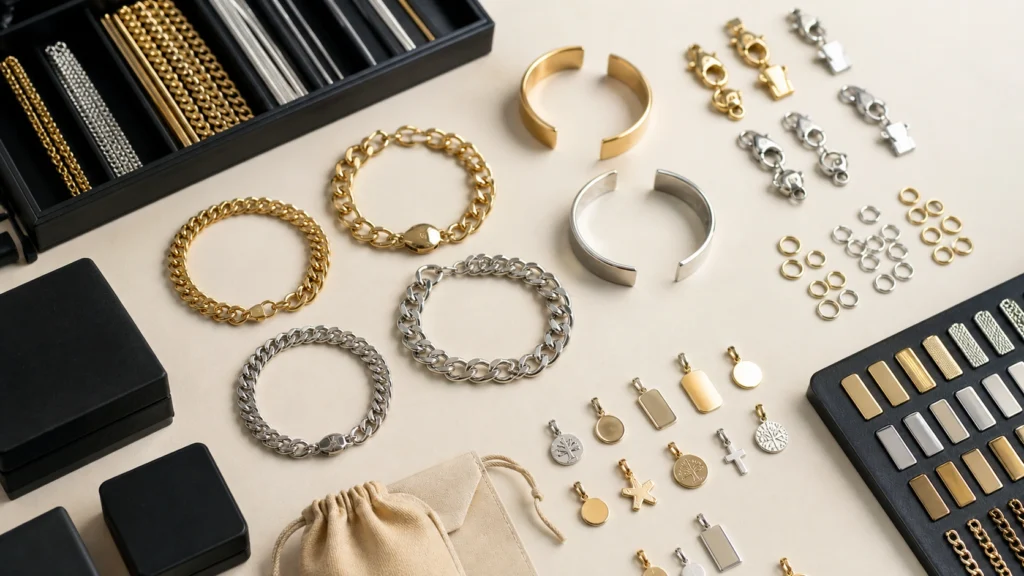
There is no universal MOQ or lead time for a custom bracelet. Both depend on the approved construction, material, finish, tooling, component availability, number of variants, packaging, testing, and order allocation. A useful supplier answer should therefore state what the minimum applies to—one design, one finish, one size, one component, or the total order—and identify when the production clock starts. Buyers get a more reliable quotation by freezing the bracelet specification, separating sample development from bulk production, and disclosing the SKU breakdown, target market, packaging scope, and required delivery point. Jinnuo Jewelry’s exact MOQ and schedule should be confirmed only after project-specific feasibility review.
First Identify Which “Minimum” Is Controlling the Order
MOQ is often discussed as one number, but a bracelet order can contain several linked minimums. For brands comparing manufacturers or planning a launch, the first task is to find the constraint that actually governs the order.
| Minimum layer | What it may apply to | Why it matters to the buyer | Typical decision trade-off |
|---|---|---|---|
| Product minimum | A bracelet construction or design | Determines whether the design can enter bulk production | Reducing quantity may require a less customized route or different allocation |
| Variant minimum | A finish, size, stone color, or charm version | Controls how total units can be divided | More variants increase merchandising choice but reduce volume per variant |
| Component minimum | Custom chain, clasp, charm, casting, stone, or branded part | A component supplier or process may require its own production quantity | Shared parts can reduce fragmentation but limit design independence |
| Finish or process batch | Plating color, coating, polishing treatment, enamel, or another batch operation | Small splits can create separate setups and color approvals | Fewer finish batches improve consistency but narrow the assortment |
| Packaging minimum | Card, pouch, box, insert, print method, or label version | Packaging may have a different supplier and minimum from the bracelet | Custom packaging strengthens presentation but can create leftover stock |
Ask the supplier to identify each applicable layer rather than reporting only a total. If the total order meets the product minimum but each plating color falls below a process or component minimum, the quote may still be incomplete. Conversely, a shared bracelet body with several packaging labels may be easier to allocate than several structurally different bracelets.
These are general sourcing mechanics, not Jinnuo-specific thresholds. No numerical MOQ should be inferred from the product category or from another buyer’s order.
Use a Constraint Map Before Cutting Quantity
When a proposed order does not fit the available minimums, reducing the total is not the only lever. The right adjustment depends on what is causing the minimum.
If custom tooling or a new component is the constraint
This applies to brands seeking original geometry, exclusive findings, or a new branded element. The main trade-off is differentiation versus development commitment. Options to evaluate include simplifying the construction, using an existing compatible component, sharing a component across several SKUs, or keeping the custom element and consolidating the launch around fewer designs. Any option still requires feasibility confirmation; an existing component is not automatically compatible with the desired load, finish, or dimensions.
If finish or color splitting is the constraint
This applies when one bracelet is divided among several plating colors or decorative treatments. Consolidating into fewer finishes can improve volume concentration and reduce approval points. The trade-off is a narrower color offer. A buyer should not assume that unlike finishes can be combined into one process batch merely because the base design is identical.
If the size range is the constraint
This is relevant to fixed-length chain bracelets, bangles, and cuffs with multiple fit variants. An extender or adjustable construction may consolidate some sizes, but it changes appearance, function, component count, and inspection needs. For rigid forms, reducing size options may exclude part of the intended customer base. The choice should follow verified fit requirements rather than MOQ alone.
If packaging is the constraint
This applies when a custom box, insert, printed card, or versioned label has a separate minimum. A neutral shared package with variable labels may reduce fragmentation, while a fully customized package can support brand presentation. The trade-off is between launch flexibility and packaging differentiation. Product protection and traceability must remain intact in either route.
The Custom Bracelets page establishes the relevant product scope, while the materials and finishes overview provides context for material discussions. Specific constructions, materials, and processes still require review.
Lead Time Is a Dependency Chain, Not One Continuous Block
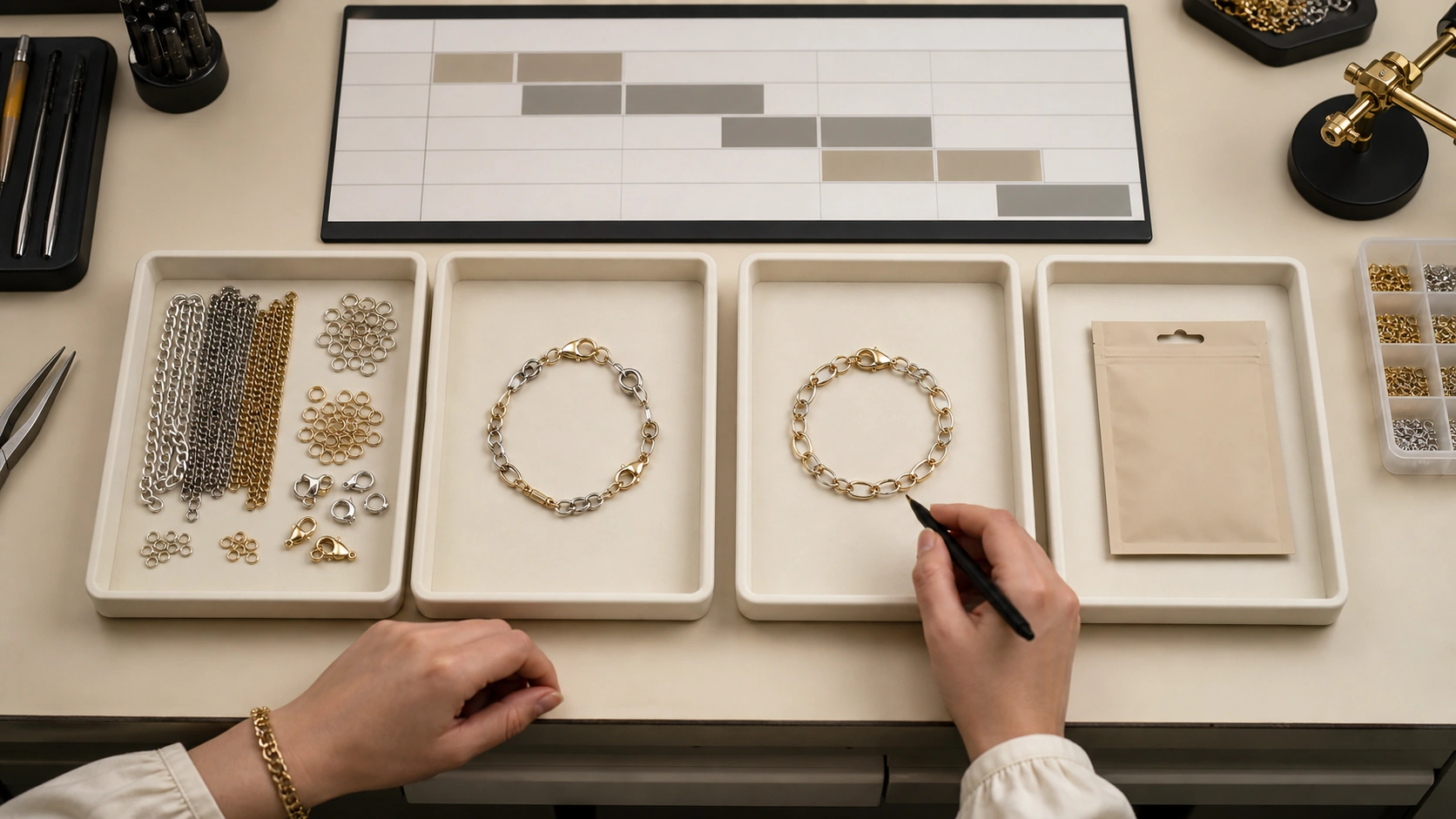
A quoted lead time is meaningful only when its start point, end point, and assumptions are defined. Buyers should separate development time from bulk production time and map the dependencies between them.
complete brief → feasibility decisions → CAD/tooling if required → sample inputs → physical sample → buyer review → revisions if any → written approval → bulk inputs → production and finishing → inspection → packaging → release
Not every bracelet follows every step. A simple adaptation using compatible existing components may have fewer development dependencies than an original hinged bangle, custom charm system, or multi-finish design. The supplier should confirm the route after reviewing the project.
Development clock
Define whether development begins when an inquiry is received or only after the specification, artwork, commercial terms, and required payment or authorization are complete. The development clock may depend on CAD approval, tooling, component sourcing, sample construction, finish trials, packaging samples, buyer review, and revision rounds.
For buyers, the key responsibility is response readiness. A sample waiting for consolidated comments is not active manufacturing time. Name the decision owner, schedule the review window, and return one version-controlled comment list.
Bulk clock
Define whether bulk lead time begins at purchase-order confirmation, deposit, final sample approval, specification freeze, receipt of buyer-supplied materials, or another documented trigger. Bulk work can depend on material and component availability, process sequencing, production allocation, finishing, quality checks, packaging readiness, and release approval.
The requested delivery date also needs a boundary. “Ready to ship,” factory departure, freight handoff, customs clearance, and arrival at the buyer’s warehouse are different milestones. Freight and customs should not be silently included in a factory production estimate unless the quoted scope expressly includes them.
MOQ Decisions Can Change the Schedule
MOQ and lead time are connected, but not in a simple “larger is always slower” formula. Quantity changes can alter material purchasing, component production, batch allocation, inspection workload, packaging requirements, and production planning. Smaller quantities can also be inefficient when they retain all the setup, tooling, color, or packaging complexity of a larger order.
Use scenario-based questions:
- For a first launch with uncertain demand: ask whether concentrating volume into fewer designs or finishes produces a more workable order. This can reduce SKU fragmentation, but it places more inventory in each selected option.
- For a wide assortment: ask which components and finishes can genuinely be shared. Shared inputs may simplify allocation, but one delayed component can affect several SKUs.
- For a fixed launch date: ask which features sit on the critical path and which optional changes can be deferred. Simplification may protect schedule confidence, but it can reduce differentiation.
- For a reorder: confirm whether the original tooling, component source, finish system, artwork, and packaging remain available and approved. A reorder is not automatically identical in timing to the first production run.
This analysis is for planning, not a promise of a particular outcome. The actual schedule should be confirmed against current project conditions.
Normalize Supplier Quotes Before Comparing Them
Two quotes can show different MOQs or lead times because they describe different scopes. Before comparing suppliers, put each answer into the same worksheet.
| Quote field | What a usable answer should clarify | Hidden mismatch to watch for |
|---|---|---|
| Product scope | Exact bracelet design and approved revision | One quote is based on a reference image; another includes engineered details |
| MOQ basis | Per design, size, finish, component, package, or total order | Total quantity appears equal but variant rules differ |
| Included variants | Sizes, finishes, stones, charms, and packaging versions | A low minimum excludes the planned split |
| Development scope | CAD, tooling, samples, finish trials, and packaging sample | Sample work is excluded or assumed complete |
| Clock start | The documented event that starts the estimate | Supplier and buyer use different start dates |
| Clock end | Sample ready, bulk ready, factory departure, or delivered date | Logistics is included in one answer but not another |
| Approval allowance | What buyer reviews or revisions are included in the schedule | Buyer decision time is omitted |
| Input assumptions | Material, component, artwork, packaging, testing, and buyer-supplied items | A critical input is treated as immediately available |
| Change rule | Which changes require requoting or rescheduling | The schedule appears fixed despite an unfrozen design |
A shorter stated lead time is not automatically the better offer if its clock starts later, ends earlier, or excludes work included elsewhere. A lower stated MOQ is not necessarily usable if each finish, size, or custom package must meet a separate minimum.
Know Which Changes Reset the Estimate
The highest schedule risk often appears after a preliminary quote, when the project scope continues to move. Require an impact review when a change affects any of the following:
- bracelet construction, dimensions, weight, or fit system;
- base material or component material;
- chain, clasp, jump ring, hinge, charm, stone, or branded part;
- finish color, surface preparation, texture, or decorative process;
- size, plating, stone, or packaging allocation;
- logo artwork, position, scale, or application method;
- testing, labeling, documentation, or destination-market requirements;
- unit packaging, insert, barcode data, or master-pack configuration;
- buyer-supplied components, artwork, or approval timing;
- requested delivery milestone or shipping scope.
For each change, record whether it affects feasibility, tooling, sample approval, material purchasing, MOQ allocation, unit cost, production sequence, testing, packaging, or delivery. Do not preserve an old date on a new scope without written confirmation.
The Jewelry Sampling Service is the appropriate internal reference for sample development context, and the manufacturing process explains the broader path from development to production. Neither page establishes a universal timeline for this project.
Send a Quote Brief That Can Produce a Qualified Answer
A supplier can assess MOQ and lead time more reliably when the brief includes:
- drawings, CAD, annotated references, or a physical sample;
- bracelet type, dimensions, fit range, weight target if relevant, and construction details;
- base material and component requirements;
- finish, surface, stones, enamel, charms, or other decorative details;
- clasp, extender, hinge, opening, and connection specifications;
- logo artwork and intended application;
- total expected quantity plus the design, size, finish, and packaging breakdown;
- packaging structure, printed versions, labels, and barcode ownership;
- destination market, sales channel, and any buyer- or retailer-defined testing/documentation requests;
- target milestone and the exact delivery point it refers to;
- which specifications are final and which require manufacturer recommendation.
Jinnuo Jewelry’s verified capabilities include custom bracelets, OEM, ODM, OBM, private-label work, sampling, bulk production, logo customization, and custom packaging, with 925 sterling silver and brass as confirmed core materials. This does not establish a standard MOQ or lead time. Submit the complete scope through the custom jewelry quote request so feasibility, minimums, allocation rules, price, tooling, testing, packaging, and schedule can be confirmed for the specific project.