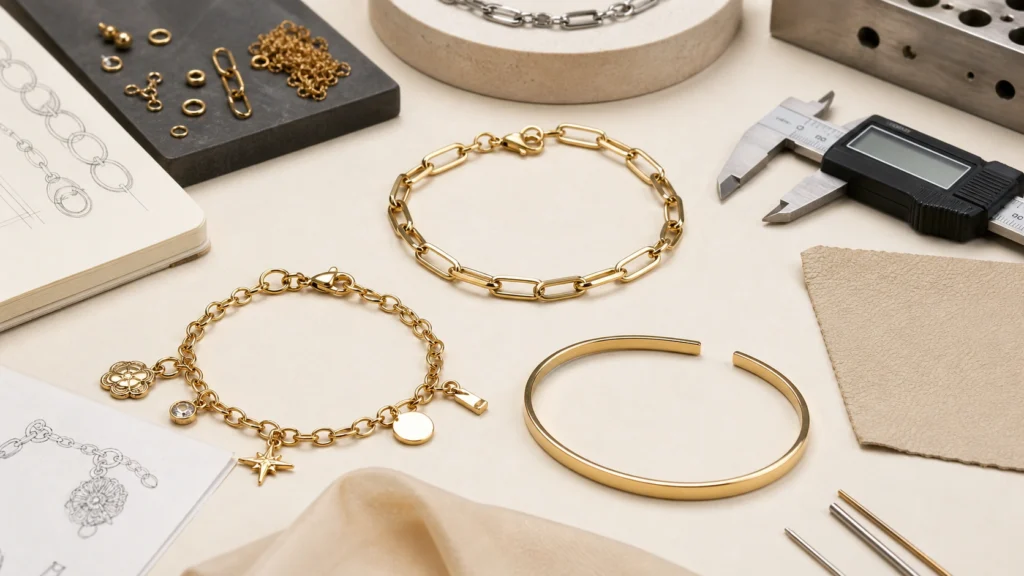
To start a private label bracelet collection, define one customer and wearing occasion, select a small set of bracelet constructions, build a wrist-size system, and specify every functional component before requesting samples. Treat the bracelet as a system: chain or band, clasp, extender, jump rings, charms, stones, logo, finish, and packaging must work together. Approve complete, wearable samples against a written specification—not appearance alone—before bulk production. The right material, quantity, price, tooling, testing, and schedule depend on the design and target market and should be confirmed after a feasibility review.
Build the Assortment Around Wearing Behavior
A bracelet range becomes difficult to control when every SKU uses a different construction. Begin by deciding how the customer will wear the collection: one everyday piece, a stack, an adjustable gift, or a statement cuff. That decision should govern the architecture of the range.
Use a limited number of construction families and give each a commercial job. A fine chain bracelet can be the quiet core style; a compatible charm version can add variation without changing the entire fit system; a cuff can provide a stronger visual anchor but needs a separate size and deformation review. A rigid bangle is not merely another visual option—it introduces different entry, diameter, shape, and packaging decisions.
| Construction | Best suited to | Critical decisions | Main trade-off |
|---|---|---|---|
| Chain bracelet with extender | Brands needing adjustable fit or gifting flexibility | Finished length, extender range, clasp reach, end weight | More fit flexibility, but more moving connections to inspect |
| Fixed-length chain bracelet | A tightly defined size offer | Wearable circumference, clasp allowance, size grading | Cleaner specification, but less forgiving fit |
| Hinged or slip-on bangle | Structured, repeatable silhouettes | Internal dimensions, entry method, hinge/lock if used | Strong shape, but sizing and mechanism risk increase |
| Open cuff | Style-led ranges with controlled adjustability | Opening, spring behavior, edge comfort, intended adjustment | Easy entry, but repeated bending can distort some designs |
| Charm bracelet | Storytelling or collectible programs | Charm spacing, orientation, snag risk, connection security | High variety, but component and inventory complexity grows |
This is general assortment guidance, not a promise that every construction or modification is suitable for every project. Jinnuo Jewelry’s verified scope includes custom bracelets and private-label, OEM, ODM, and OBM business models; a specific construction still requires review.
Lock a Size System Before Styling Variants
Bracelet “length” can describe the laid-flat product, while buyer comfort depends on wearable circumference, component thickness, wrist shape, and desired ease. A thick chain and a fine chain with the same laid-flat length may not fit the same way. Rigid bracelets require internal dimensions rather than a chain-style measurement alone.
Create a measurement convention before sampling:
- Name the dimension being measured: end-to-end length, closed inner circumference, internal diameter, cuff opening, or extender range.
- State whether the clasp and end components are included.
- Define the intended wrist range and fit character: close, regular, or loose.
- For bangles, record internal shape and both relevant internal axes when the form is not circular.
- For cuffs, specify the opening and whether the wearer is expected to adjust it. Do not assume repeated bending is harmless.
- Identify which dimensions are controlled and how they will be checked; tolerance and measurement method should be agreed for the project.
Do not multiply sizes casually. Each added length can affect SKU count, labels, packaging, stock allocation, photography, and replenishment. An extender can consolidate some fit coverage, but it changes the product visually and creates extra joints. It is most appropriate when adjustability outweighs the cleaner look of a fixed length.
Reduce Variation at the Component Level
Visual consistency is not enough; collection-level control comes from shared engineering decisions. Map each SKU as a component stack:
main body → connector → clasp or opening → adjustment element → decorative element → brand mark
Then look for controlled reuse. Sharing a clasp family, connection method, logo tag, finish reference, or compatible chain across several styles can simplify approvals and reorders. It can also create a single point of failure, so the shared component must suit the heaviest or most demanding relevant style—not just the lightest sample.
Material selection should follow structure and positioning. Jinnuo Jewelry has verified capability in 925 sterling silver and brass. Their suitability still depends on geometry, finish, wear expectations, cost position, and target-market requirements. Stainless steel or other materials should only be discussed after the specific production or partner-supported scope is confirmed. Review the site’s materials and finishes overview for the available buyer context, then obtain project-specific advice.
Three bracelet-specific conflicts deserve early review:
- Clasp access versus scale. A small clasp may look refined but be difficult to operate, especially with one hand. A larger clasp can improve use while changing the visual balance.
- Charm movement versus connection security. Free movement adds character, but poorly selected rings can rotate, open, abrade, or let charms bunch together. Connection design and assembly method should be assessed together.
- Finish consistency across mixed parts. Chain, cast elements, clasps, and findings may present surface color and polish differently. Approve the complete assembly under controlled viewing conditions rather than isolated components.
Make the First Sample Answer Failure Questions
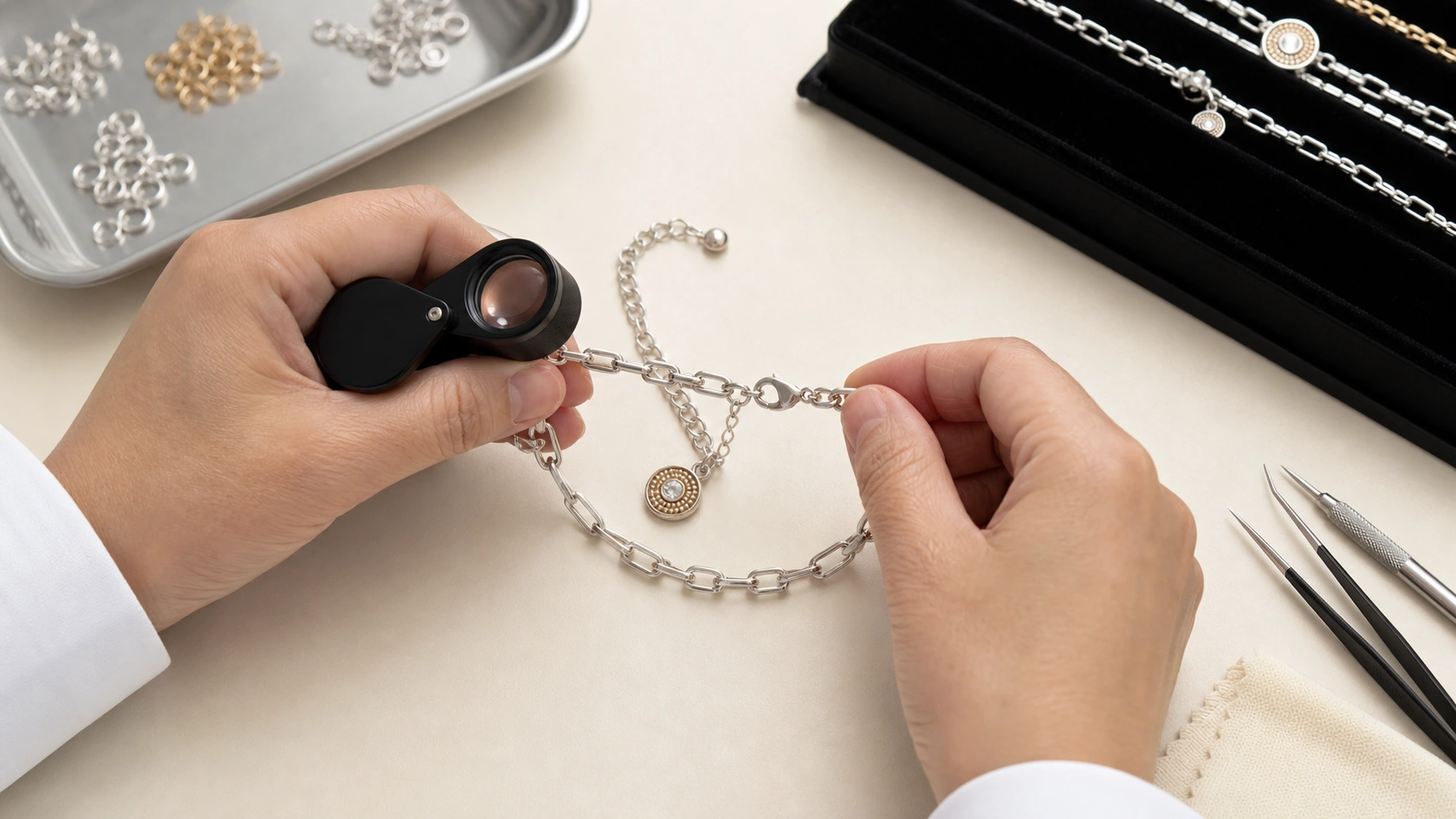
A beauty sample answers only whether the idea looks attractive. A development sample should expose weak assumptions. Ask for a fully assembled bracelet in the intended size, construction, finish, branding configuration, and representative packaging so the team can evaluate interactions.
Use the following failure-mode review:
| Failure mode | Likely cause to investigate | Buyer-side approval evidence |
|---|---|---|
| Bracelet rotates or focal element sits off-center | Weight imbalance, connector position, excess ease | Worn photos/video on the intended wrist range and approved orientation |
| Clasp is hard to operate | Scale, lever access, chain flexibility, end-component placement | Recorded one-hand use check under agreed conditions |
| Charm or connector snags | Open geometry, sharp transition, unsuitable spacing | Close inspection and wear simulation relevant to the use case |
| Cuff loses shape | Material/section behavior or repeated over-adjustment | Agreed adjustment instructions and sample checks after defined handling |
| Finish varies between components | Different substrates, processes, polish, or geometry | Complete assembled reference viewed under consistent light |
| Bracelet tangles or scratches in the pack | Loose retention, contact between pieces, excess chain movement | Approved packed sample after handling and transport simulation appropriate to the project |
The buyer should define what counts as acceptable before the sample is approved. “Looks good” does not establish fit, clasp operation, connection security, surface acceptance, or packaging retention. Testing scope and acceptance methods vary by product and destination market; they should not be assumed from general industry practice.
The Jewelry Sampling Service provides relevant context for development support, but exact sample stages, revisions, cost, and timing must be confirmed for the project.
Approve a Stack, Not Only Individual SKUs
If the collection is intended for layering, evaluate combinations as deliberately as individual pieces. Two acceptable bracelets can fail as a stack because rigid edges collide, charms trap fine chain, surface finishes rub, or closures accumulate at the same point.
Create a small compatibility matrix using the combinations you will actually merchandise. For each pair, record:
- whether both pieces can move without persistent tangling;
- whether hard edges or stones contact a vulnerable surface;
- whether focal elements remain visible;
- whether the combined weight and bulk suit the target wearer;
- whether the set fits the planned card, pouch, insert, or box;
- whether separate packing is needed to control contact during transit.
This check is useful for brands selling coordinated sets or showing stacked imagery. It is less important for a collection positioned around single-piece wear, where the extra packaging and compatibility work may add complexity without buyer value.
Freeze the Reorder Specification Before Quoting Bulk
Once a sample is accepted, convert the decisions into a controlled handoff. A production-ready bracelet specification should identify:
- SKU and approved sample reference;
- dimension convention, target size, and agreed measurement method;
- base material and each component material where relevant;
- chain, band, bangle, or cuff construction;
- clasp, extender, connectors, charm attachments, hinge, or lock details;
- finish, surface texture, and approved comparison reference;
- stones or decorative components and their locations;
- logo artwork version, method, scale, and placement;
- packaging retention, contact protection, labels, and SKU mapping;
- approved exceptions and open issues;
- target market plus any buyer, retailer, testing, labeling, or documentation requirements;
- change-control rule for substitutions or process changes.
Request the final quotation against that frozen scope. MOQ, price, tooling, sampling time, production time, and packaging cost vary by material, process, quantity, and project requirements; no universal figures should be inferred. If any component, finish, artwork, size rule, or packaging method changes later, reopen the affected approval rather than treating the original sample as proof.
A Practical Go/No-Go Gate
Proceed to bulk planning only when the team can answer “yes” to all of these questions:
- Does every SKU have a role and an intended wearing behavior?
- Is the measurement convention unambiguous for flexible, rigid, or adjustable styles?
- Have clasp access, connectors, focal orientation, edges, and adjustment behavior been reviewed?
- Has the complete assembly—not isolated parts—been approved for appearance and function?
- If stacking is part of the offer, have the marketed combinations been checked together?
- Does packaging retain and separate the product as needed?
- Are the approved physical reference and document versions connected?
- Are target-market and buyer-specific requirements identified for separate confirmation?
- Will substitutions or changes require written review?
Jinnuo Jewelry can review a private-label bracelet brief within its confirmed custom-bracelet and development scope. Start with the Custom Bracelets page and send the size system, constructions, component map, artwork, packaging concept, target market, and expected quantity through the custom jewelry quote request. Feasibility, exact specifications, quantity, price, tooling, testing, and timing should be agreed before sampling or production.