Choose a custom jewelry manufacturer by testing whether it can make one real product to your specification and repeat it in production. Start with a clear brief, request comparable quotes, review a physical sample, and check how changes and quality will be controlled. A polished portfolio or low unit price is not enough evidence.
The right choice depends on your product, order pattern, target market, and the work you expect the manufacturer to perform. Use the process below to compare candidates on the same facts.
Your Product Brief Is the First Filter
Define the product before you build a supplier list. A factory cannot give a useful answer when the request is only “custom jewelry” or “gold-plated collection.” The brief should show what the product is, what must stay fixed, and where you need development help.
Answer these questions first:
| Decision | What to state | Why it changes the shortlist |
|---|---|---|
| Product and construction | Ring, earring, necklace, or bracelet; cast, stamped, formed, assembled, stone-set, or mixed | Different constructions require different equipment, skills, components, and checks |
| Material and finish | Intended base metal, surface finish, color direction, stones, and any buyer-specified components | Material and finish choices affect feasibility, sampling, testing, cost, and care requirements |
| Development starting point | Sketch, reference sample, CAD, technical drawing, or production-ready specification | A factory that develops from a concept provides a different service from one that produces to fixed files |
| Order pattern | Number of designs, size or color variants, quantity by SKU, and expected reorder pattern | A total order can look suitable while each variant falls below a workable production batch |
| Sales destination | Target market, channel, packaging, labeling, and evidence the buyer needs | Product and documentation requirements depend on where and how the jewelry will be sold |
Also state your non-negotiables. These may include a clasp type, logo position, stone size, product weight range, finish reference, or retail pack. Separate them from features that may change after a feasibility review. This gives the manufacturer room to suggest a workable solution without changing the identity of the design.
Use the same brief for every candidate. Otherwise, the resulting prices and schedules will describe different products. This keeps the first check fair and helps both teams see why a quote may not fit the job. It also cuts time spent on weak bids.
Test Technical Fit with One Representative SKU
Choose the SKU with the most important production risk. It may be the product with a moving part, a difficult finish, a stone-setting detail, or a feature that customers will notice immediately. It does not have to be the bestseller or the most ornate design.
For example:
- A chain bracelet with a branded clasp tests component sourcing, closure function, link movement, logo placement, and finish coverage around moving parts.
- A stone-set ring tests CAD interpretation, seat geometry, setting, polishing around the stones, and size consistency.
- A hollow hoop tests forming, seam finishing, post alignment, pair matching, closure action, and surface preparation.
- A flat stamped pendant tests tool definition, edge finishing, hole position, soldered parts, flatness, and finish coverage.
Ask each manufacturer to explain how this SKU would move from your current files to an approved sample. The answer should identify the main steps, information still needed, features that may need adjustment, and work performed outside the quoted factory.
A portfolio is useful for finding possible candidates. It is not proof that a supplier can produce your construction, material, finish, and order pattern. Look for evidence tied to the representative SKU: a relevant process explanation, comparable sample work, sensible follow-up questions, and clear limits.
Make the Sample Answer Five Buying Questions
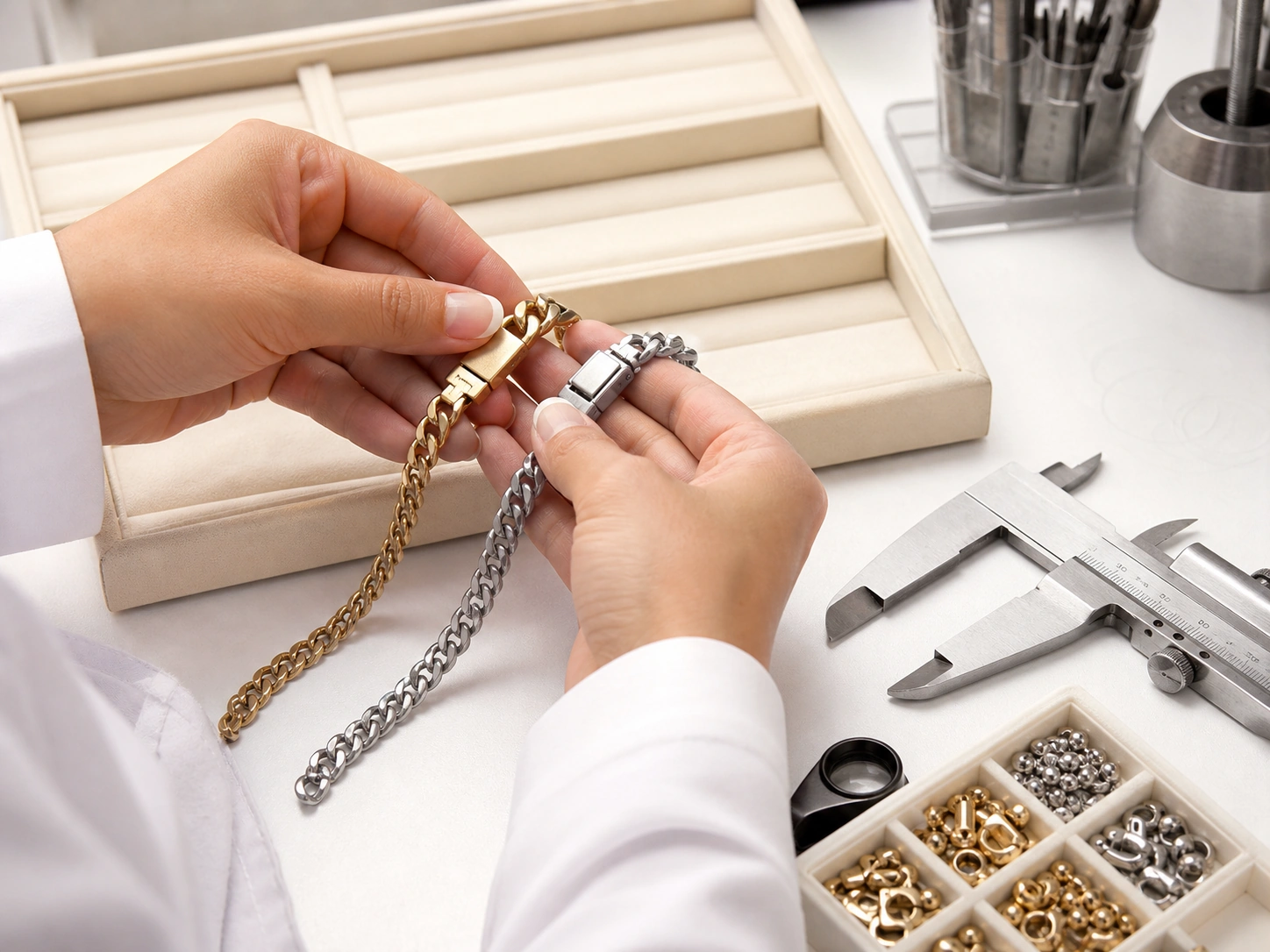
The sample is not only a beauty check. It should answer whether the manufacturer understood the brief and whether the proposed production route is suitable.
Review it in this order:
- Is it the product you specified? Compare dimensions, proportions, material, components, stone details, logo, and size with the current brief. Record which file and revision you used.
- Does it work as intended? Test clasps, hinges, posts, jump rings, moving links, fitted parts, and comfort points. A visually accurate bracelet can still fail if the clasp is awkward or the links catch during wear.
- Does the finish match the agreed reference? Check broad faces, edges, recesses, soldered areas, and contact points under consistent light. A front-view photograph does not show full finish coverage.
- Are there signs of a construction problem? Look for misalignment, sharp edges, excess solder, pits, distorted thin areas, loose stones, weak contact between fitted parts, or polishing that has removed detail.
- Can the result become a production reference? The approved sample should connect to a named drawing or CAD revision, component list, finish reference, packaging setup, and inspection points.
Photograph each issue at close range and again in context. Number the comments and state the requested result. “Move the logo 1 mm toward the clasp, subject to feasibility” is more useful than “logo looks wrong.” Keep accepted features on the revision list as “no change” when a nearby correction could affect them.
Do not assume one excellent sample proves bulk consistency. A sample may receive extra bench work. Ask what will keep production aligned with the approved version.
Compare Quotes on the Same Scope
The lowest unit price may exclude work that another quote includes. Before comparing numbers, place every offer into the same scope table.
| Quote item | Confirm in writing | Common source of mismatch |
|---|---|---|
| Development | CAD, engineering review, sample work, revisions, tooling, and ownership or access to files | One quote includes development while another starts from production-ready files |
| Product | Material, components, stones, finish, logo, size, and weight basis | Similar descriptions hide different components or finish specifications |
| Quantity | MOQ basis, quantity per design or variant, and price tiers | A total quantity is mistaken for the minimum that applies to each SKU |
| Quality and evidence | Approval sample, inspection scope, reports, testing, and who pays for retesting | “QC included” does not identify checks or acceptance rules |
| Packaging | Individual protection, branded pack, labels, barcode work, and carton preparation | Product price is compared with a packed, retail-ready price |
| Delivery | Production completion point, shipping term, destination, and responsibilities | Suppliers quote different handover points or exclude freight and import costs |
| Timing | When the clock starts, approval dependencies, and what can reset the schedule | A production estimate is compared with a full development-to-delivery plan |
Exact MOQ, price, sample cost, tooling, lead time, testing, and payment terms depend on the project. Confirm them after the manufacturer reviews the design, variant breakdown, packaging, and delivery requirement.
Pay attention to how assumptions are handled. A strong quotation identifies what is fixed, estimated, optional, or excluded. This is more useful than a precise number based on an incomplete brief.
Check What Happens After Sample Approval
Supplier selection is not complete when the sample looks right. Ask how the approved result will be carried into bulk production and later reorders.
You need clear answers to four areas:
- Production reference: Which drawing, sample, component list, finish reference, and packaging setup control the order?
- Change approval: Who can approve a substituted clasp, stone, material lot, finish process, packaging item, or production-site change?
- Inspection: Which features are checked during production and at final inspection? Which are measured, and which are compared visually or functionally?
- External work: Are plating, stone setting, chain production, testing, packaging, or other steps outsourced? If so, how are the SKU, quantity, specification, and returned lot tracked?
Outsourcing is not automatically a problem. An external specialist may be suitable for a particular operation. The buyer needs visibility because a handoff can separate the product from its current specification.
Ask for capacity and timing in the context of your planned SKU mix. A general monthly capacity claim does not show whether the factory has the right line, bench skill, component supply, or subcontractor slot for your order. Discuss what happens when the quantity, variant count, or finish mix changes.
Treat certificates and test reports in the same way. Match the legal entity, site, scope, product or sample, material, method, date, and status to the claim you need to verify. IAF CertSearch provides a route to check accredited management-system certificate information, but a management-system certificate does not prove that a specific jewelry SKU passed a product test. The buyer remains responsible for defining the evidence required for the destination market.
Jinnuo Jewelry’s verified site scope includes CAD and product development, sampling, bulk production, custom packaging, and quality control. You can review its manufacturing process and jewelry sampling service. The exact in-house or partner-supported route still needs confirmation for each design.
Use Pass-or-Fail Rules Before Scoring Trade-offs
Reject a candidate before scoring if it fails a requirement that the project cannot safely trade away. Examples include an unsupported material or construction, refusal to make or document a sample, an unexplained legal-entity mismatch, or no workable way to control a brand-critical feature.
Then compare the remaining manufacturers using criteria that match the product:
| Decision area | Evidence to compare | Main trade-off |
|---|---|---|
| Product fit | Representative-SKU response, relevant sample, and stated process limits | More development support may cost more or require additional approvals |
| Sample quality | Match to the brief, function, finish, construction, and revision handling | More sample rounds can improve clarity but add cost and time |
| Production control | Approved references, inspection points, change rules, and outsourced-step visibility | More documentation requires effort from both supplier and buyer |
| Commercial fit | Normalized quote, MOQ basis, schedule conditions, payment, packaging, and delivery scope | A lower unit price may require a larger commitment or narrower service scope |
| Working fit | Specific answers, named contacts, issue escalation, and version discipline | Fast replies matter less than accurate answers that remain consistent |
Consider a brand launching a ring, pendant, and bracelet. If the bracelet has a custom moving clasp and drives most return risk, it should carry more weight than the simpler pendant. A supplier with the lowest average price may still be the wrong choice if its clasp solution remains untested. Another supplier may be stronger for the bracelet but less competitive for the pendant. The brand can choose one lead manufacturer, split categories, or simplify the collection; each option changes coordination, cost, and consistency.
The final decision should be traceable to evidence, not confidence in a sales call. For a project-specific review from Jinnuo Jewelry, send the representative SKU and current files. Add the material and finish direction, variant quantities, target market, packaging scope, and desired delivery point through the custom jewelry quote form.

Carol
Carol is a jewelry manufacturing expert with first-hand experience across materials, surface finishes, production processes and quality control. He brings critical thinking and rigor to his work, questioning common assumptions and testing them against industry standards and real production results. He looks at every issue from the point ofview of the people who buy and wear jewelry, turning technical details into clear, practical answers to real-world problems.