

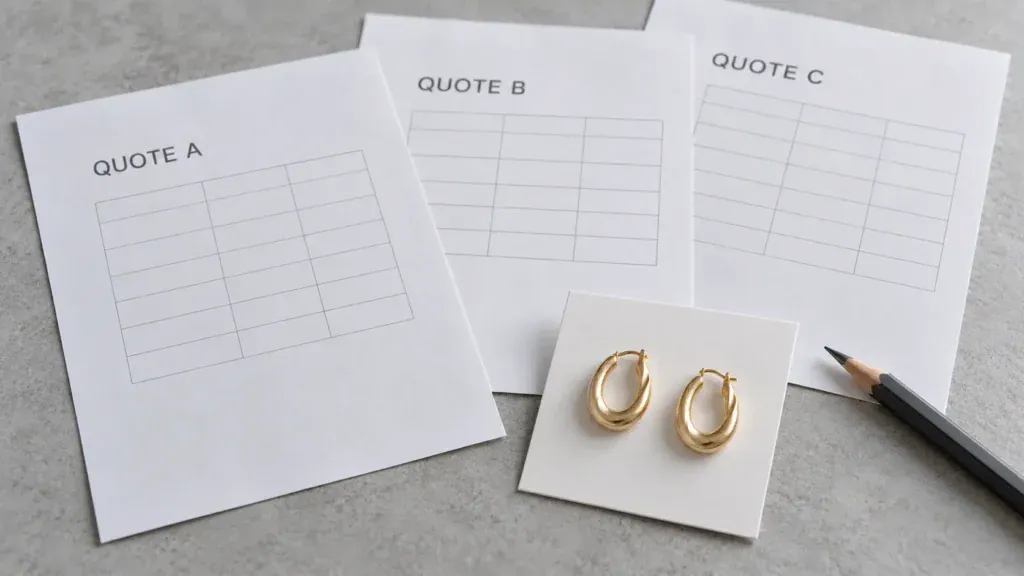
An illustrative first-time buyer scenario:
I’m preparing the first production order for my jewelry brand. I’ve found a few manufacturers on Alibaba and through Google, sent them the same design and received their quotes. I thought I was ready to choose a supplier.
Now I’m not so sure. One offers a much lower unit price. Another costs more but says its materials and quality control are better. Some quote development and shipping separately; others do not make those costs clear.
I haven’t bought jewelry in bulk before. I can see the price differences, but I don’t know whether I’m comparing the same thing. If I choose the cheapest, am I missing something? If I pay more, how do I know what the extra money buys?
Before I pay a deposit, I need to understand what each quote includes, what I might still have to pay and which questions will help me make a fair comparison.
What Should a Jewelry Manufacturing Quote Include?
First, clarify the agreed-upon product specifications, order quantities, and units of sale. Taking earrings as an example: does “per piece” refer to a single earring, or to a complete pair—including the earring backs? Before calculating or comparing prices, ensure you have a precise understanding of what exactly is included in each unit.
The U.S. International Trade Administration’s quotation guidance lists unit prices and extended totals, product weights and dimensions, delivery terms, payment terms and a validity date. For a jewelry order, use the following checklist to clarify the scope behind those figures.
| Cost area | What to confirm |
|---|---|
| Product price | Materials, stones, plating or finish, assembly and all required components; price per agreed unit and total for the specified quantity. |
| Development and tooling | CAD, samples, masters, molds or special tools; what is included, what is charged separately and when a fee would apply again. |
| Testing and inspection | Which agreed checks are covered, and whether specified laboratory tests or independent inspections require a separate fee. |
| Packaging | Transport protection versus branded cards, bags or boxes; labels and packing work. |
| Delivery-related costs | Shipping, insurance and applicable import-related charges; what is included and what you must arrange or pay separately. |
These do not all have to be separate charges. Mark each specific item—not just each cost area—as Included, Extra charge, To confirm or Not applicable.For items already included, please specify the corresponding price or total amount. A blank space does not signify a value of zero, and costs that are already included should not be counted again.
Also establish whether the price is fixed or an estimate. For example, Stuller’s CAD/CAM service terms base final pricing on actual item weight and the material selling price on the day of shipment. That is one supplier’s policy, not an industry-wide rule.
Ask the supplier:
“Please confirm the full scope of this quote, identify every separately payable charge and state which fees would apply again to an unchanged repeat order.”
You are comparing the promised order and the charges you would owe—not an assumed factory profit margin.
Why Can Quotes for the Same Jewelry Design Differ?
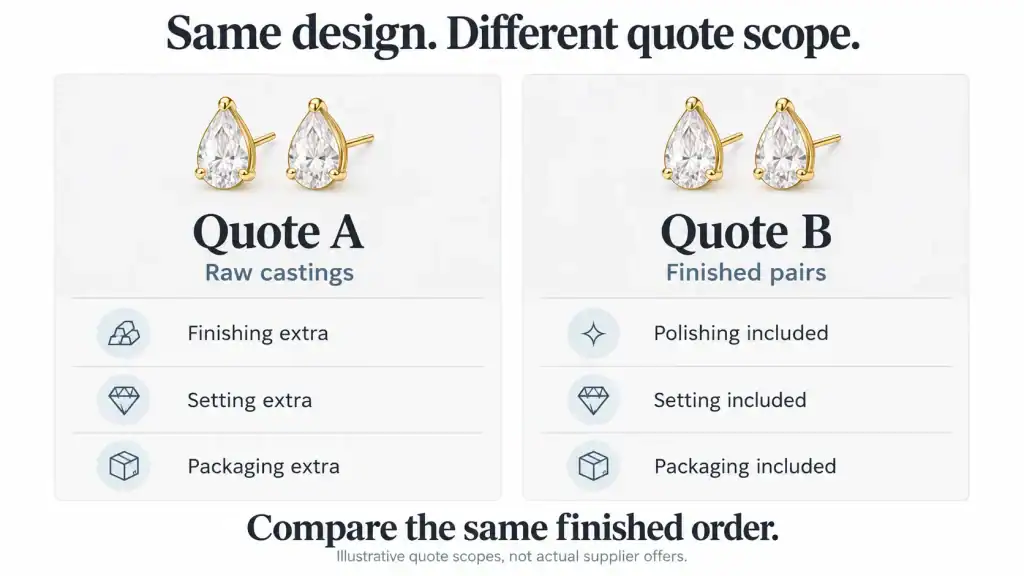
Once the included charges are clear, ask another question: are these comparable offers for the finished item you need?
It is not possible to reach a definitive conclusion based solely on reference images. Please review the differences outlined below to understand what accounts for the variations; furthermore, do not automatically assume that a lower-priced supplier is necessarily cutting corners.
| Price driver | What may differ | What to ask |
|---|---|---|
| Metal and construction | Alloy, metal weight and solid or hollow construction. | “Confirm each metal component’s alloy and solid or hollow construction. What is the finished metal weight per quoted unit, excluding stones and nonmetal parts? Is it estimated?” |
| Plating | Base metal, underlayers, gold layer and protective coating. | “Specify the base metal, underlayers and any protective coating. For the gold layer, give its karat, thickness and coverage. How is thickness defined, and where is it measured?” |
| Stones and components | Stone selection, setting work, clasps, posts and backs. | “List the included stones and components with their specifications. Does the quote include all setting and assembly?” |
| Finishing and assembly | The manufacturing route and the stage at which work stops. | “What will still need to be done after delivery, if anything?” |
| Quality-related work | Agreed checks, records and handling of nonconforming pieces. | “Which checks and records are included, and what happens to pieces that fail?” |
The stage of completion matters. Stuller’s custom wax casting service, For example, a supplier might provide raw castings or semi-finished castings that have undergone mechanical tumbling. Such descriptions do not guarantee that the products are fully processed and ready for sale. If a quote appears low but still requires you to arrange for further processing, it cannot simply be equated to a cost saving under equivalent conditions.
Different routes can also change the work involved. In a published workshop test, Daniel Grandi of Racecar Jewelry describes joining a school ring’s wax components before casting them as one piece, avoiding a difficult soldering operation in metal. The report does not give a price saving, but it illustrates why the same intended design need not involve identical operations.
The lesson is to match the required finished result, not insist on identical methods. Ask a supplier to explain its proposed route and confirm that the delivered item will meet the agreed specification.
If the specifications and scope are already aligned, do not resort to far-fetched arguments about “quality” to explain any remaining price difference.Suppliers can still have different costs and commercial pricing. A quotation alone does not tell you which supplier is more efficient, what its margin is or whether its quality is better.
How Much Can These Differences Change the Price?
Jeweler Yvonne Arritt’s account of moving into production work offers a useful warning against turning a production change into an automatic price change. Through several versions of one design, she reduced its making time from 30 minutes to eight. She explicitly rejected lowering its price just because it took less time to make.
That maker’s account is not a factory price benchmark. It shows why work saved and the price offered to a buyer are different numbers. A supplier’s efficiency improvement does not establish the discount you will receive.
The same principle of caution applies to the opposite scenario. Consider a calculation example: suppose the actual thickness of a gold layer increases from 0.5 microns to 2.5 microns. Assuming the plated surface area and the composition of the gold alloy remain constant, and that the gold layer is of uniform thickness, the mass of the deposited metal would theoretically increase by approximately five times. This refers to the physical thickness, not the “pure gold equivalent” thickness; therefore, this calculation does not reflect the total amount of gold consumed by the electroplating provider. Furthermore, this does not imply that the electroplating costs or the price of the finished jewelry will increase fivefold.
Nor should you assume that the additional deposit is the only change. Chris Corti’s technical paper on electroplating explains how thickness increases with plating time under controlled conditions. The option may involve more processing, not just more metal. The useful question is what changes in this order—not whether “five times as thick” sounds expensive.
Ask for the price of a defined change. Get a baseline and an alternative from the same supplier, rather than using the total gap between two suppliers as the price of one feature:
“Please quote both thickness options for the same order quantity and delivery terms, on the same metal-price basis. Specify what each order total includes or excludes. Keep other requirements unchanged and identify any necessary linked changes, extra charges or lead-time impact.”
Option price difference = revised order total − baseline order total.
Divide by the same number of quoted units for the per-unit difference. If the option also requires a different underlayer or testing plan, keep those changes visible; the difference is the price of the combined option, not thickness alone.
This gives you an order-specific amount to evaluate—not an industry-wide premium or proof of the supplier’s internal cost. You can then decide whether the specified change is worth paying for.
How Do Order Quantity and Reorders Affect Jewelry Quotes?
“Low quantity” does not fully explain why a quote might be on the high side. You need to determine whether the price difference stems from costs amortized across the entire project, tasks that must be performed repeatedly, or a vendor’s minimum commercial charge. Each scenario calls for a different approach.
First, distinguish a shared charge from work charged per piece. Under JI Casting’s published small-job schedule, labor is generally $40 per metal type up to 30 grams, plus $5 per item. Its examples are $45 for one casting and $55 for three in the same metal. These are one caster’s labor examples, not finished jewelry prices or industry benchmarks.
Within that same-metal, up-to-30-gram job, extra pieces share the first charge but still carry their own item charges. That is more useful than saying “volume lowers cost”: it shows which part of the bill changes. Ask whether a quantity break spreads a job-level charge, reduces the per-piece charge or does both.
Do not confuse a minimum quantity with a minimum charge. Evershiny’s terms allow limited mixing of ring sizes within its minimum, apply the same MOQ to first orders and reorders, and separately impose a small-order fee below an invoice-value threshold. Meeting the quantity minimum does not automatically remove the small-order fee. Likewise, reusing a mold does not guarantee the previous unit price.
If a different finish raises the quote, ask what actually changes: tooling, a finishing run or the supplier’s ordering conditions. More SKU codes are not, by themselves, evidence of an equal number of new molds or production setups.
A repeat tooling charge needs an explanation—not automatic rejection. International Manufacturing Company’s casting FAQ says changing a metal model’s sprues—the feed arrangement used for casting—requires a new mold for an additional fee, with recommended changes discussed in advance. So “we already paid for a mold” does not settle every later tooling bill. Request the existing tool or model version, the proposed change and a marked-up image showing why it is needed. This helps distinguish identified new work from an unexplained repeat charge.
To check the explanation, keep the design, quantities of each item, quality requirements and metal-price basis unchanged. Request these quotation options if available:
| Option | Production | Delivery |
|---|---|---|
| A | One run | One shipment |
| B | One run | Two shipments |
| C | Two separately scheduled runs | Two shipments |
Specify item quantities per run and A’s delivery date. Keep destination and shipping method unchanged and use the same shipment quantities and dates for B and C. Ask which charges change from A to B and from B to C, and why. Use quoted line items where available; otherwise compare the option totals and stated changes. Keep linked changes visible: these are price comparisons, not the factory’s internal cost accounts.
If B is close to A but C is higher, check any separately quoted production-run charges and ask what else changed. If the gap between A and B is larger than the gap between B and C, review delivery and storage first. This is a better starting point for negotiation than buying extra stock just to lower a unit price.
What Are You Paying for in Jewelry Quality Control?
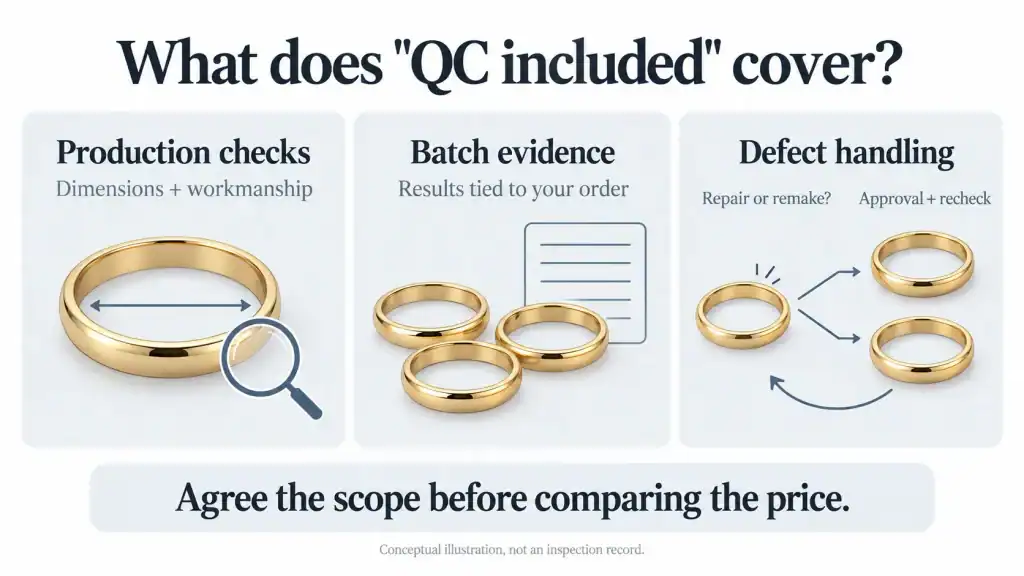
If a higher quote is presented with the claim that it includes “stricter quality control,” this implies more than just increasing the number of inspectors. It is worth asking for clarification: does the price cover the prevention of defects, the detection of defects, or the rectification of defects? These are distinct types of activities.
A final shine is not the same as controlled finishing. The Gem & Jewellery Skill Council of India’s polisher qualification pack includes checks during polishing for exposed casting porosity and over-polishing, while preserving important dimensions such as the ring’s inside diameter. This makes the task specific: inspect while material is being removed, rather than only approve the final appearance.
That distinction matters to the price discussion. ASQ classifies rework on defects found before delivery as an internal failure cost, separate from prevention and appraisal. More time spent correcting pieces is not, by itself, evidence of a better-controlled process. For polishing, ask whether the extra charge covers checks while material is removed or correction afterward. Ask each supplier to describe that work in the quote so you can compare the same task.
Define what happens when a defect is found. In a 2019 GIA account, appraiser Teri Brossmer recommended remaking a ring with extensive porosity. The customer returned with a supposedly new ring, but Brossmer identified solder filling the existing pores. The ring met her assessment criteria on a subsequent return.
This is not to say that any form of repair is unacceptable. The key distinction lies in the fact that “fixing defects” and “re-doing the work” fall into different categories of commitment. Both parties should clearly define which types of repairs are permitted, which require prior approval, under what circumstances a complete redo is mandatory, and how the final deliverable will be inspected. Consequently, two quotes that both claim to “include quality control (QC)” may actually cover vastly different scopes of work. You should ask each vendor to explicitly list the specific “permitted repairs” and the scenarios under which a “redo” is required. Before deciding whether a higher-priced quote truly offers greater value, be sure to compare these commitments.
For consistency, ask for production evidence—not just a good sample. An approved sample shows what was accepted on that piece; it does not establish the spread of results across a shipment or future batches. NIST explains that acceptance sampling primarily supports accepting or rejecting a lot, rather than estimating its quality level.
Before ordering, agree what records will accompany the goods: the inspected batch, selection method, characteristics checked, applicable limits and results. For measured dimensions, ask for readings rather than only “passed.” A claim of 100% inspection still needs a list of what is inspected; checking every piece visually is not the same as measuring every critical dimension.
Use a focused question:
“For this item, which checks happen during production and before shipment? What limits apply? What batch-linked results will you provide? Who approves repairs or remakes? Please identify what is included in the quote and any additional charge. Could you show a redacted completed record from a comparable job?”
Use past records to assess the method, not as results for your order. Compare the checks included, the batch evidence supplied and the agreed response to defects. A higher price alone does not show that the two offers differ in these respects. “We check more carefully” is not yet a comparable specification.
What Should You Ask Before Comparing Jewelry Quotes?
“Why is your price higher?” invites an explanation. Ask instead for an offer you can accept or reject: a revised quote tied to one product specification, with deviations and extra charges identified. You do not need a supplier’s profit margin to establish what its price buys.
Resolve specification differences before comparing prices.If a supplier proposes a casting weight that is lower than specified, or an electroplating thickness that differs from your requirements, ask them to provide separate quotes for your original specifications and for their proposed alternatives. If a supplier is unable to provide a product that meets your requirements, document this limitation. Even if the supplier explains why they prefer their alternative, it does not mean that the two options are functionally or technically equivalent.
A genuine report can still answer the wrong question. Consider an illustrative earring quote accompanied by a test report for a chain from another order. The report may be authentic; it does not, by itself, establish results for the earrings’ bodies, posts or backs.
PJLA’s reporting training explains that results relate to the items tested. If the customer supplied the sample and the laboratory did not perform the sampling, results apply to the sample as received. A customer-supplied batch reference therefore does not independently verify the sample’s origin. PJLA, Reporting Results.
Ask for sample descriptions, submission records or photographs linking the report to the quoted part, material and finish. These help identify what was tested; they do not independently verify its origin or show that it represents the whole batch. Without a clear link, treat the report as background only. For goods not yet made, agree on verification, sampling responsibility and cost—not a completed batch report that cannot yet exist.
Use a short follow-up with a clear consequence for each answer:
| Ask the supplier | Request in its reply | How to treat the quote |
|---|---|---|
| “Which specification revision have you priced, and where does your offer differ?” | An identified drawing/specification, component and finish details, stage of completion and a list of deviations. | Keep different specifications as separate options, not an unexplained price gap. |
| “Which agreed checks, reports and defect remedies does this price cover?” | Included commitments, separately priced items and any unresolved charges, referenced to the agreed requirements. | Compare the priced scope; distinguish promised work and reports from completed results. |
| “Please consolidate these answers into one revised quote.” | Price per piece/pair/set, quantities by variant, currency, included/excluded/pending charges, payment terms, delivery terms/location, validity and repricing conditions. | Keep unpriced items pending; confirm the revision being compared. |
The U.S. International Trade Administration’s pro forma guidance likewise lists unit prices, totals, delivery terms, payment terms and a validity date. ITA, Pro Forma Invoice.
Do not turn every unknown into a dollar allowance. Missing freight is a missing cost. An unspecified base metal or acceptance limit leaves the product or acceptance terms undefined. Resolve that difference before ranking totals: otherwise, the spreadsheet can look precise while comparing different promises.
How Do You Compare the Total Cost of a Jewelry Order?
Compare what you would pay for the same order delivered to the same point—not unit prices alone.
Keep the agreed specification, quantity, SKU mix, complete unit of sale, required services and destination fixed. Use one currency and a stated exchange-rate basis. The U.S. International Trade Administration’s landed-cost guidance includes goods, freight, insurance, duties, taxes and other fees, but the result remains an estimate. ITA, Determine Total Export Price.
Count each charge once. To calculate the subtotal for items, multiply the quantity of each product variant by its listed price, then sum the results. If any necessary charges are not already included, they must also be factored in.
Use the same worksheet for both suppliers. Consolidate all amounts payable (prior to any subsequent refunds or recoveries).For each item, record Included in [line], Extra [amount], To confirm or Not applicable, plus a quote reference. Split rows if items have different statuses.
| Comparison line | Supplier A | Supplier B |
|---|---|---|
| Goods subtotal for the agreed order | [Amount] | [Amount] |
| Development and tooling not already included | [Status; amount/reference] | [Status; amount/reference] |
| Required testing, inspection and packaging not already included | [Status; amount/reference] | [Status; amount/reference] |
| Freight, insurance and clearance services not already included | [Status; amount/reference] | [Status; amount/reference] |
| Applicable duties, taxes and other fees not already included | [Status; amount/reference] | [Status; amount/reference] |
| Other required payments not counted above, including refundable advances | [Status; amount/reference] | [Status; amount/reference] |
| Estimated first-order gross outlay before later refunds or recoveries | [Total, or pending] | [Total, or pending] |
| Estimated gross outlay per complete agreed unit | [Total ÷ agreed unit count] | [Total ÷ agreed unit count] |
Prepayments already reflected in a product invoice are considered part of that invoice; please ensure that shipping costs—if already included—are not counted twice. Necessary, refundable prepayments should be included but must be clearly distinguished from non-refundable charges. Any subsequent cash refunds or future invoice credits should be documented separately, with details regarding their confirmation status, amount, and date. None of these items should be deducted from the total amount, as that total encompasses both the funds you may potentially recover and any non-refundable costs.
Use the goods-price saving as a break-even limit. When, in a pricing proposal featuring a lower unit price for the goods, the additional charges exceed those of an alternative proposal by an amount exactly equal to the savings on the subtotal of the goods, the total expenditure for both options becomes equivalent. All separate, payable items—including any mandatory, refundable advance payments—must be factored into the calculation, while ensuring that no costs are double-counted. Any required payments for which no specific price is listed should be flagged for further clarification; consequently, both the total expenditure and the unit price remain indeterminate at this stage.
Equal freight costs do not mean equal delivery risk. Under CPT, the seller pays carriage to the named destination, but risk transfers when goods are delivered to the carrier arranged by the seller. Record the Incoterms® rule, version and precise named destination; for CPT, also record the delivery/risk-transfer point. Paying carriage to a destination does not mean bearing transit risk until arrival. ICC, Introduction to Incoterms® 2020.
When calculating unit expenditure, the basis should be the quantity of the current order only, excluding any anticipated future order volumes. If an order comprises multiple SKUs, an average value should be used rather than calculating the cost separately for each specific design. Furthermore, the date of payment must be recorded; even if the total amount is identical, the cash outlay required prior to delivery may vary. The figures compared here represent procurement expenditure—they are neither the factory’s production or manufacturing costs, nor the unit cost allocated based on the quantity of acceptable (received) products.
Which sourcing channel fits your order?
An unchanged hoop reorder and a small run of newly designed hinged earrings are different sourcing tasks, even at the same quantity. Choose channels by development needs and sourcing risk—not assumed platform price or quality tiers.
| Channel | Main advantage | Main drawback | When to use it |
|---|---|---|---|
Target a material or process rather than browse a general catalog: try brass jewelry casting manufacturer. | Requires independent screening; a well-marketed website does not establish production capability. | Original designs, specialist processes or finding alternatives to your current supplier. | |
| Yandex | A second search route for the same technical requirements. | Results may overlap; changing engines does not establish a price advantage. | When your first search produces too few relevant candidates; check whether the additional leads are genuinely different businesses. |
| Buyer referrals can identify relevant past work—ask what was made and what the buyer can substantiate. | Recommendations may be promotional or lack order details; conversations are not standardized quotes. | Gathering leads and checking relevant buying experience before requesting written offers. | |
| Quickly assess whether a portfolio matches your product style and finish direction. | A portfolio does not establish minimums, engineering or repeatability, and may not identify the manufacturer. | Style-led discovery, followed by sample and technical checks; not as a shortcut to low-MOQ production. | |
| Alibaba and other B2B directories | Collect candidate profiles and send the same RFQ to several businesses. | Stock offers, customization and different quantity conditions can produce misleading headline-price comparisons. | Testing existing ranges or comparing a well-defined, production-ready design across suppliers. |
| Exhibition directories and trade shows | Shortlist exhibitors online, then arrange sample reviews and technical meetings where appropriate. | Travel/time costs; booth samples do not establish production performance. | Complex or ongoing sourcing where the sourcing risk justifies deeper meetings and verification. |
Search tools and exhibitor lists are starting points, not supplier endorsements. Google, Yandex, HKTDC.
Small order, little development: Start with an existing range close to your requirements, found through B2B catalogs or supplier portfolios. Confirm the design is available for your order. Compare first-order spending: a higher stock-item unit price may be justified if it avoids new tooling or unwanted minimum quantities. Ask whether a logo, finish change or packaging request changes the minimum quantity or adds a fee; “small customization” is not a cost specification.
Small order, complex original design: Use process-specific searches and relevant portfolios to find development candidates. Compare their proposed engineering review, sample stages, revision allowance and fees before comparing a production unit price. GIA’s design curriculum includes CAD engineering, physical prototypes and manufacturing constraints—not just renderings. GIA, Jewelry Design & Technology.
Larger order, established design: Use standardized RFQs through B2B directories and direct supplier contacts. Ask for prices based on your actual quantities for each design and finish and your shipment plan. Check whether the lower price changes the product, batch sizes or included work.
Larger, complex or repeat program: Combine specialist searches with official exhibitor directories or relevant referrals, then schedule technical discussions. Compare tooling/version control, a pilot-production plan, inspection records from comparable production runs and defect remedies. Choose factory visits or independent checks according to the money at risk and the consequences of failure—not quantity alone.
Judge volume against each supplier’s minimums by design/finish and the development burden, not a universal piece count. Deduplicate legal entities, but retain different sellers’ quotes even when they share a factory. Ask: who already fits the job, and what must you pay to close the gap?
How Do You Compare Jewelry Quotes and Negotiate Lower Costs?
Make the price gap explainable before asking either supplier to close it.
Suppose you receive offers for the same earring drawing. A shows a lower headline price; B looks more expensive. This is an illustrative comparison, not actual supplier pricing.
| Field in the comparison worksheet | A’s initial offer | B’s initial offer |
|---|---|---|
| Pricing basis | One unfinished cast earring body | One complete finished pair |
| Finish and components | Plating and closure parts not priced | Finished pair specified |
| Checks and packaging | Not stated | Packaging included; required lab testing still to confirm |
| Delivery scope | Factory collection | Transport quoted; import-related scope unclear |
The first decision is not which supplier wins. Neither offer yet establishes a complete, comparable price for your order. Merely converting A’s piece price to pairs does not add the missing assembly and finishing work.
Ask both suppliers to re-quote against the same specification revision: complete pair contents, material, dimensions, finish, quantity/SKU mix, required checks, packaging and delivery scope. Confirm the acceptance requirements, defect remedies and records to be delivered. A future test plan is a commitment, not a completed batch result.
Enter the revised amounts in the previous worksheet. Leave totals pending until every required item is priced or confirmed included. Check the gross outlay against your budget without deducting later recoveries. Check payment dates against available funds. List recoveries separately with their conditions and expected timing. Assess the risk of paying before delivery or acceptance; review delivery responsibilities separately. A may still be the better offer—but not because its first number was lower.
Negotiate the work behind the price. NIST’s 1997 MEP Successes report describes fine-gold-jewelry manufacturer Braunstein introducing standardized operations, process-quality controls and training. It reports improved quality and lower operating costs. This is a historical company case, not a savings benchmark or evidence of what another supplier should charge. NIST, MEP Successes, Braunstein case.
Ask: “Which step would change for these earrings, what cost would that reduce and how would you verify that the finished pair still meets our requirements?”
Keep different negotiations separate:
- Same order, better price: Ask for the supplier’s best price with the product, quantity, services, dates and terms unchanged.
- Different process, same required result: Ask what work changes, whether there is a new setup cost or lead time and what sample or test will confirm the agreed outcome.
- Different product or scope: A standard component, revised geometry or simpler packaging may be worth pricing separately. Identify what changes and what must be approved. A requirement change is not a discount on the original order.
You can write:
“Please confirm your best price against the approved brief. Separately, propose an efficiency option and identify any new setup cost or timing change. Put any change to the product or required services in a separately priced option, with agreed verification before approval.”
Do not meet a target price by dropping applicable safety or compliance requirements. Record any agreed change to required function. Do not assume that approval of a drawing or sample also authorizes bulk production.
Finally, record the specification, quote and sample versions, unresolved items and the exact next step—for example, approving a revised sample while keeping bulk production on hold. Pay more only for a useful, supportable difference—not a quality slogan. If the remaining gaps prevent a sound comparison, obtain another offer or pause the purchase rather than force a winner.
Jewelry Manufacturing Quote FAQs
Is a jewelry manufacturing quote the same as the factory’s production cost?
No. ITA’s pricing guidance treats production cost as one input to pricing, not the selling price itself. ITA, Pricing Strategy. Subtracting an estimated metal value from a quote does not establish factory profit: it leaves out other costs and does not show what the supplier actually spent.
Can I compare suppliers if they will not disclose their internal costs?
Yes—if they clearly define the product, included work, separately payable charges and acceptance requirements. Ask: “Which requirements does this price cover, what is excluded and what could change the amount payable?” You can compare offers without knowing the supplier’s internal labor rate.
How do I confirm whether a jewelry quote is fixed or an estimate?
Ask in writing: “Which amounts are fixed, until when and under what conditions could they change?” For any variable charge, request the calculation basis, pricing date or trigger and approval process. Confirm the specification version, quantity, currency and included services. ITA’s pro forma invoice checklist includes payment terms, an estimated shipping date and a validity date. ITA, Pro Forma Invoice.
A validity date alone does not tell you whether every charge is fixed.
Sources
- U.S. International Trade Administration, Pro Forma Invoice.
- Stuller, CAD/CAM Services Terms of Service Agreement, section 7; Custom Wax Casting; Stone Setting Services.
- U.S. Federal Trade Commission, Guides for the Jewelry, Precious Metals, and Pewter Industries, 16 CFR §23.3, Misrepresentation as to gold content.
- Tina Wojtkielo Snyder, Testing ACCU Carve Injection Wax, Ganoksin; cited section: “Test 2,” by Daniel Grandi, Racecar Jewelry Co. Inc.
- Yvonne Arritt, From Limited to Mass Production of Jewelry, Ganoksin.
- Chris Corti, Electroplating Jewellery, originally published in Gold Technology, Issue 35, Summer 2002, World Gold Council; reproduced by Ganoksin.
- JI Casting, Expert Lost Wax Casting Service, “Transparent Pricing” section, Jahda Jewelry website.
- Evershiny Jewelry, Quick Facts & Trade Terms, MOQ and small-order notes.
- International Manufacturing Company, Frequently Asked Questions, “Sprue placement” section.
- Gem & Jewellery Skill Council of India (GJSCI), Jewellery Polisher and Cleaner, G&J/Q0701, version 4.0.
- American Society for Quality (ASQ), Cost of Quality (COQ).
- Amanda J. Luke, Gemological Institute of America (GIA), Jewelry Detectives: Students Search for Clues to Quality Workmanship, Longevity, July 22, 2019.
- NIST/SEMATECH e-Handbook of Statistical Methods, 6.2.1. What is Acceptance Sampling?.
- Michael Tomase, Perry Johnson Laboratory Accreditation (PJLA), ISO/IEC 17025:2017 Section 7.8 “Reporting of Results”, webinar slides, October 9, 2024.
- U.S. International Trade Administration, Determine Total Export Price.
- Charles Debattista, International Chamber of Commerce (ICC), Introduction to Incoterms® 2020.
- Google Search Help, Refine Google searches.
- Yandex Search Help, Search by individual words and phrases.
- Hong Kong Trade Development Council (HKTDC), Hong Kong International Jewellery Show, Exhibitor List.
- Gemological Institute of America (GIA), Jewelry Design & Technology Program.
- National Institute of Standards and Technology (NIST), MEP Successes: A Case Study Approach, NIST Special Publication 916, May 1997; Braunstein, Inc. case study, printed pages II-13–II-15.
- U.S. International Trade Administration, Pricing Strategy.