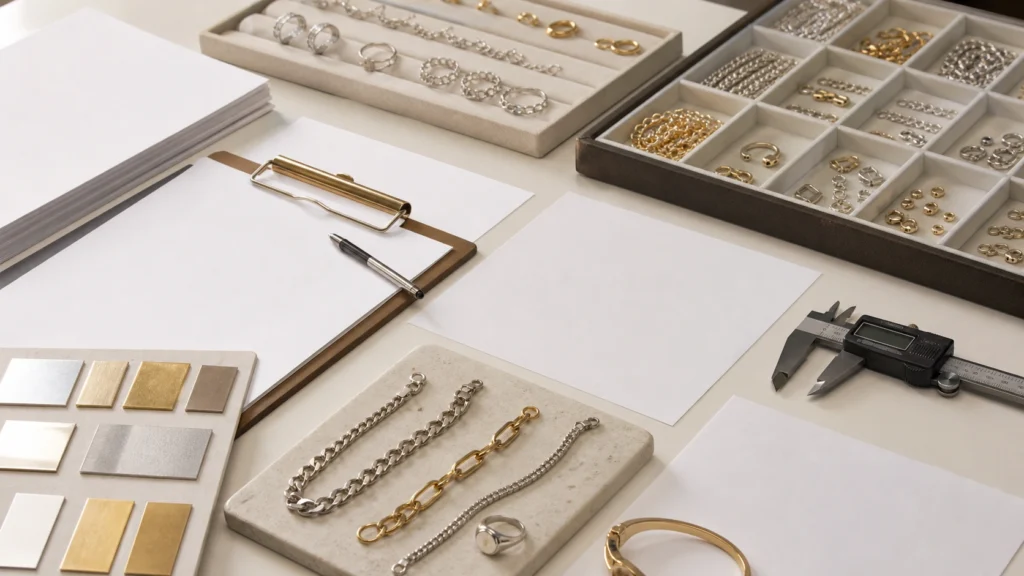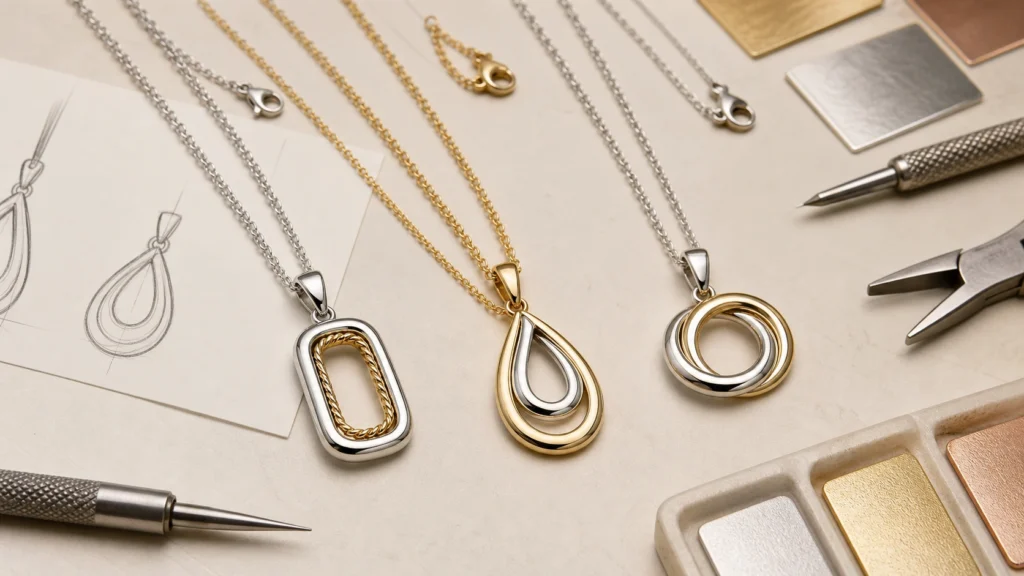
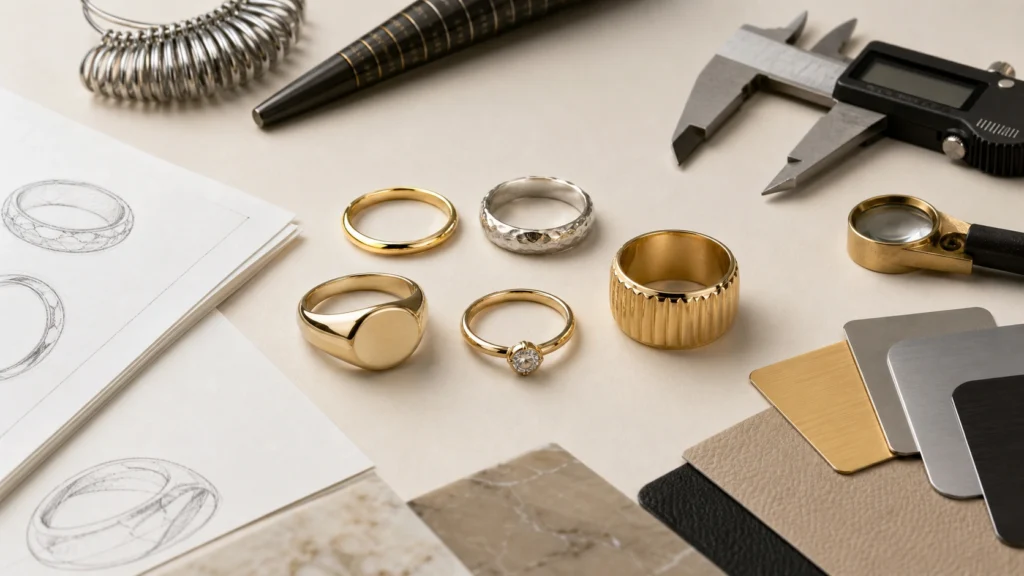
Design a custom ring collection by giving each ring a clear role, limiting the number of size and finish combinations, and testing the pieces together on the hand. A mood board can set the visual direction, but it cannot control shank dimensions, setting height, size standards, surface finish, or pack identity.
Start with a small assortment whose differences customers can understand. Then approve the collection through physical samples and a written production record. Jinnuo Jewelry works with confirmed 925 sterling silver and brass programs, but material, construction, quantity, and timing still require project-specific feasibility review.
Give Every Ring a Job Before Drawing It
A first collection does not need several versions of the same idea. It needs a deliberate assortment. Assign each proposed ring one primary job:
- Signature ring: carries the strongest brand code and may justify greater development attention.
- Everyday ring: has a simpler profile and a clear reason for repeat wear.
- Stacking band: works alone but also creates a planned relationship with another SKU.
- Entry style: introduces the collection without copying the signature ring at a lower specification.
- Statement style: earns its place through scale, stone layout, movement, or surface treatment.
Put the rings in one line and hide the names. If the role of two pieces is indistinguishable, combine them or change one before CAD. This test is useful for small brands with limited launch inventory. A broader retailer may keep more overlap when different stores or price bands need it.
Count Production Variants, Not Just Designs
One design can become many production variants. The working count is:
designs × sizes × base materials × finishes × stone options = production variants
Five designs offered in six sizes and two finishes already create 60 variants before stone choices. Shared visual language does not make those variants identical to produce or inspect.
Use a variant map before requesting a quote. Mark which choices are fixed, optional, or deferred. A finish shared across the collection may simplify approval, while several finishes can widen merchandising options. The tradeoff is more samples, labels, inventory lines, and chances for the wrong version to be packed.
Do not assume that one CAD file can simply be scaled for every size. A stone layout, signet face, opening, wall section, or logo position may need size-specific decisions. Ask the manufacturer which dimensions remain constant and which must change.
Engineer the Relationships Customers Will Wear
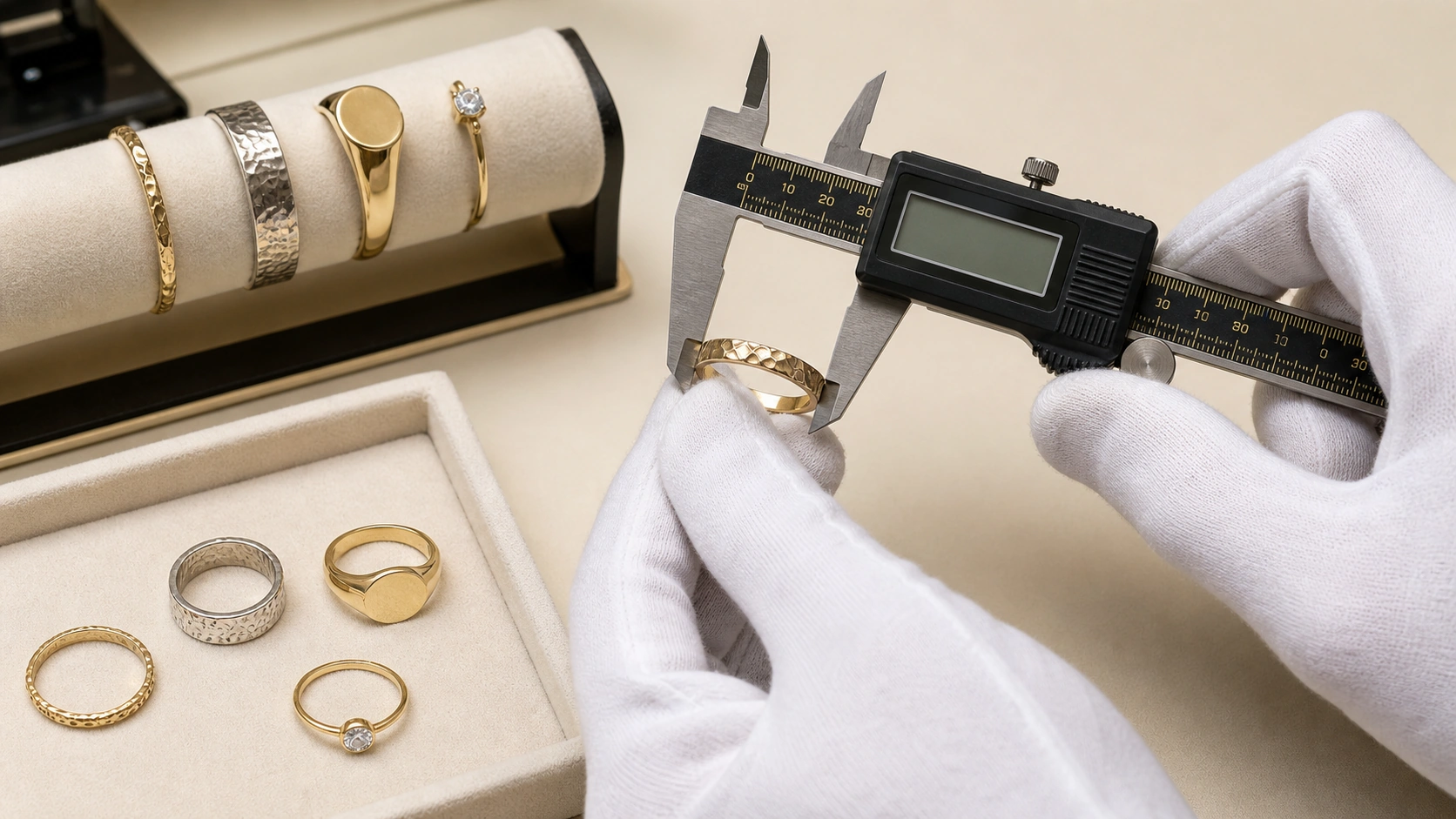
Ring design is three-dimensional and finger-specific. Record the top width, shank width, inside profile, setting height, edge shape, and intended wearing position. For stackable pieces, also define the desired gap when two rings sit together.
Check these failure modes during design review:
- A high setting collides with the neighboring band.
- Pavé or texture rubs against an adjacent ring.
- A wide shank feels tighter than a narrow ring in the same nominal size.
- An open ring catches, twists, or changes its gap during use.
- A statement face rotates because its weight and shank do not balance.
These checks are most important for stack sets, wide bands, top-heavy forms, and adjustable styles. A simple narrow band may need fewer relationship tests, but its size and inside finish still need clear approval.
Approve the Collection as a System
Review samples individually, then place the full assortment together. The collection board should show the approved sample, SKU code, nominal size, material, finish, stone reference, and packaging identity for every variant.
Run four short reviews. First, compare silhouette and scale from a distance. Second, try the intended stacks and adjacent-finger combinations. Third, compare finish and color under the same light. Fourth, check that labels and packaging distinguish similar variants.
Do not approve only the most photogenic size. Inspect at least the sizes most likely to expose construction changes, as agreed with the supplier. Exact inspection methods and acceptance limits depend on the ring architecture and target market.
Leave a Reorder Record, Not a Mood Board
The final record should contain current drawings or CAD views, size standard, size-specific dimensions, material, finish reference, and stone data. Add logo artwork, approved sample notes, packaging setup, and inspection points. Link shared decisions to every affected SKU.
Reopen approval when a relevant material, stone, component, tooling condition, finish route, pack insert, or production location changes. Not every change requires a complete new sample. The buyer and supplier should agree which changes need notification, a part sample, or full reapproval.
For a feasibility review, send Jinnuo Jewelry the proposed assortment map, target materials, size range, finish direction, stone plan, reference images, and destination market. The exact scope, MOQ, cost, and schedule should be confirmed only after the design and variant structure are reviewed.

Carol
Carol is a jewelry manufacturing expert with first-hand experience across materials, surface finishes, production processes and quality control. He brings critical thinking and rigor to his work, questioning common assumptions and testing them against industry standards and real production results. He looks at every issue from the point ofview of the people who buy and wear jewelry, turning technical details into clear, practical answers to real-world problems.