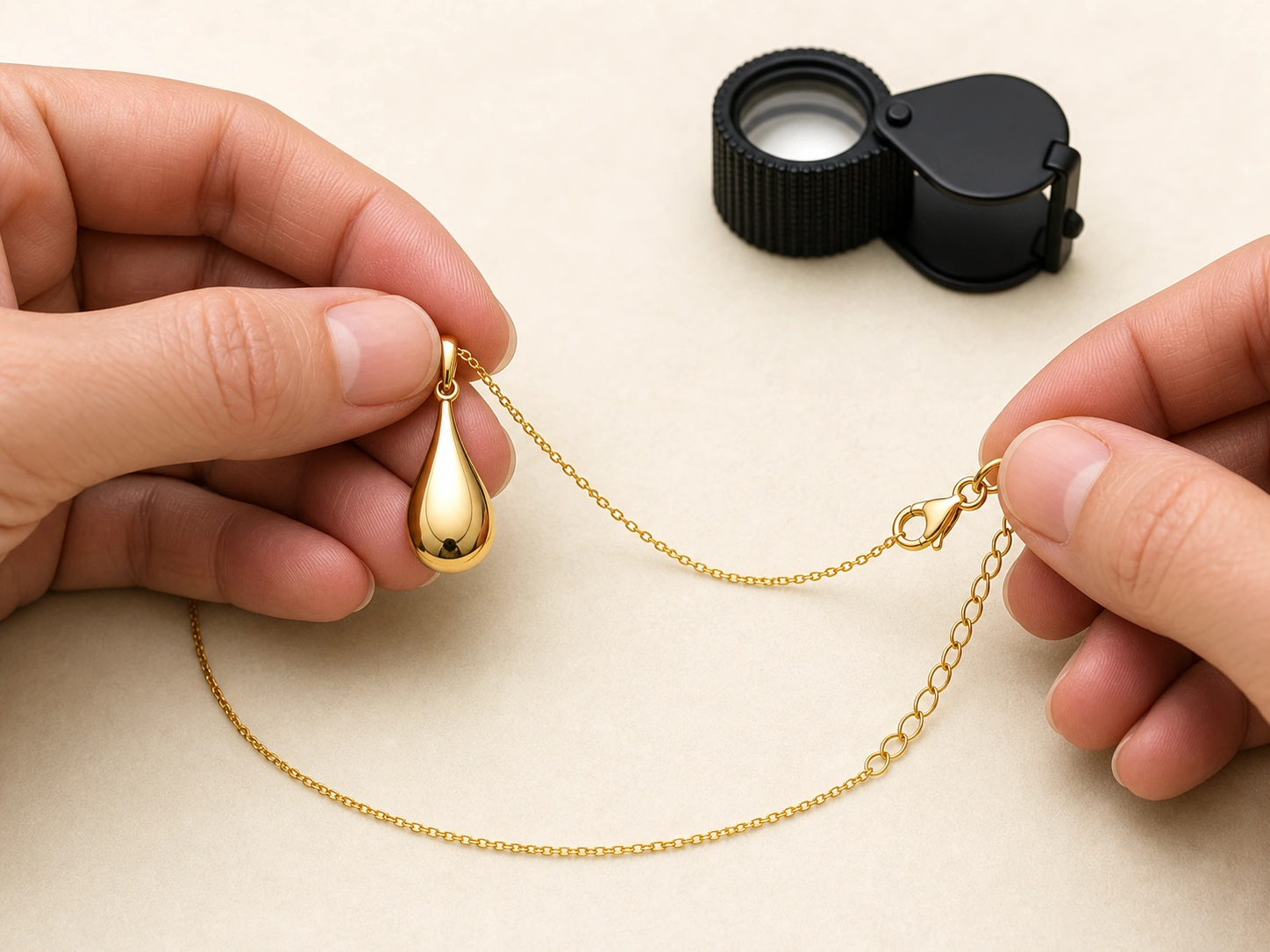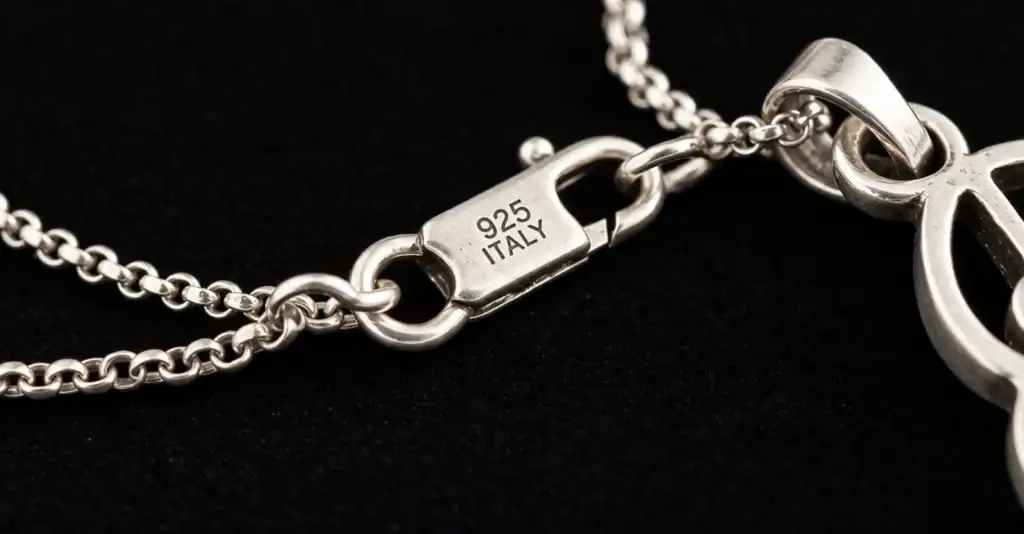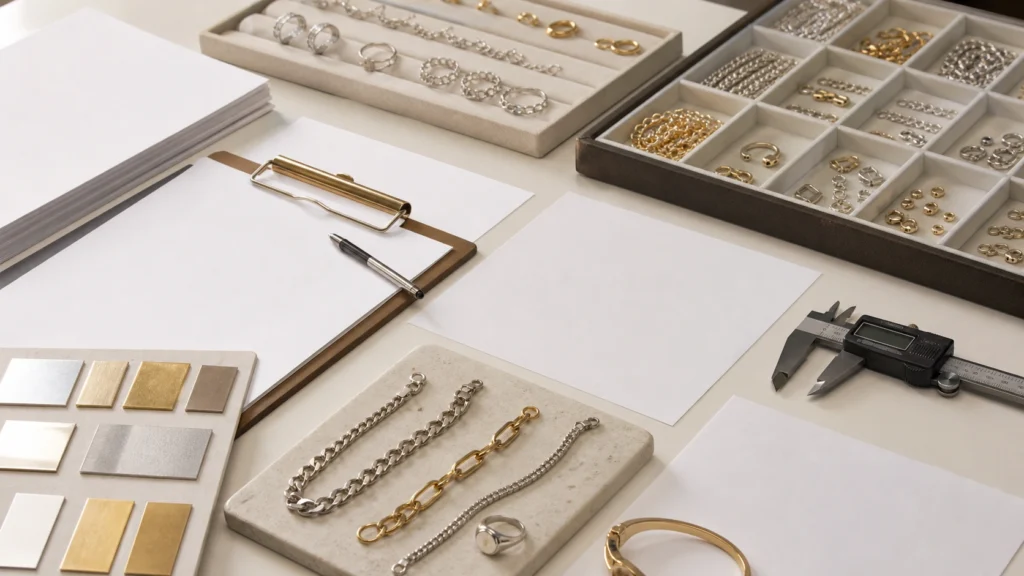
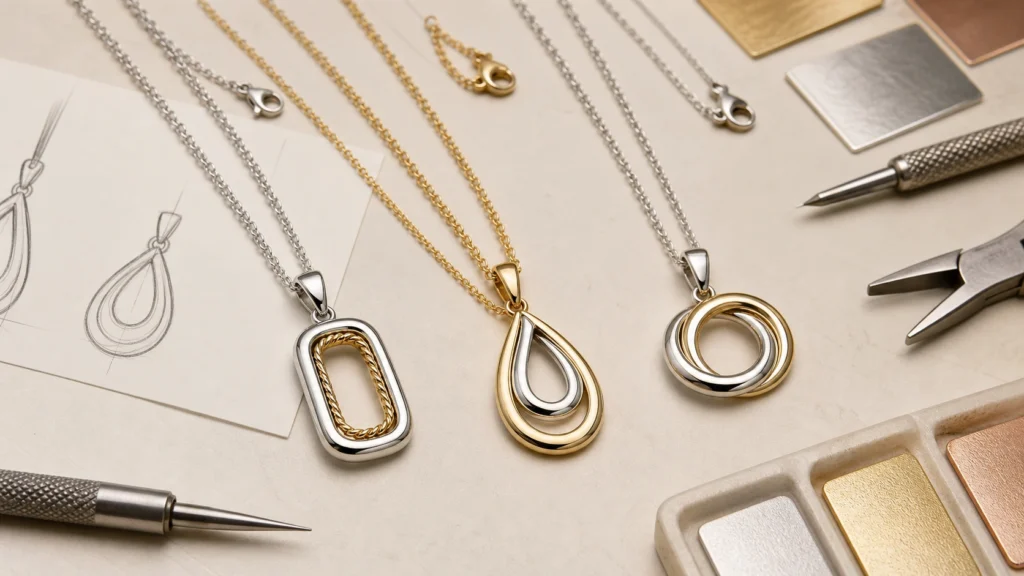
Designing custom pendant necklaces for a private label collection is a product-system task, not simply a drawing exercise. Start with the customer and collection role, establish a repeatable design language, then specify the pendant, bail, chain, clasp, finish, branding, and packaging together. Convert the selected concepts into production-ready files, approve complete necklace samples, and freeze a documented reference for production and reorders.
This approach helps a collection look related without making every SKU identical. It also exposes practical conflicts—such as a chain that does not move freely through the bail or packaging that scratches the pendant—before they become bulk-production problems.
Start with a Collection Architecture, Not Individual Sketches
Before drawing, decide what each necklace contributes to the range. A compact launch collection often benefits from three layers:
| Collection layer | Commercial role | Design rule | Complexity control |
|---|---|---|---|
| Hero style | Expresses the strongest brand idea | Most distinctive silhouette or detail | Limit special components and processes to decisions that matter |
| Core styles | Provide broadly wearable options | Repeat the main motif in simpler forms | Share chain, clasp, finish, or packaging where appropriate |
| Variations | Extend choice without creating a new product system | Change one controlled variable such as scale, finish, or stone layout | Avoid changing pendant, chain, closure, and packaging at the same time |
Give every proposed SKU a job: entry product, everyday core, giftable style, statement piece, or coordinated layer. If two concepts serve the same buyer, price position, and visual role, one may be redundant.
Create a SKU matrix before requesting samples. Record pendant family, size, base material, finish, chain type, chain length, clasp, extender, stones or enamel, logo treatment, and packaging. Shared components can simplify development and repeat ordering, but only when they suit the pendant’s weight, proportion, and intended wearing behavior.
Define the Design DNA Before Drawing Pendants
A recognizable collection usually repeats a small set of decisions. Define them in a one-page design-DNA sheet:
- primary shapes and recurring motifs;
- soft, geometric, organic, architectural, or symbolic character;
- preferred edge language, such as rounded, beveled, crisp, or irregular;
- typical solid-to-open-space balance;
- finish direction and color family;
- stone, enamel, engraving, or texture rules;
- logo visibility and acceptable placement;
- target scale and visual weight;
- details that must not appear because they belong to another collection.
Use references to communicate separate attributes. One image may control silhouette, another surface texture, and another wearing position. Label that priority explicitly. Asking a manufacturer to “combine these references” leaves critical decisions open to interpretation and can also produce a collection that feels derivative.
Originality does not require every SKU to use a different visual idea. A single motif can be cropped, mirrored, opened, layered, simplified, or changed in scale while retaining a coherent family resemblance.
Design the Pendant, Bail, and Chain as One System
The pendant is only one part of the necklace. Its connection and chain determine how it hangs, moves, turns, and feels in use.
| Component | Decisions to define | Interaction risk to review |
|---|---|---|
| Pendant | Height, width, depth, weight objective, front/back detail, edge treatment | Rotation, sharp contact points, inaccessible polishing areas, excessive visual or physical weight |
| Bail or loop | Internal clearance, orientation, fixed or moving construction, visible or hidden style | Chain cannot pass, pendant jams, bail flips, connection becomes a weak point |
| Jump ring | Diameter, wire gauge, orientation, soldered or otherwise secured construction | Opening, twisting, abrasion, poor pendant alignment |
| Chain | Link style, gauge, length, finish, movement, pendant compatibility | Kinking, visual imbalance, restricted movement, finish mismatch |
| Clasp and extender | Type, scale, function, logo tag, extension range | Difficult operation, disproportionate hardware, chain-end failure, tangling |
Do not select chain width from appearance alone. Review it against the pendant’s scale and expected weight, the bail opening, the clasp hardware, and the target customer. A delicate chain can make a heavy pendant feel unstable; an oversized chain can overpower a small pendant or fail to pass through a removable bail.
Check the assembled necklace in front, side, and hanging views. Ask whether the pendant returns to the intended orientation after movement, whether the bail allows enough freedom without looking loose, and whether the pendant can slide across any intended chain features.
Choose Materials and Finishes by Product Position
Material affects appearance, weight, construction, finishing route, cost, care expectations, and target-market requirements. Jinnuo Jewelry’s primary confirmed materials include 925 sterling silver and brass. The suitability of a material, plating, stone, enamel, or other finish still depends on the specific design and project requirements.
Build the material decision around:
- intended price and brand position;
- pendant geometry and manufacturing route;
- target weight and wearing comfort;
- finish color and surface texture;
- stone-setting, engraving, enamel, or assembly needs;
- packaging contact and storage conditions;
- destination-market testing, labeling, or documentation requirements;
- repeat-order availability and approved substitution rules.
Do not approve a finish with words such as “warm gold” or “high polish” alone. Use an agreed physical sample, controlled finish reference, or another documented approval method. Plating specifications, testing scope, tolerances, and care claims should be confirmed for the actual material, process, and destination market rather than copied from another product.
For commercial material and finish context, review Jinnuo Jewelry’s custom necklace capabilities, then confirm the exact project scope after feasibility review.
Build a Manufacturer-Ready Design Brief
A useful brief lets the supplier identify missing decisions before CAD, tooling, or sampling begins. Include:
- collection concept, target customer, price position, and intended launch market;
- SKU matrix and the role of each design;
- dimensioned front, side, and back sketches or files;
- pendant material, construction, target finish, and texture;
- bail, loop, jump-ring, chain, clasp, extender, and tag requirements;
- stone, enamel, engraving, cutout, or logo artwork with placement and orientation;
- target chain length and how it should be measured;
- reference priorities and prohibited details;
- packaging interface, including card, pouch, insert, and box clearance;
- expected order quantity and target timing for planning;
- target-market testing or documentation questions;
- file ownership, confidentiality, approval, and change-control expectations.
Mark unknowns as questions instead of filling them with guesses. MOQ, price, tooling, sample development time, bulk-production time, tolerances, and testing depend on the design and project requirements and should be confirmed after review.
Convert the Concept into Production-Ready CAD
CAD should translate visual intent into manufacturable geometry. A production-ready model needs more than an attractive render: it must consider structural integrity, correct proportions, functional clearances, manufacturing limitations, casting behavior, setting access, assembly, movement, stress, and polishing access. These principles are described in PJ Chen’s production-focused jewelry CAD guide.
During CAD review, check:
- overall dimensions and thickness from multiple views;
- the pendant’s center of gravity and hanging orientation;
- narrow bridges, sharp transitions, and stress areas;
- bail and chain clearances;
- front, back, and edge finishing access;
- stone seats, prongs, bezels, and tool access when applicable;
- engraving or logo size, depth, direction, and visibility;
- assembly joints and whether moving parts can operate;
- areas where casting, forming, soldering, polishing, or plating may change the appearance.
Approve a named file version, not a screenshot in a message thread. A render can confirm shape and proportion, but it cannot prove final color, tactile finish, clasp function, chain behavior, or packaging fit. If your team needs production-oriented modeling support, review the 3D Jewelry Design service.

Plan Branding Without Weakening the Product
Private label branding can appear on the pendant back, edge, bail, logo tag, clasp component, jewelry card, pouch, box, or insert. Choose a hierarchy rather than placing the logo everywhere.
Evaluate each product mark for:
- legibility at the actual scale;
- orientation when the necklace hangs;
- visibility to the wearer versus the customer;
- interaction with polishing, plating, casting, or engraving;
- proximity to thin or stressed sections;
- skin contact and comfort;
- consistency across small and large pendant variants.
Packaging branding can carry the strongest visual identity while the necklace uses a subtle maker or brand mark. Confirm artwork version, placement, color reference, and production method separately for product and packaging.
Sample the System, Not Just the Pendant
A loose pendant cannot demonstrate the finished necklace. Review a complete sample with the intended chain, bail or jump ring, clasp, extender, logo tag, finish, and packaging.
Sampling should answer:
- Does the pendant hang and return to the intended orientation?
- Does the chain move freely without excessive play or abrasion?
- Are connection points secure and visually clean?
- Does the clasp operate comfortably?
- Do the chain and pendant finishes match under controlled lighting?
- Are the front, back, edges, recesses, stones, and markings finished as agreed?
- Does the necklace sit correctly at the intended length?
- Does the packaging hold the necklace without tangling, scratching, or unwanted movement?
- Do related SKUs look like one collection when placed together?
Industry-facing necklace pages commonly tell buyers to approve chain construction, dimensions, finish, clasp, pendant connection, branding, and packaging before bulk production; this is also reflected in the project flow and quality checkpoints published by Jewins. Treat such lists as practical context, not proof of another manufacturer’s exact process.
Use a Sample Approval Matrix
| Approval area | What to compare | Approval evidence |
|---|---|---|
| Identity | SKU, CAD version, specification, sample version | Labeled sample and document set |
| Visual | Silhouette, proportions, motif, front/back detail, collection consistency | Controlled photos and approved reference |
| Dimensional | Pendant dimensions, key thicknesses, bail clearance, chain length | Recorded measurements and agreed acceptance method |
| Functional | Hanging orientation, movement, clasp, extender, connection security | Written result and issue record |
| Finish | Color, polish or texture, coverage, surface defects, component match | Physical reference or agreed controlled comparison |
| Branding | Artwork, size, position, depth, direction, legibility | Approved artwork and close-up |
| Packaging | Fit, retention, contact points, anti-tangle arrangement, labels | Approved packed sample/version |
| Documentation | Material, components, exceptions, changes, target-market requirements | Signed or written approval record |
Send one consolidated revision list per round. Give each issue an ID, show its location, describe the current condition and requested result, and identify the controlling file or reference. Ask which changes require new CAD, tooling, or a physical resample.
Freeze a Reorder Specification
After approval, connect the physical reference to controlled documents:
- product and SKU name;
- approved CAD, drawing, artwork, and packaging versions;
- material and component specification;
- chain, bail, jump-ring, clasp, extender, and tag details;
- finish reference and acceptance method;
- stone or decorative-component details;
- key dimensions and agreed tolerance method;
- approved sample identifier and photos;
- accepted exceptions;
- testing or documentation scope;
- packaging configuration and labeling data;
- rules for substitutions and change approval.
If a material, component, finish process, chain source, packaging item, or artwork changes, reopen the affected approval. A reorder should not rely on memory or an unlabeled sample.
Common Design Mistakes
- Designing the pendant in isolation: Bail, chain, clasp, and packaging conflicts appear late.
- Launching too many independent constructions: Every special chain, finish, closure, stone, and box adds another variable to control.
- Using references without priorities: The supplier must guess which shape, scale, texture, or detail governs.
- Approving only a beauty render: Structural, assembly, finish, movement, and wear issues remain untested.
- Ignoring the back and edges: These surfaces affect comfort, branding, polishing access, and perceived quality.
- Treating the bail as decoration: Its clearance, orientation, and connection determine necklace behavior.
- Leaving packaging until the end: The card, insert, pouch, or box may not fit or protect the approved necklace.
- Giving revisions through multiple channels: The current version and approval status become ambiguous.
- Allowing undocumented substitutions: The bulk or reorder product no longer matches the approved reference.
Private Label Pendant Necklace Design Checklist
- Every SKU has a defined customer, role, and price position.
- The collection repeats a documented design language.
- Pendant, bail, jump ring, chain, clasp, extender, and tag are specified together.
- Material and finish choices have passed project-specific feasibility review.
- CAD shows front, side, back, connections, clearances, and branding.
- File versions and reference priorities are unambiguous.
- A complete assembled necklace sample has been reviewed.
- Hanging behavior, function, finish match, and packaging fit are approved.
- Revision feedback is consolidated and closed.
- The approved sample is tied to controlled product and packaging documents.
- Target-market testing, labeling, and documentation requirements are separately confirmed.
- Substitutions require written impact review and approval.
Jinnuo Jewelry supports OEM, ODM, OBM, and private-label projects within confirmed product scopes. To prepare a pendant necklace collection, review the Jewelry Sampling Service and send your design brief through the custom jewelry quote request. Exact materials, processes, quantity, tooling, cost, testing, packaging, and timing should be agreed after feasibility review.
FAQ
What files do I need to start a custom pendant necklace design?
Send a dimensioned sketch or CAD file if available, front/side/back references, artwork, target material and finish, pendant size, bail and chain requirements, clasp and extender details, branding, packaging, target market, expected quantity, and the priority of each reference. A complete brief is more important than a polished render alone.
How many pendant designs should be in a first private label collection?
There is no universal number. Choose enough SKUs to express a clear hero, core, and controlled variation strategy without creating more materials, chains, finishes, components, and packaging formats than the team can sample, approve, stock, and reorder consistently.
Should a private label pendant use a stock chain or a fully custom chain?
Either can be appropriate. A compatible stock chain may reduce development complexity, while a custom chain can strengthen differentiation but adds specifications and production variables. Decide after reviewing visual proportion, bail clearance, function, availability, finish matching, quantity, and cost.
What must be approved before bulk pendant necklace production?
Approve the exact CAD and specification versions, complete assembled sample, material, pendant and connection construction, chain, clasp, extender, finish, stones or enamel, branding, packaging fit, accepted exceptions, and any required testing or documentation scope in writing.