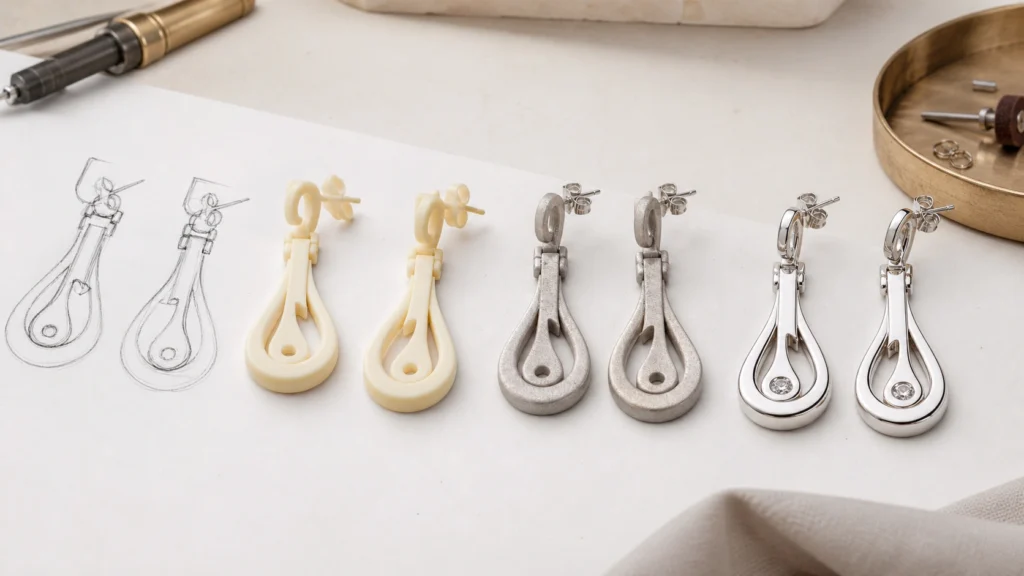
The custom earring sampling process moves from a clear design brief to CAD or drawing review, a physical pair, documented revisions, and written approval. Each stage should answer a different question. CAD can confirm shape and construction intent, while the finished sample must prove fit, function, pair matching, surface finish, and packaging compatibility.
Decide What the Sample Must Prove
Not every sample has the same purpose. Define the decision before work starts.
| Sample goal | What it can help answer | What it does not prove by itself |
|---|---|---|
| Visual model or mock-up | Scale, silhouette, proportion, and design direction | Final material, finish, closure feel, or production repeatability |
| Fit or function sample | Post position, hinge action, hook shape, movement, and comfort concerns | Final color or complete surface quality if materials differ |
| Finish sample | Color, polish, texture, logo appearance, and detail retention | Full function if it is a flat coupon or non-working part |
| Final custom sample | Combined product appearance and use against the approved brief | Consistency across every unit in a bulk order |
A simple stud may combine these goals in one sample. A hinged hoop or multi-part drop may need more than one stage. The right path depends on what remains uncertain.
Give the Factory Enough to Start
Send the current design views, intended dimensions, material direction, finish reference, stones or components, logo placement, closure type, target market, packaging need, and quantity by SKU.
Mark what is fixed and what the factory may suggest changing. For example, the outside hoop diameter may be fixed while the section thickness can change after a weight and closure review.
Identify the source of each reference. A sketch may control the look, while a component sample controls the clasp feel. If two references conflict, state which one wins. This prevents the sample maker from choosing without the buyer’s knowledge.
Use CAD to Resolve Shape and Construction
CAD or a controlled drawing should settle decisions that can be reviewed before metal work. Check front, side, and back views. Confirm overall size, section, stone position, logo depth, post angle, hinge or latch space, joint locations, and left-right orientation.
Ask how polishing, forming, casting, setting, or assembly may change visible detail. Very fine edges, deep recesses, thin links, and close moving parts may need adjustment for the proposed process.
Do not approve CAD as if it proves the finished earring. It cannot show exact weight on the ear, real closure feel, surface color, hand-polished detail, or how a pair will match. Record CAD approval as permission to make the agreed physical sample.
Review the Physical Pair in a Fixed Order
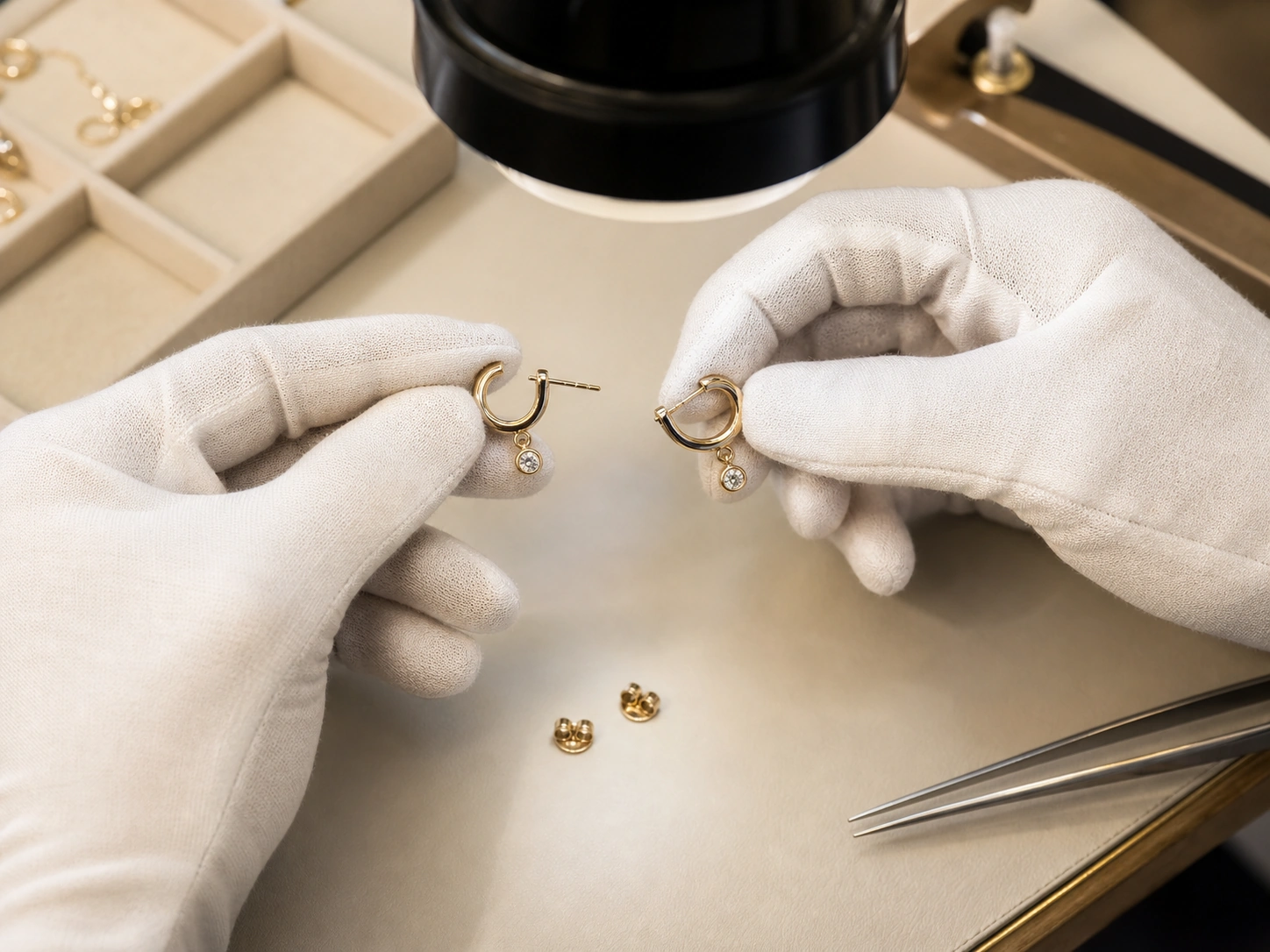
Start by checking identity. Match the sample with the current file, material and finish note, components, and sample code. Then inspect:
- Size and shape: measure the features that affect fit, pair match, packing, or brand identity.
- Function: open and close hinges, latches, hooks, backs, and moving joints without forcing them.
- Comfort: review weight, balance, sharp points, post angle, hook shape, and contact with the ear.
- Pair match: compare height, angle, silhouette, stone placement, texture, and color from the same view.
- Finish: check front, back, edges, recesses, soldered zones, joints, and areas near stones or logos.
- Pack fit: place the pair in its card, insert, pouch, or box and look for bending, movement, or contact.
Use neutral, consistent light for visual comparison. Photos should show both the detail and its location on the earring.
Turn Feedback into a New Controlled Version
Put all comments into one numbered list. For each item, show the sample area, current result, requested change, and whether the change is required or optional. State which accepted features must not move.
Do not combine comments from different sample rounds without a clear version. A note such as “use the first color but the second clasp” should point to named sample codes and an updated product brief.
When a change affects size, weight, material, finish, component, tooling, packaging, or testing, ask whether the quote or schedule also changes. Exact effects require project review.
State Exactly What the Approval Releases
Written approval should name the approved sample and the files that support it. Keep the current drawing or CAD revision, component list, finish reference, logo file, packaging setup, and inspection points with the approval.
List anything that remains open. A sample may be approved for shape while a test, label, or outer carton is still pending. This prevents “sample approved” from being interpreted as approval of every commercial and technical detail.
Jinnuo Jewelry’s verified scope includes CAD and product development, jewelry sampling, bulk production, packaging, and quality control. The exact sample route, cost, timing, and acceptance plan depend on the earring. Send the brief and unresolved sample questions through the custom jewelry quote form.

Carol
Carol is a jewelry manufacturing expert with first-hand experience across materials, surface finishes, production processes and quality control. He brings critical thinking and rigor to his work, questioning common assumptions and testing them against industry standards and real production results. He looks at every issue from the point ofview of the people who buy and wear jewelry, turning technical details into clear, practical answers to real-world problems.