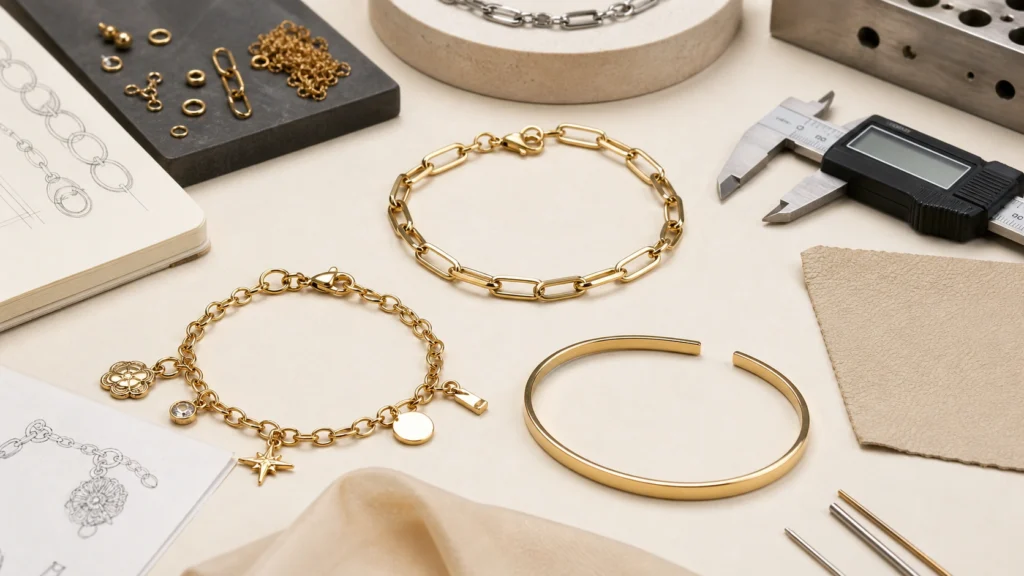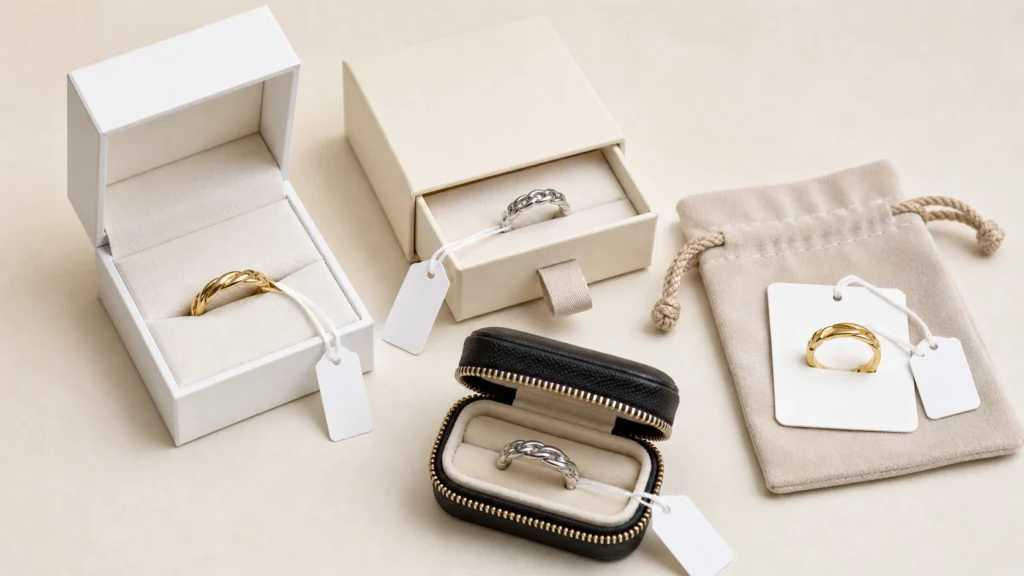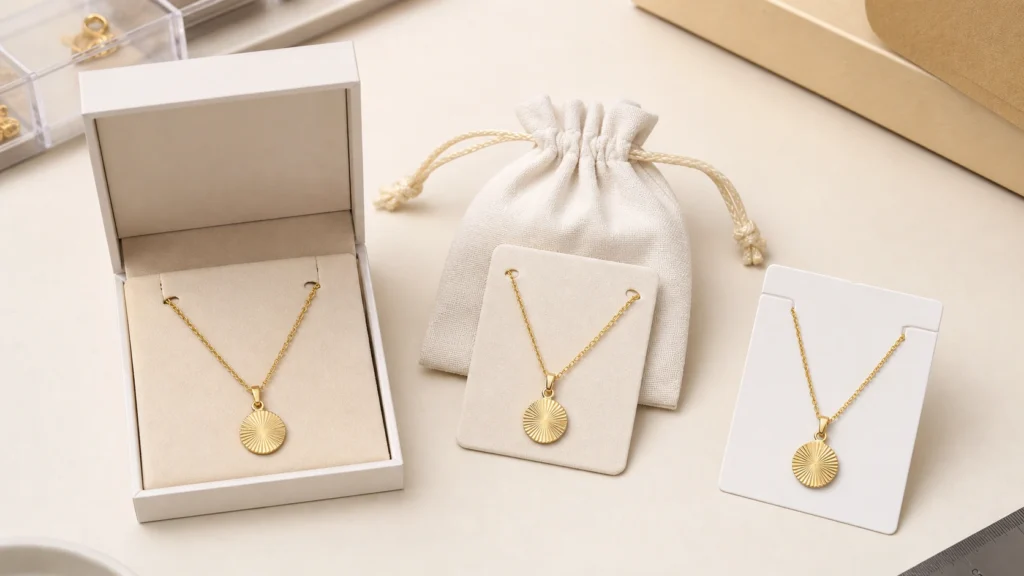
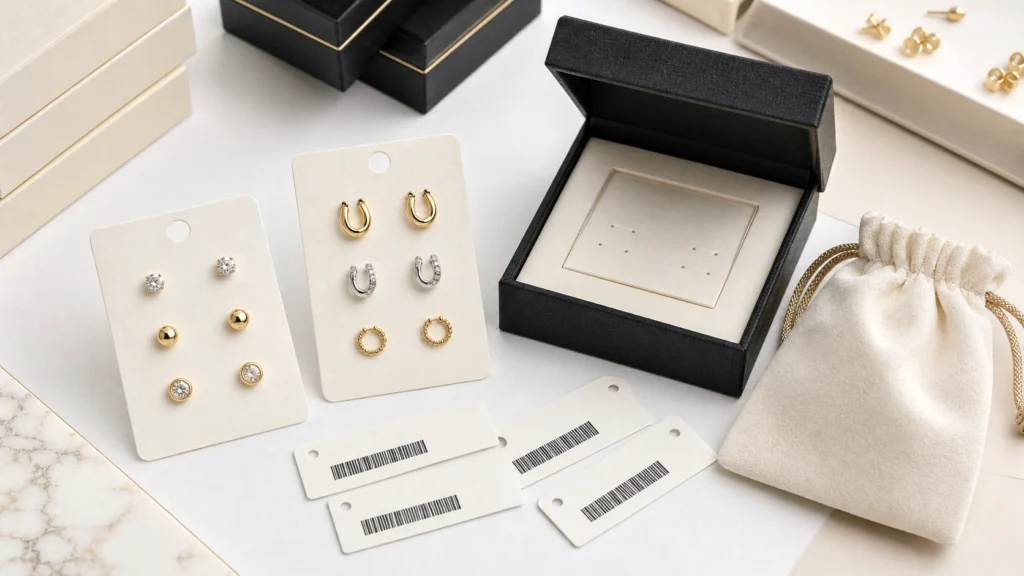
Private label earring packaging should be designed as a system, not selected as one decorative item. The system must hold the product, present the brand, survive its sales channel, and carry the correct SKU and barcode data.
For many collections, the most practical starting point is a secure earring card plus channel-appropriate outer protection. Add a pouch when it improves finish separation or presentation. Add a fitted box when the earring shape, gifting position, or handling risk justifies the extra components and shipping volume. Confirm every choice with finished product samples before ordering packaging in bulk.
Quick Answer: Which Earring Packaging Format Should You Choose?
Choose the format according to the earring architecture and sales channel:
- Cards suit compact display, efficient storage, and lighter styles when the holes, slots, backs, and card stiffness are proven with the actual earrings.
- Boxes provide more structural protection and presentation space, but the insert, lid clearance, component count, and shipping cube must be controlled.
- Pouches can separate surfaces and create a soft presentation layer, but they do not automatically protect posts, stones, hinges, or large silhouettes from pressure.
- Barcode labels connect the physical pack to the brand’s SKU, inventory, retail, and fulfillment systems. Their data and print performance should be approved as carefully as the packaging structure.
Do not let the packaging format drive the product. Start with the finished earring dimensions, weight, projection, closure, moving parts, surface finish, and intended customer journey.
Compare Cards, Boxes, Pouches, and Labels at a Glance
| Component | Best use | Main advantages | Main limitations | What to validate |
|---|---|---|---|---|
| Earring card | Retail display, compact stock, ecommerce inner pack | Low volume, visible product, flexible printing | Limited crush protection; holes can tear or strain hardware | Card stiffness, hole or slot layout, back clearance, hang orientation |
| Folding or rigid box | Gifting, premium presentation, fragile or projecting styles | Structural space, fitted insert, strong unboxing control | More components, higher packed volume, more artwork surfaces | Insert fit, lid clearance, movement, abrasion, box compression |
| Pouch | Secondary presentation, finish separation, travel or storage | Compact, tactile, reusable in some use cases | Little resistance to bending or crushing; products can contact each other | Fabric contact, closure, color transfer, snagging, product separation |
| Barcode or SKU label | POS, warehouse, retailer, or fulfillment identification | Variable data without reprinting all packaging | Poor placement, glare, low contrast, or wrong data can stop scanning | Identifier ownership, data accuracy, size, Quiet Zone, print quality, scan test |
A brand can use more than one component. A stud pair might sit on a card inside a pouch and then enter a protective mailer. A larger hoop may need a fitted box inside a shipping carton. The useful question is not “card or box?” but “which layer performs each job?”
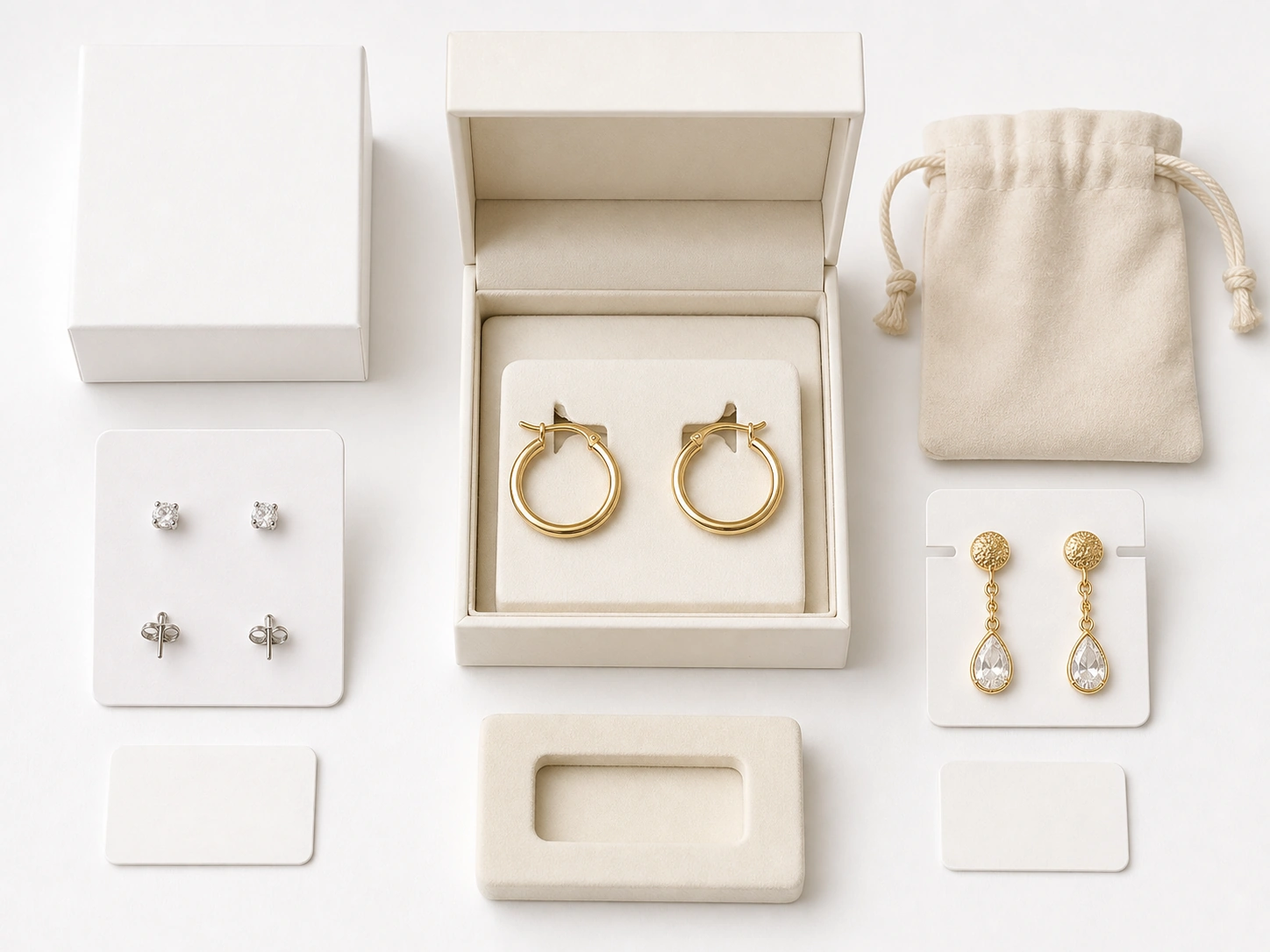
When an Earring Card Is the Right Base
An earring card is efficient when the product can be secured without bending the card or loading the jewelry hardware incorrectly. It also keeps product identity, logo, care information, and variable labels close to the item.
Specify the card as an engineered holder:
- finished width, height, corner shape, and thickness;
- board type, surface coating, and print finish;
- hole, slit, tab, or fold position;
- distance between the pair and required left-right orientation;
- clearance for posts, backs, hinges, charms, or hooks;
- hanger hole or retail fixture requirements;
- front branding area and back label area;
- edge tolerance and acceptable warping.
For studs, check that posts enter the holes without excessive force and that backs do not press against an outer pack. For hooks or drops, confirm the card does not tip, curl, or allow the pair to tangle. For hoops, test whether the card supports the actual weight and closure without distorting the silhouette.
A card is a product holder, not necessarily a shipping package. It may still need a sleeve, pouch, small carton, cushioning, or a suitably protective mailer depending on the route to the customer.
When a Box Earns Its Extra Volume
A box is useful when the earrings need controlled space around them or when gifting presentation is central to the offer. The value comes from the complete structure: outer shell, lid or drawer, insert, covering material, and the way the product is fixed.
The insert should support the earring without creating a new risk. Check:
- cavity dimensions and product orientation;
- post, back, hinge, hook, and charm clearance;
- whether paired earrings can touch or rub;
- the force needed to insert and remove the product;
- whether flocking, paper, fabric, foam, or adhesive contacts the finish;
- lid clearance at the highest point;
- product movement when the closed box is turned or handled;
- how the box performs inside the actual transit pack.
A larger box is not automatically safer. Excess space can allow movement, while an insert that is too tight can load a post, hinge, stone setting, or plated surface. Approve the box with a finished sample, not only a render or an empty packaging prototype.
Box dimensions also affect storage, master-carton count, freight, warehouse handling, and the customer’s delivery format. Those trade-offs should be reviewed before the presentation is locked.
When a Pouch Helps—and When It Does Not
A pouch can add a soft presentation layer and reduce direct contact with other items. It may suit compact ecommerce packs, travel storage, or a coordinated packaging family.
However, a pouch generally provides limited structural resistance. A protruding post can still bend, a hoop can be compressed, and two earrings can rub inside one compartment. If the pouch is used without a card or insert, verify how the pair remains together and how delicate parts are isolated.
Define:
- pouch dimensions and usable internal space;
- textile or sheet material and lining;
- closure type and drawstring or snap location;
- seam quality and loose-fiber limits;
- logo method and placement;
- colorfastness and potential transfer;
- product-to-material contact;
- whether a separate card, sleeve, or protective insert is required.
Treat “anti-tarnish,” “acid-free,” or similar performance descriptions as claims that need evidence for the actual material and use condition. They should not be assumed from the pouch color, softness, or supplier category.
Build the Packaging as Four Functional Layers
Separating the layers prevents one component from being expected to do everything:
- Product holder: card, insert, tray, tab, or fixture that keeps the pair oriented and protects critical hardware.
- Presentation pack: card face, pouch, folding carton, or rigid box that carries the visual identity and customer experience.
- Transit protection: sleeve, cushioning, mailer, inner carton, or master-carton configuration that manages handling and compression.
- Identification layer: printed or applied SKU, GTIN, barcode, material, care, market, or retailer data.
| Sales channel | Product holder | Presentation priority | Transit priority | Data priority |
|---|---|---|---|---|
| Boutique display | Stable card or fitted insert | Visibility, hanging or tray fit, easy staff handling | Backroom and replenishment protection | SKU, price workflow, retailer label rules |
| Ecommerce direct-to-consumer | Holder that prevents movement and lost backs | Brand consistency and compact unboxing | Mailer compression, vibration, moisture exposure, returns | SKU, fulfillment barcode, order accuracy |
| Wholesale | Repeatable holder and pack count | Consistent line presentation | Space efficiency and master-carton control | Case, inner-pack, and retailer data alignment |
| Gift-led offer | Fitted insert in a controlled box | Opening sequence and product reveal | Protect the box finish as well as the jewelry | Discreet but accessible product identification |
Use the same finished earrings to test every layer together. A product can pass an insert-fit review and still fail when the box is closed, labelled, stacked, or placed in the final mailer.
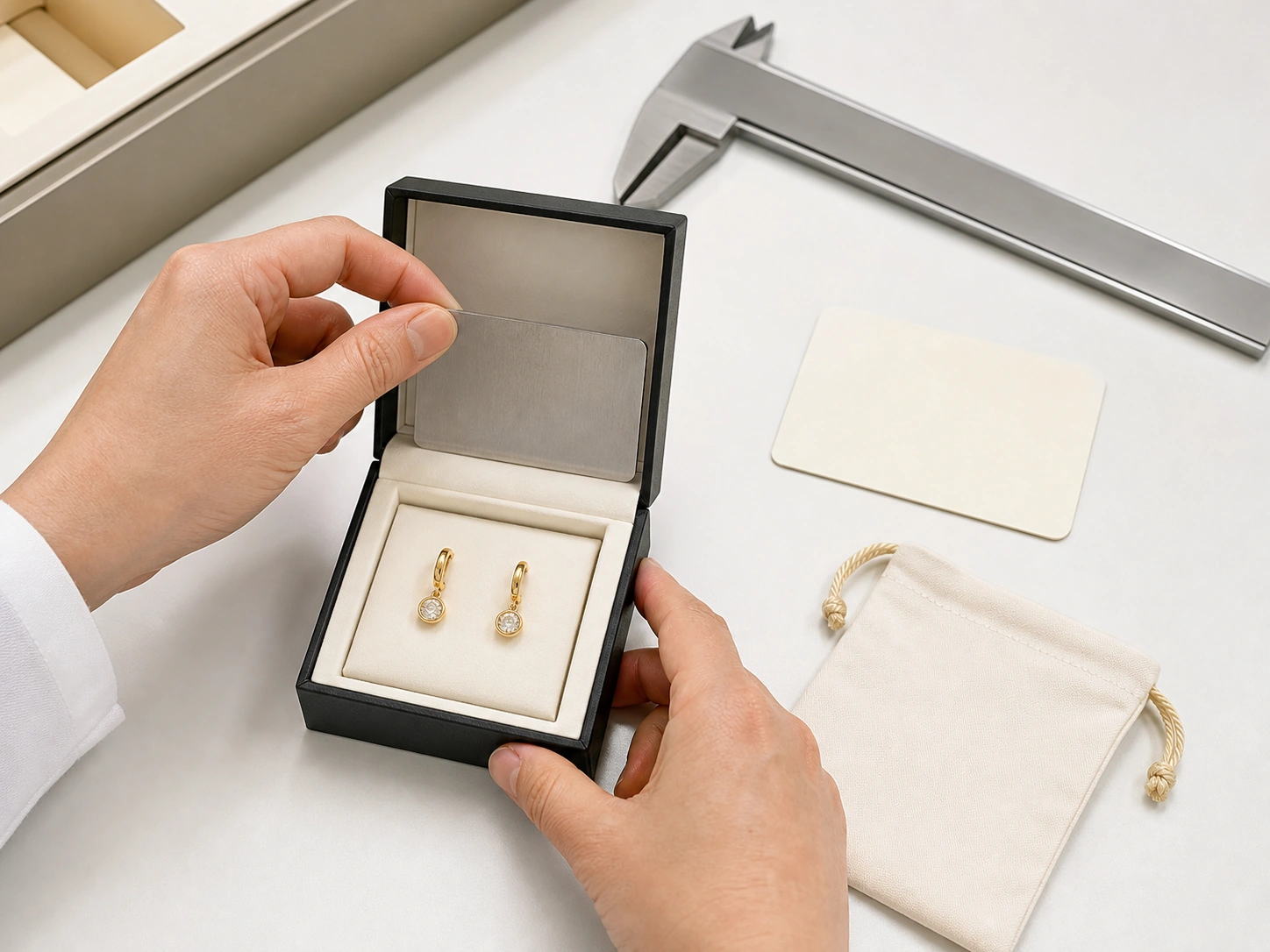
If packaging development is running alongside the product, keep it tied to the broader private label earring collection workflow. Product revisions, packaging revisions, and SKU data should point to the same approved version.
Match the Holder to the Earring Architecture
“Earrings” is too broad for one untested packaging layout.
| Earring type | Main packaging risk | Holder priorities | Sample check |
|---|---|---|---|
| Studs | Bent posts, lost backs, rotation, pressure on the front motif | Accurate hole spacing, back retention, rear clearance | Close the complete pack and inspect post alignment and front pressure |
| Huggies and small hoops | Hinge or latch pressure, surface rubbing, distorted circle | Support without loading the closure; preserve diameter | Operate closures before and after the handling test |
| Drop earrings | Tangling, hook movement, uneven hanging, chain abrasion | Length clearance, separated hanging points, stable orientation | Turn and lightly handle the pack, then check pairing and tangles |
| Statement earrings | Card bending, multiple contact points, stones or links striking surfaces | Higher stiffness or a fitted insert, adequate depth, controlled removal | Inspect every projection and moving part after closed-pack testing |
Use representative worst-case samples when one packaging design serves several SKUs. The largest diameter, longest drop, heaviest pair, most projecting stone setting, and most delicate finish may not be the same SKU.
The packaging brief should remain connected to the actual custom earring design and development requirements rather than being approved as a separate graphic-design exercise.
Plan SKU, GTIN, and Barcode Labels before Artwork Approval
An SKU is the brand’s internal stock code. A GTIN is a standardized identifier for a trade item within the GS1 system. A printed barcode is a data carrier that allows a scanner to capture an identifier or other structured data. They are related, but they are not interchangeable.
The brand owner or responsible trade-item party should confirm who assigns the identifiers and how each sellable variant is treated. The official GS1 GTIN guidance explains the role of the Global Trade Item Number, while GS1’s barcode implementation steps cover symbol choice, size, color, placement, and print-quality considerations.
Prepare a data table before final artwork:
- brand SKU;
- product name or short description;
- style, color, material, finish, and size variant;
- GTIN or retailer identifier where applicable;
- barcode symbol and approved source file;
- human-readable number or text required by the chosen system;
- country, importer, care, material, or warning text where applicable;
- label size, substrate, adhesive, and application position;
- artwork version and approval owner.
Reserve a flat, accessible area. Avoid holes, slots, folds, seams, curved edges, rough texture, heavy embossing, and reflective finishes that can disrupt the code or its surrounding clear area.
GS1’s current 2D barcode retail guideline explains that barcode size, module dimensions, contrast, substrate, sheen, placement, and Quiet Zones affect scanning. It also distinguishes POS uses from consumer-engagement uses and recommends verification in the intended scanning environment. For a small earring card, the artwork team should therefore reserve the barcode area early rather than shrink the symbol after the visual design is complete.
Use high contrast and keep the Quiet Zone free of graphics, text, cut lines, and finishing effects. Test a production-representative print after lamination, varnish, label application, trimming, and package forming—not only a barcode displayed on a monitor.
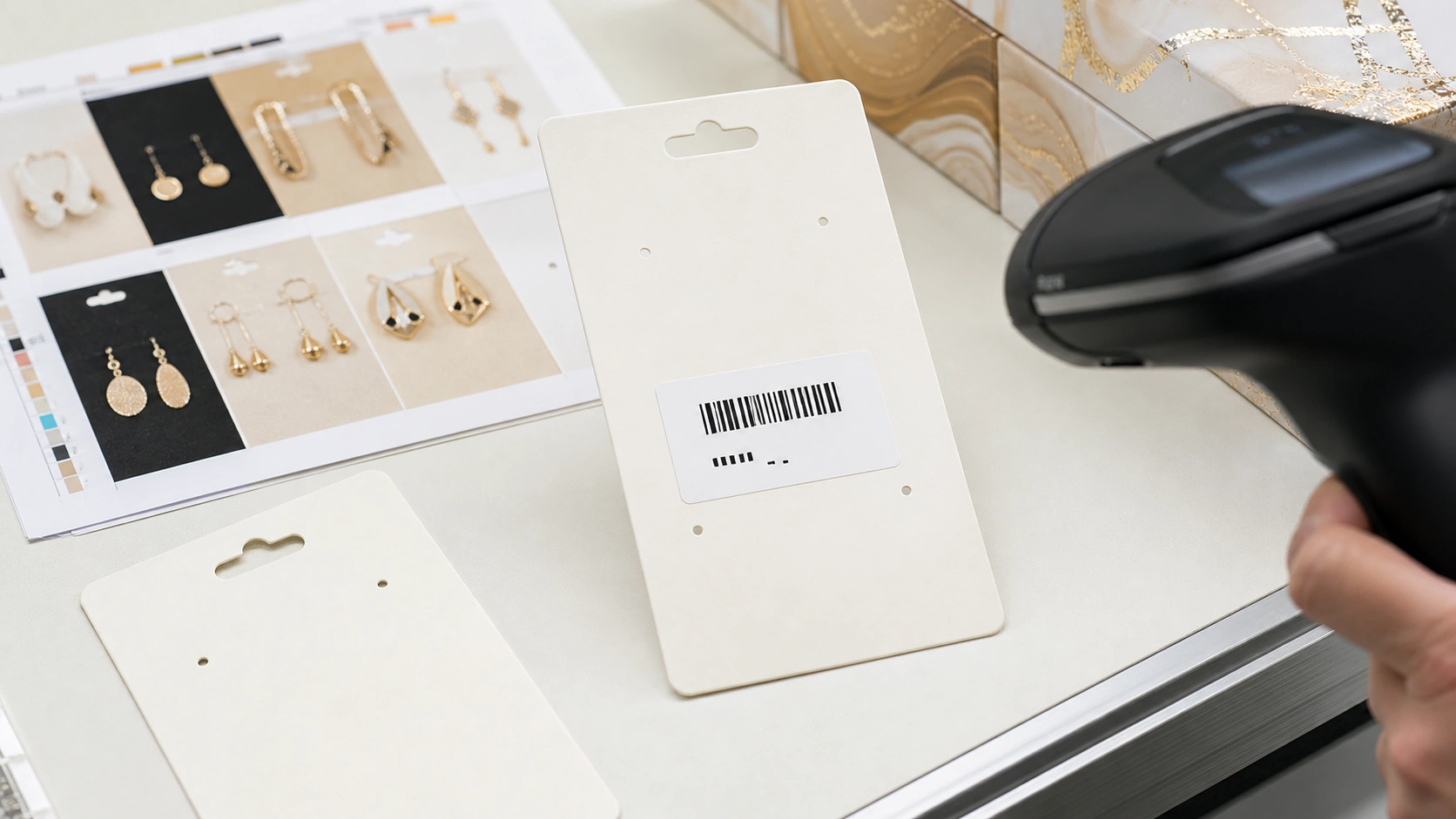
Control Fixed Artwork and Variable Data Separately
Fixed artwork may include the brand mark, colors, care language, social or web information, and general legal text. Variable data changes by SKU, finish, size, market, retailer, batch, or sales channel.
Keeping those layers separate reduces costly artwork duplication. A brand might print one common card and apply a controlled variable label, or create market-specific backs while sharing the same structural die line. The correct route depends on order configuration, retailer rules, print process, and the amount of variable information.
Use an artwork release record that identifies:
- approved die line and structural sample;
- color standard and allowed print tolerance;
- logo file and minimum clear area;
- fixed front and back artwork;
- variable-data source and field mapping;
- barcode source file and placement;
- finish layers such as foil, embossing, varnish, or lamination;
- proof type and approval date;
- revision number and superseded versions.
Do not rely on a screenshot as the master barcode file. The brand should supply an approved asset or data source in a format suitable for the chosen printing workflow, and the final printed result should be scanned and verified.
Treat Sustainability Claims as Specifications
“Eco-friendly” is too broad to function as a packaging specification. Break the goal into measurable decisions: material reduction, pack volume, recycled content, certified fiber, reusable components, separability, local collection systems, and destination-market requirements.
For paper and paperboard, do not treat every FSC label as the same claim. The Forest Stewardship Council’s label guide distinguishes FSC 100%, FSC Recycled, and FSC Mix according to the material sources used. If the brand wants an FSC statement or mark on packaging, confirm the component, supplier documentation, chain-of-custody route, and permitted artwork before printing.
Market rules can also change the packaging brief. The European Commission’s packaging-waste overview states that Regulation (EU) 2025/40 entered into force on February 11, 2025 and generally applies from August 12, 2026. It covers packaging placed on the EU market and sets requirements across manufacturing, composition, waste prevention, and recoverability. A brand selling into the EU should obtain current market-specific advice instead of assuming that one global packaging statement or structure is sufficient.
Sustainability decisions still need product protection. A material reduction that increases damaged earrings, replacement shipments, or unusable packs may shift impacts rather than solve them. Compare the complete system.
Sample and Approve the Complete Pack
Approve packaging with production-representative components and finished earrings. A practical sequence is:
- Check the product identity and sample revision against the packaging brief.
- Record finished product dimensions, pair weight, closure, and critical projections.
- Fit the product to the card or insert and photograph the approved orientation.
- Check insertion and removal force, back retention, and surface contact.
- Close the pouch or box and verify clearance at every critical point.
- Apply the real label in the specified position.
- Scan the barcode with the intended equipment or retailer-approved method.
- Place the presentation pack in the planned mailer or inner carton.
- Run agreed handling, compression, vibration, or shipping-simulation checks appropriate to the route.
- Reinspect product pairing, posts, closures, stones, finish, cards, boxes, pouches, and labels.
- Record defects and corrections by packaging and product version.
- Keep an approved reference sample with the released artwork and packing instructions.
The exact test scope should be agreed for the product, channel, quantity, and destination. A local boutique card and an international ecommerce gift box should not inherit the same unexamined test plan.
Packaging approval should be a controlled gate within the jewelry manufacturing process, not a verbal note added after bulk earrings are finished.
What to Send a Manufacturer for a Packaging Review
Prepare:
- earring drawings or finished samples with dimensions and pair weight;
- product codes and sellable variant list;
- intended retail, ecommerce, wholesale, or gift channel;
- destination countries and retailer requirements;
- required holder, presentation, transit, and identification layers;
- reference packaging with notes explaining what to copy and what to avoid;
- material, color, surface, logo, and finish direction;
- card hole or slot layout and box insert concept;
- pouch construction and closure requirements;
- logo files, die lines, and fixed artwork;
- variable-data table, SKU logic, and approved barcode files;
- packing quantity by inner pack and outer carton;
- sample, proof, testing, and approval expectations;
- order configuration by packaging version and SKU.
MOQ, price, tooling, proofing, sample time, and production time vary by structure, material, print process, finishing, quantity, and supplier. Confirm them after the packaging and product requirements are reviewed.
Jinnuo Jewelry supports private-label jewelry projects and custom packaging discussions. Share the product sample or design, packaging references, sales channel, destination market, and label data through the custom jewelry quote request to start a feasibility and specification review.
FAQ
Is an earring card enough for ecommerce shipping?
Usually not by itself. The card can hold and present the earrings, but the packed product still needs suitable transit protection against bending, crushing, abrasion, moisture, and lost backs. Test the complete card, inner pack, and mailer together.
Who should supply the GTIN and retail barcode for private label earrings?
The brand owner or the party responsible for the sellable trade item should confirm identifier ownership and obtain the required numbers through the applicable GS1 organization or retailer process. A manufacturer can apply approved label artwork, but should not invent or reuse product identifiers.
When should earring packaging artwork be finalized?
Finalize it after the physical packaging structure and finished product fit are approved, but before bulk packaging is ordered. Variable data, market-specific text, barcode files, finishes, and the approved artwork version should all be locked in the same release record.
Can one earring card fit studs, hoops, and drop earrings?
Sometimes one card size can support several styles, but the hole or slot pattern, product weight, projection, back clearance, and hanging length still need product-specific checks. A universal card should be proven with representative finished samples from every intended style group.
What should a private label earring packaging RFQ include?
Include the earring types and dimensions, sales channel, destination markets, required packaging layers, materials and finishes, logo files, color references, insert or card layout, variable label data, barcode ownership, quantities by SKU, sample expectations, and packing configuration.