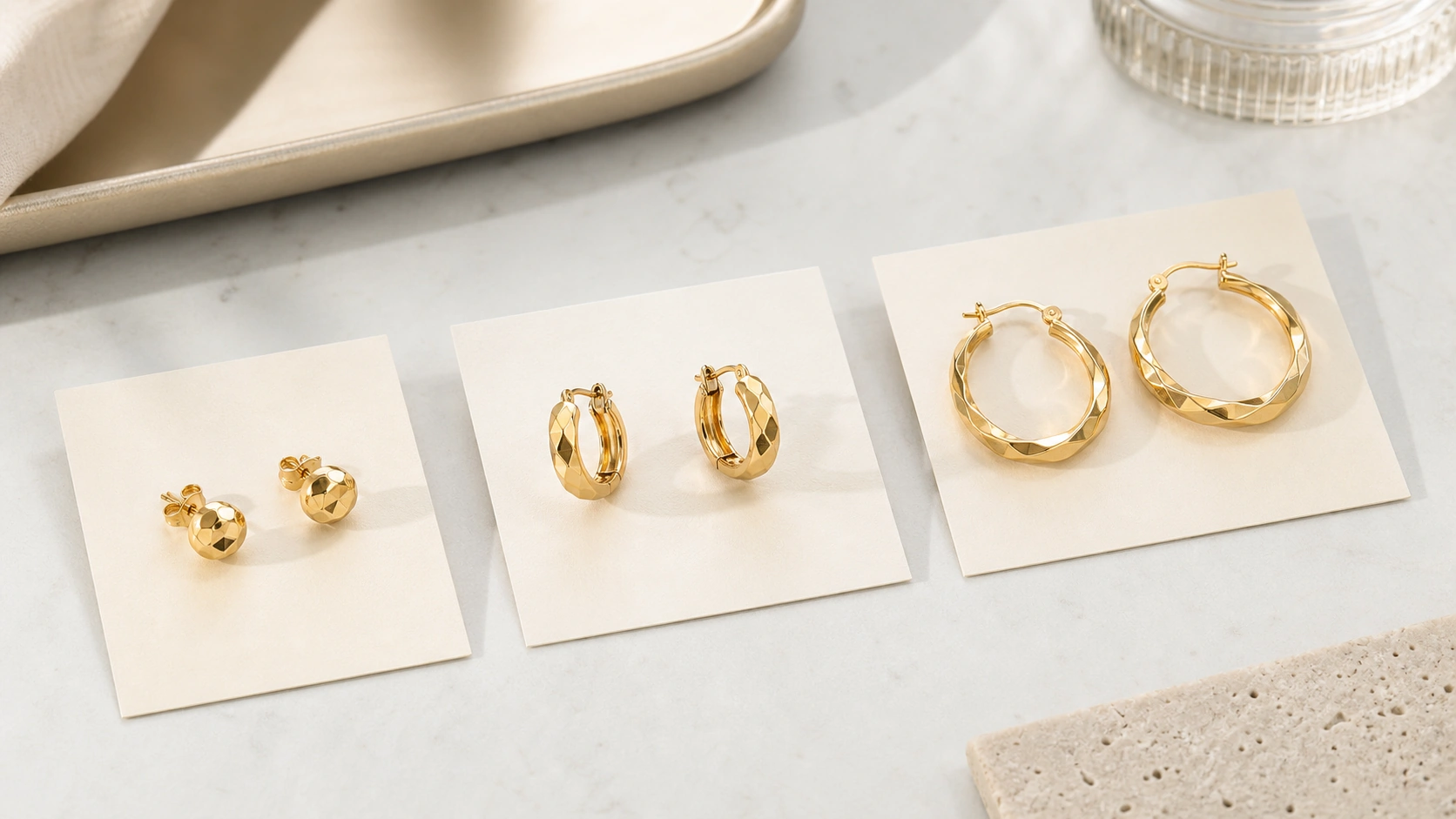
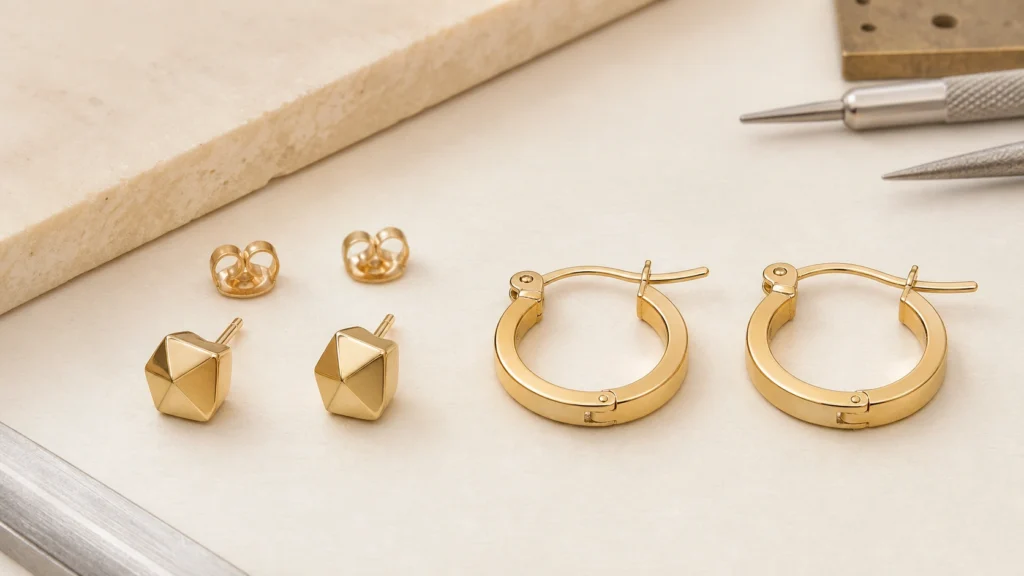
Stud earrings and hoop earrings can both anchor a collection, but they do different work. Studs concentrate attention close to the ear, while hoops create a visible outline and movement.
The right choice is not simply “minimal versus statement.” A large stud may be heavier and more visually dominant than a small huggie hoop. Your decision should connect the brand promise to measurable product requirements: dimensions, weight, closure, balance, packaging, target market, and the role of each SKU.
Quick Answer: Should Your Brand Choose Studs or Hoops?
Choose studs when the collection needs low-profile core styles, fine detail, giftable motifs, or pieces that work easily in an ear stack. Choose hoops when the brand relies on a recognizable silhouette, movement, fashion impact, or a size ladder from compact huggies to larger statement designs.
For many brands, use one format as the collection leader and the other as support. Confirm the decision with samples, because wearability depends on actual dimensions, weight distribution, material, closure, and intended wearer—not the category name alone.
Stud Earrings vs Hoop Earrings at a Glance
| Decision factor | Stud earrings | Hoop earrings | What the brand must confirm |
|---|---|---|---|
| Visual effect | Focused motif close to the ear | Circular outline, scale, and movement | Desired visibility in product photos and on the wearer |
| Common collection role | Core, gifting, stacking, symbolic or stone-led designs | Hero silhouette, fashion update, huggie-to-statement size ladder | Which role leads the assortment |
| Key hardware | Post plus back, or another close-to-ear system | Hinge, latch, wire, post-back, or continuous construction | Closure type and intended use |
| Development sensitivity | Post position, motif balance, projection, back fit | Diameter, cross-section, weight, symmetry, hinge and latch fit | Sample approval points |
| Wearing considerations | Pressure, projection, rotation, post length | Movement, opening, snag points, diameter, closure operation | Wear test with the actual sample |
| Packaging considerations | Protect the post and back from bending or loss | Protect the circle, hinge, and surface from deformation or abrasion | Finished-product packaging test |
This table describes typical design priorities, not fixed rules. Oversized studs, hollow hoops, huggies, sculptural forms, stones, and detachable elements can change the comparison.
How Each Style Changes Your Brand Signal
When Studs Support the Brand Promise
Studs suit brands whose value is communicated through controlled detail. A small geometric form, recognizable symbol, stone setting, texture, or enamel area can become a repeatable signature. The format also works well when customers build ear stacks or want a product that does not dominate the rest of an outfit.
However, “stud” does not automatically mean light or subtle. A wide face, deep setting, or off-center motif can rotate or pull away from the ear. The post position and back are part of the design, not afterthoughts.
When Hoops Support the Brand Promise
Hoops suit brands that want the earring silhouette to be recognizable from a distance. Diameter, cross-section, front-facing width, texture, and movement create a clear visual system. A brand can build a family from a compact huggie, a medium everyday hoop, and a larger editorial version while keeping a consistent design language.
Hoops can also carry charms, stones, twisted profiles, or sculptural surfaces. The trade-off is more structural decisions: actual weight, hinge, latch, opening angle, and distance from the earlobe can make a clean render feel different as a sample.
Compare the Product Architecture, Not Just the Silhouette
Stud Development Priorities
A stud brief should define:
- front motif dimensions and thickness;
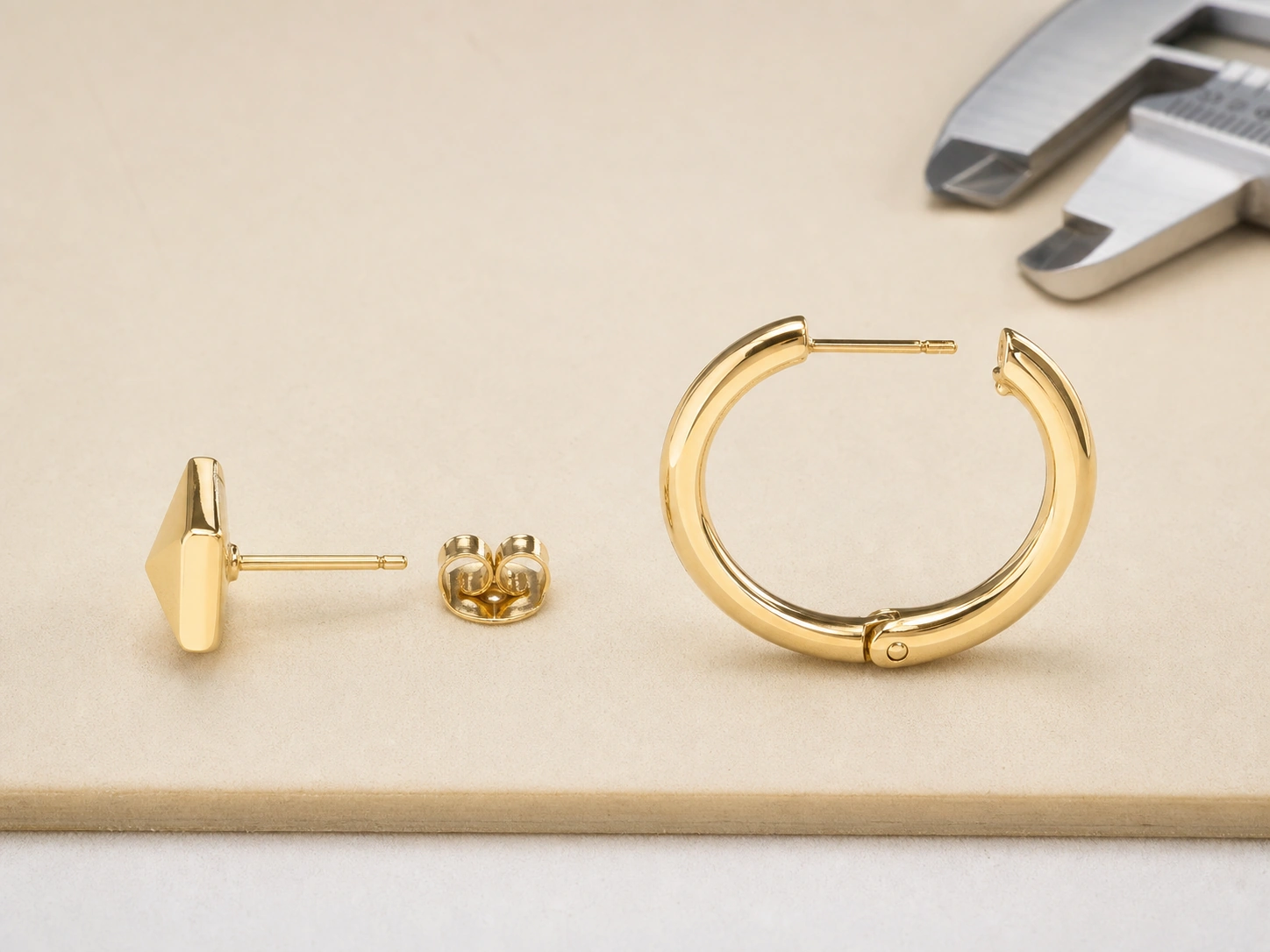
- post position, length, diameter, and orientation;
- back type, fit, and distance from the ear;
- left-right orientation for asymmetric designs;
- decorative-part security and acceptable rotation or tilt.
A post placed off the center of gravity can change how the motif sits. The back must hold it without unnecessary pressure, and packaging must prevent bending.
Hoop Development Priorities
“Hoop” covers several constructions. Huggies, hinged hoops, wire hoops, continuous hoops, and post-back hoops should not share one unspecified drawing. Define:
- internal and external diameter;
- cross-section shape and thickness;
- construction, hinge location, and opening angle;
- latch geometry, closing feel, and pin alignment;
- left-right symmetry;
- decorative-part position, target weight, and balance.
Small changes in diameter or cross-section alter appearance and weight. Assess the closure on finished samples after the intended surface treatment, and agree acceptance criteria before production.

Decide What Job Each Style Performs in the Assortment
Instead of asking which category is universally better, assign each SKU a role:
- Core style: the repeatable design that expresses the brand without relying on a trend.
- Hero style: the most recognizable or campaign-ready silhouette.
- Supporting style: a product that coordinates with the hero and creates an accessible styling option.
- Stacking or add-on style: a compact piece designed to combine with other earrings.
- Seasonal test: a controlled way to evaluate a new feature.
A stud-led collection can repeat one motif across core and stacking studs, with the hoop as support. A hoop-led collection can repeat one profile across huggie, medium, and statement diameters, with a coordinating stud as the quieter option. For a balanced capsule, repeat one controlled element while adapting it to each structure.
The broader planning sequence is covered in how to start a private label earring collection. Keep this comparison focused on the product roles that the brand actually needs.

Evaluate Wearability with Measurable Sample Checks
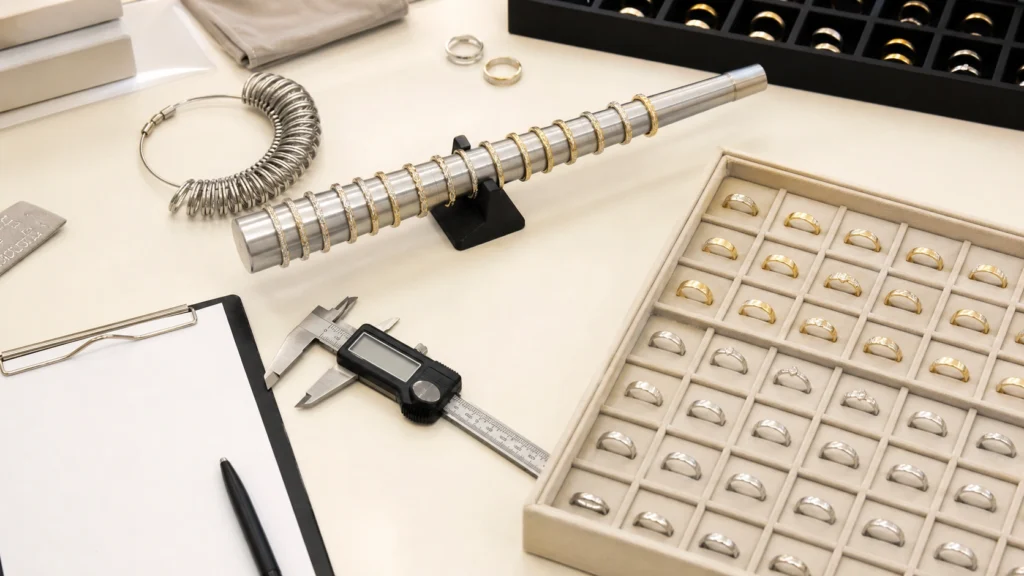
Wearability should be reviewed on physical samples, not inferred from the category name. A practical sample review can include:
- Record the finished weight of each earring and compare the pair.
- Check whether the stud sits level or rotates under normal movement.
- Confirm that the post and back engage consistently without excessive force.
- Check the hoop’s opening path, hinge movement, and latch alignment.
- Inspect edges, prongs, joints, and charm connections for snag points.
- Confirm left-right orientation and visual pairing.
- Wear the sample for the intended use period and record pressure, movement, and interference.
- Repeat closure operation under an agreed inspection method.
- Recheck appearance and operation after packaging and handling trials.
Use product-specific acceptance criteria; a compact huggie and a large fashion hoop should not share one movement standard.
A structured jewelry sampling service can help separate structural approval from finish, branding, and packaging approval. Keep revision notes tied to the product code and sample version.
Account for Packaging, Merchandising, and Fulfillment
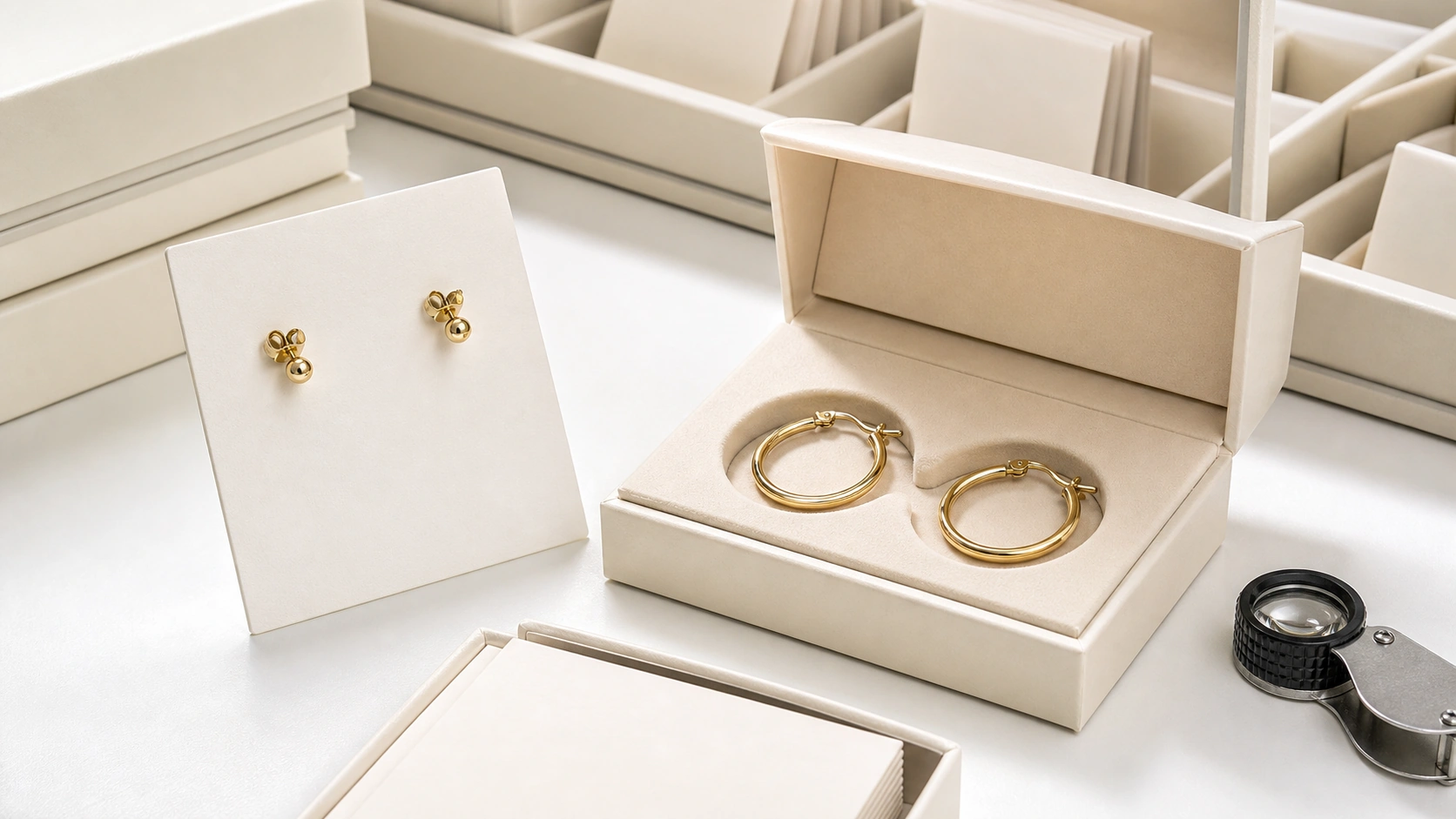
Studs need secure backs and protection against bent posts. Hoops need space to avoid abrasion, hinge pressure, or a distorted profile. Charms can add tangling or loss risks to either format.
Test the finished pair on the intended card, tray, pouch, or box. Confirm:
- the product remains paired and correctly oriented;
- the card holes or fixtures do not strain the post or closure;
- metal surfaces do not rub against each other;
- the package protects projections, stones, and moving parts;
- the product can be removed and replaced without damage;
- the package scale works for photography, storage, and shipment.
In merchandising, studs can look small without detail and scale. Several hoop diameters can look too similar without consistent measurements. Product data should record dimensions, closure, materials, finish, and pair contents.

Confirm Target-Market Requirements before Locking Materials
Earring requirements depend on the destination market, intended wearer, material, coating, skin-contact parts, and product claims. The same front design may also use different findings, so the post, back, pin, hinge, and body must be included in the material and compliance review.
For example, the European Chemicals Agency’s REACH Annex XVII Entry 27 on nickel addresses nickel release from post assemblies inserted into pierced ears and from articles such as earrings intended for direct and prolonged skin contact. It also identifies CEN standards as the test methods for demonstrating conformity with that restriction.
This does not establish one universal specification for every market. The applicable requirements, test methods, documentation, age-related rules, labeling, and retailer standards should be verified for each destination before the brand locks materials or makes product claims. Do not use “nickel-free,” “hypoallergenic,” or similar language without appropriate evidence for the exact product.
A Practical Brand Decision Framework
Use five questions to reach a controlled decision:
- What is the brand promise? Detail and restraint may point toward studs; silhouette and movement may point toward hoops.
- How will the customer wear the product? Consider ear stacking, work, events, travel, gifting, and the expected wearing period.
- What must be visible in the sales channel? Review how the product reads in an ecommerce thumbnail, campaign image, display tray, or wholesale line sheet.
- Which technical risks can the project manage? Compare post balance and back fit with hoop diameter, weight, hinge, and latch requirements.
- What role does the SKU play? Decide whether it is core, hero, supporting, stacking, or a seasonal test.
If the answers remain unclear, sample one representative stud and hoop against the same criteria before expanding either into variants.
What to Send a Manufacturer for Stud and Hoop Development
A manufacturer-ready request should include:
- front, side, and back views;
- dimensions and wearing orientation;
- base material and intended surface finish;
- stones, enamel, charms, or decorative parts;
- stud post and back requirements;
- hoop diameter, cross-section, hinge, pin, and latch requirements;
- target weight or wearability objective;
- left-right pairing instructions;
- logo artwork and position;
- destination market and intended wearer;
- packaging format and product-card requirements;
- sample review criteria and approval owner;
- number of styles, finishes, and sellable variants.
If you own the design and technical direction, OEM jewelry development may be relevant. If not, identify which structural decisions require manufacturer input.
Final Recommendation: Build the Collection around Roles
Studs generally provide a focused, close-to-ear platform for detail, gifting, stacking, and core styles. Hoops generally provide a stronger outline, movement, and a clear size-based product family. Neither category guarantees comfort, simplicity, durability, or commercial success.
Choose the lead style that expresses the brand promise, give the other a supporting role, and confirm both through samples, packaging trials, market review, and documented approval criteria.
Explore Jinnuo’s custom earrings capabilities or share your design files, dimensions, closure preferences, finish direction, packaging needs, and target market to request a custom jewelry quote.
FAQ
Should a new jewelry brand launch stud earrings or hoop earrings first?
Start with the format that communicates the brand promise most clearly. If uncertain, sample one representative design of each and compare wearability, photography, packaging, and customer fit.
Can the same motif be used on both studs and hoops?
Yes, but adapt it to each structure. Confirm scale, balance, orientation, movement, and attachment security separately for the stud and hoop versions.
Are hoop earrings always more complex to manufacture than studs?
No. Complexity depends on dimensions, construction, closure, stones, finish, and decorative parts. A simple hoop may be less complex than an elaborate stone-set stud.
Which closures should a brand specify for studs and hoops?
Studs and hoops support several back or closure systems. Choose according to the design, wearer, market, weight, and use case, then confirm exact parts and acceptance criteria during development.
How can a brand balance studs and hoops in one collection?
Give each format a role and repeat one controlled element across both. For example, use studs as core and stacking styles, hoops as the hero, and one shared texture or motif.