

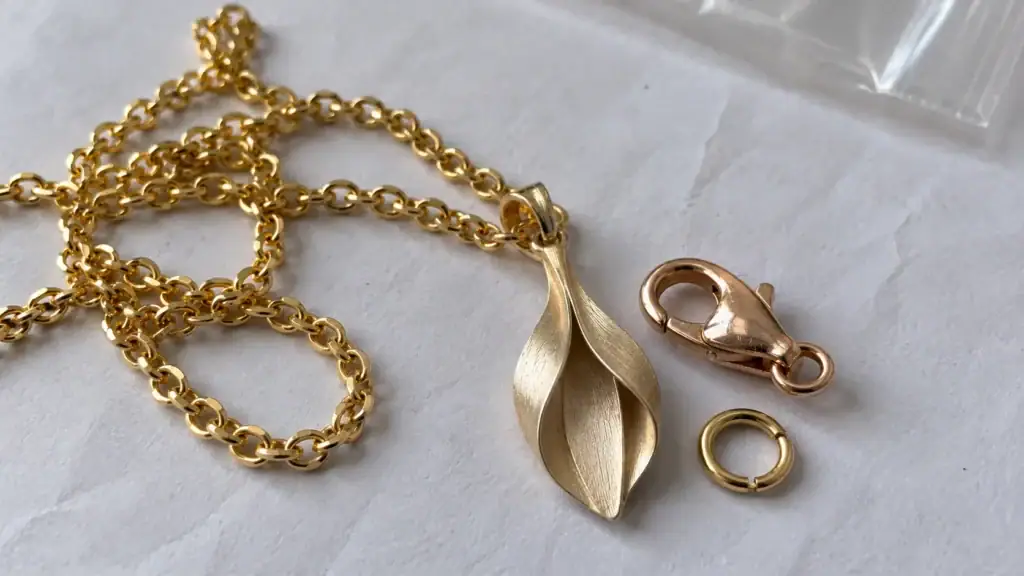
Imagine you’re putting together your first necklace collection:
“I’ve chosen a charm I really like, then found a chain and clasp to go with it. All three listings say ‘18K gold plated,’ so I thought they would match. But now they’re here, the chain looks much yellower than the charm, and the clasp is noticeably shinier. Should I replace one part, return everything or try another supplier?”
Gold chains, clasps and charms can look mismatched because their surface alloys and finishes differ. The same karat description does not specify an exact shade, and even similar shades can look different in gloss or texture. World Gold Council, CIE
The descriptions may all be accurate. What they haven’t established is whether those particular components look right together. Buying another part with the same “18K gold plated” description could leave you with the same uncertainty.
Before ordering replacements, you should first decide which piece needs to stay. If the charm is central to your design, use it as the reference for the chain and clasp. If you must keep an existing chain, start there instead. You can then separate “too yellow beside the charm” from “too glossy for this design.” That gives the supplier a clearer starting point and gives you something specific to check in the next sample.
Why Can Gold Components Look Different at the Same Karat?
Buyers assembling a necklace may use “18K gold plated” as a shortcut when choosing a chain, clasp and charm. The missing distinction is that karat describes gold content, not an exact color. Matching those descriptions does not establish that the finished parts will match.
An 18K gold alloy contains 75% gold by mass. The remaining 25% is not a fixed recipe: changing the proportions of metals such as silver and copper can change the shade without changing the karat. Two accurately described 18K components can therefore differ in color. A paler clasp alone is not proof of lower gold content. FTC; Cretu and van der Lingen, 1999
In an “18K gold plated” description, 18K refers to the gold coating rather than the metal underneath. The process used to produce that coating also matters. In a 2025 gold–nickel study, researchers kept the plating-bath formulation the same but changed the electrical pulse conditions, producing coatings with different compositions and measured colors. This was not a comparison of fixed-18K alloys; it showed that the same bath formulation can produce more than one finished color. Mariani et al., 2025
There is also a distinction between matching color and matching appearance. CIE identifies color, texture and gloss as different aspects of appearance. A polished clasp may still look out of place beside a textured charm even when their shades are close. In that situation, asking for a different gold shade may leave the actual problem unresolved. CIE, 2020
The purchasing mistake is treating separate material descriptions as evidence that the parts have been matched together. If you need a coordinated set, keep the required karat, but add a separate request: “Please compare this chain, clasp and connecting rings with the reference charm for both gold color and surface finish.”
A reply that only confirms “all parts are 18K” answers the material question—not the matching question.
Why Do Gold Components Match Online but Not in Person?
Separately photographed components can appear to match online but differ in person. Screens introduce another variable: the same photo can look yellower on a laptop and pinker on a phone. Buyers must assess both the photo’s fidelity to the jewelry and the screen’s fidelity to the photo. Correcting one does not automatically correct the other.
The chain is: physical jewelry → lighting, photography and editing → image file → viewing software and display.
An image’s RGB numbers need a color-space definition. sRGB and Adobe RGB are different color spaces, not quality grades. The image’s ICC profile tells color-managed software how to interpret those numbers; the display profile describes the screen’s response. Software uses both to translate between them. Incorrect profile handling can change the appearance even when the underlying image numbers are unchanged. ICC; Adobe
100% sRGB coverage is not 100% color accuracy. Coverage describes a range, not how accurately each color is reproduced. BenQ’s PD2705Q, for example, lists gamut coverage and color accuracy separately. Apple documents factory calibration for its Liquid Retina XDR MacBook Pro displays and Studio Display, with reference modes for different workflows. These are useful capabilities, not a guarantee from a brand name alone: the selected mode and viewing conditions still matter. BenQ; Apple calibration; Apple reference modes
On compatible equipment, a Datacolor Spyder can help calibrate and profile the display. That can reduce display-related error, within the panel’s physical limits. It cannot recover the real color of a clasp from a photo already made too warm or selectively recolored. A calibrated screen can faithfully reproduce an inaccurate product photo. Datacolor; ICC on color casts
The problem is not an absence of standards. An older Amazon Home Selection Image Guide, for example, required sRGB and accurate product color as separate requirements. That category guide does not establish today’s rules for every jewelry listing. More importantly, meeting a color-space requirement does not prove that the photographed gold matches the actual piece. Amazon’s category guide
For jewelry buyers, the practical response is to improve the comparison evidence:
| Ask the supplier for | What this addresses |
|---|---|
| A photo of the proposed chain, clasp and connecting rings beside the reference charm, under the same lighting. | Differences introduced by comparing separately photographed listings. It does not remove every camera or reflection effect. |
| An sRGB comparison file with the correct profile embedded, without recoloring individual parts to make them match. | File interpretation and misleading adjustments. If conversion is needed, merely assigning an sRGB profile is not the same operation. |
| A short change-of-angle video, followed by an assembled physical approval sample. | The video shows changing reflections; the assembled sample allows direct comparison of color and finish under agreed lighting. |
The conversion distinction is explained in Adobe’s profile guidance; the comparison steps are practical purchasing recommendations, not a standardized color test.
If you need a close match, use photos to screen options, then approve the assembled sample under agreed lighting. Display calibration can reduce viewing error; it cannot establish whether the photo accurately represents the jewelry.
Buy a Matching Set, Source Separately or Request Custom Matching?
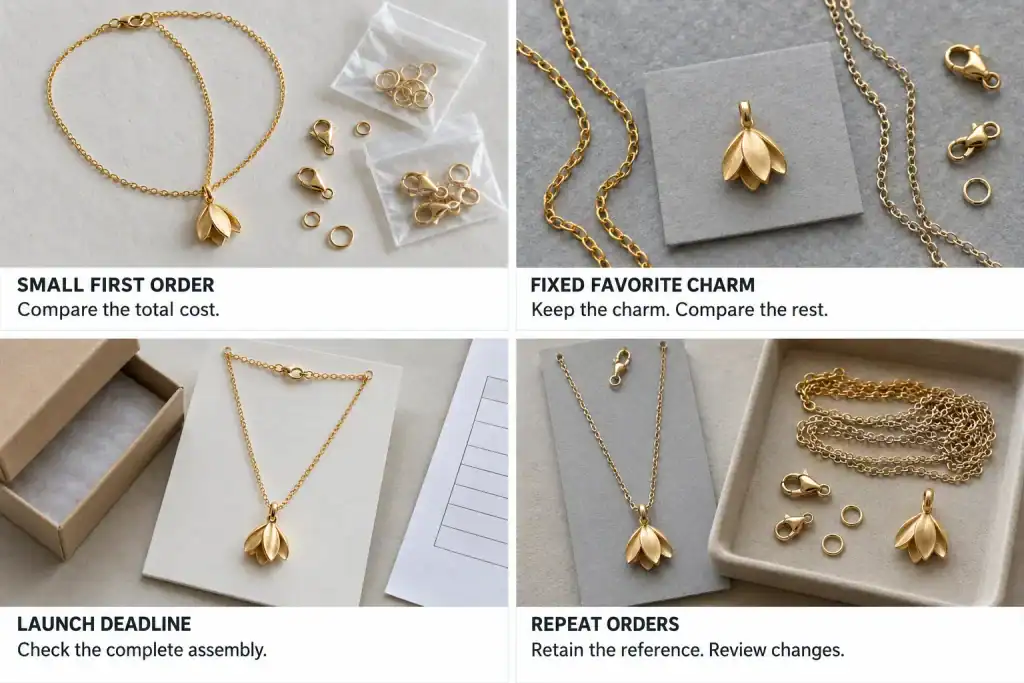
The following hypothetical situations show how buyers can choose a sourcing route around their budget, fixed design requirements, launch schedule or restocking needs.
For a first small order: “Buying each part cheaply should keep the project affordable.”
That compares component prices, not the cost of a workable combination. Separate shipping, minimum purchase quantities and unsuccessful samples can change the calculation. If the design is flexible, compare ready-made coordinated sets with the full cost of sourcing parts separately. Confirm the actual combination before choosing a set; the shared label “18K gold plated” is not enough. The aim is a usable result within budget, not the lowest price for every part.
For a fixed signature or sentimental charm: “I want to keep this charm—and the chain I already chose.”
Keeping the charm may be essential; keeping that particular chain may only be a preference. Separate sourcing makes sense when some surrounding choices can change. Identify those choices before sampling. If no acceptable stock combination works, consider custom matching. Ask whether the other components can feasibly receive a coordinated finish or need new development. Do not assume the reference charm itself can be altered without separate approval.
For a small brand approaching launch: “Using one supplier will save time, so the parts should match.”
One contact can simplify communication, but it does not confirm that the proposed parts have been checked together. Start with an available coordinated set if the design is flexible. Otherwise, assess separate sourcing or custom matching against the time needed for sampling and approval, plus development if required. Confirm the actual dispatch plan rather than treating “in stock” as a promise of arrival.
For a repeat-order collection: “Once the custom sample is right, future orders are sorted.”
An approved sample is a reference for reorders, not proof of future consistency. Ask which part identifiers and finish specification will be retained, what happens if a component becomes unavailable and who will flag substitutions before production. Compare stock and custom options on these commitments, rather than on the first sample alone. A larger order does not automatically require new component development.
Before funding development, establish what the next sample will prove. GIA describes CAD and resin prototypes as tools for assessing scale, engineering and manufacturability. GIA For color matching, our recommendation is to assess the complete physical sample in the intended materials and finishes.
Request a written scope and price for that stage. ITA’s quotation guidance also includes the quoted items, estimated shipping date and validity period. ITA
If you need one rule: choose around the requirement that cannot change and name who will check the complete combination and coordinate any corrections.
What If the Gold Components Have Already Arrived and Don’t Match?
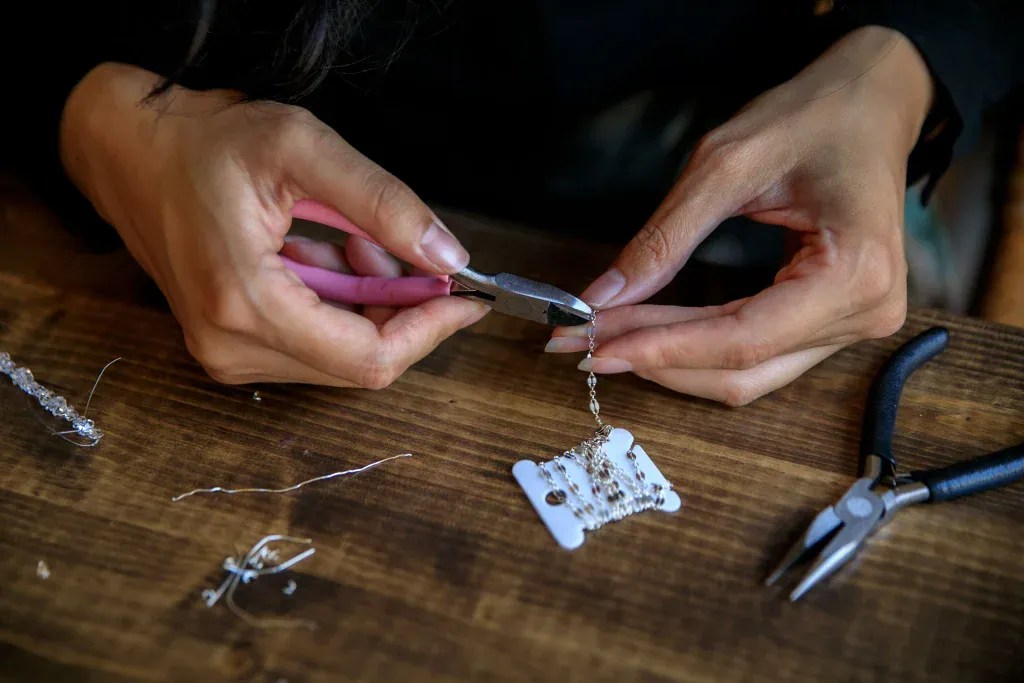
A buyer’s first thought might be: “Perhaps one more clasp will save the order.” Before spending again, separate two problems: parts that differ from the agreed specification and correctly described parts that simply look wrong together. Compare the delivery with the listing, agreed requirements or approved sample. Document the difference and check return, exchange or remake options before altering the originals.
If only one component looks wrong, change one variable.
For a small, replaceable purchase, buyers can keep the satisfactory chain and charm as the reference. If the clasp is too pink, compare a different tone; if it dominates because of size or shine, another clasp labeled “18K” may miss the real problem. Check one candidate in the complete assembly before buying more. Compare the remaining cost of each option—including shipping and installation—not just the replacement part’s price.
If a piece is irreplaceable, saving the combination is not the only goal.
An owner may feel that everything must work because each piece was chosen carefully. With an inherited charm, preserving the original may matter more than using the chain already purchased. Another chain, a different design or wearing the pieces separately can be legitimate outcomes. Do not make the irreplaceable piece the first experiment in changing the finish.
If a batch is affected, do not turn one correction into a larger gamble.
A brand under launch pressure may want the supplier to “fix everything.” Brands should first identify which component versions or deliveries are affected and retain an unchanged reference. Approve one corrected complete sample before authorizing batch rework, then check the completed work against it. Agree on the intended appearance, clasp operation, cost and timing—not just “make it the same gold.”
Replating needs an assessment, not an automatic yes.
Legor’s technical guide emphasizes surface preparation before plating. Legor Buyers can then ask a specialist about base metals, existing coatings, any limitations involving stones or adhesives and necessary preparation or disassembly. The proposal should explain whether it addresses tone, gloss or texture—not just “gold color.”
Do not try to rub mismatched parts into agreement with abrasive polish. The Canadian Conservation Institute’s silver-care guidance warns that polishes damage gilding and leave fine scratches on silver. CCI
Jewelers of America advises getting a repair cost and time estimate before authorizing work. Jewelers of America For this mismatch, buyers should also ask: “Which part will change, what result can be achieved and what happens if the completed work is not acceptable?”
Before you spend again, set a limit on additional cost and changes to the originals. If the proposed fix cannot meet the must-keep requirements within that limit, change the plan.
How Can Buyers Specify a Gold Color Match Before Ordering?
After a mismatch, a buyer might decide: “Next time, I’ll specify 18K gold plating for every part.” That clarifies one requirement, but it still does not define the finished appearance. The more useful brief identifies a reference, explains which features matter and states what must be checked before approval.
The CIE treats color, gloss and texture as distinct attributes of appearance. For purchasing, that distinction helps turn “the gold looks wrong” into a change the supplier can actually discuss. CIE
| Vague request | What remains unclear | A more useful request |
|---|---|---|
| “Make it lighter.” | Less yellow, lighter in tone or less shiny? | “Against reference [A], the clasp looks too yellow. Propose a less yellow option while keeping the polished finish.” |
| “Match this charm.” | Must its color, shine and texture all be copied? Can the charm itself change? | “Keep charm [A] unchanged. Use its gold tone as the target; the chain may have a different texture. Show the proposed parts together.” |
| “Same as the last order.” | Which approved sample and parts list? Are substitutions acceptable? | “Use approved assembly [B/date] and its component list. Get approval for any proposed material, finish or component changes before proceeding.” |
A first-time buyer without a reference does not need to invent a laboratory specification. Ask for samples of available combinations labeled with sample IDs, then select a physical reference. For reorders, keep the approved assembly and its component record—not just a screenshot of the original listing.
There is a standard for a limited range of gold-alloy colors and their measurement: ISO 8654. But a supplier’s “champagne gold” name is not automatically a designation under that standard, and choosing a charm as a reference does not make it a calibrated color standard. ISO
A short message to adapt for a supplier:
Please use physical sample [ID/date] as the reference for [gold tone/gloss/texture—specify which]. Keep [component] unchanged; alternatives are welcome for [other parts].
Include the chain, clasp, charm and all connecting or finishing parts used in the design, including any jump rings, extender chain or end tag. Before sampling, identify any differences you expect and propose alternatives.
Please confirm the sample cost and scope first. For review, provide a complete assembly in the proposed materials and finishes, alongside the reference. Let’s agree on lighting, background and viewing positions for comparison.
Record the approved sample ID and its parts list, including part IDs, materials and finishes. Get written approval before making substitutions on later orders. Approval of the sample’s appearance does not authorize bulk production. Material, performance and other product requirements still need to be agreed on separately.
A useful supplier reply might be: “The available clasp has a different texture. Here are alternatives to compare beside the charm.” That is more informative than “No problem. Every part will have 18K gold plating.”
Before you approve, make sure both sides can identify the same reference, the complete combination and any differences being accepted.
How to Specify a Gold Color Match Before Ordering
Imagine a brand developing a new necklace. The charm’s shape has been approved, while the chain and clasp will be bought as stock components. When the samples arrive, the chain looks pale, the clasp looks warmer and the charm has a softer finish. The brand puts them together and asks the supplier to “make them all the same gold.”
That sounds like a clear request. But it leaves the supplier guessing about the decisions that determine whether the match is achievable: which finishes can change, which components must come from existing stock and whether the real objection is a different gold tone or a part that looks too shiny.
First, identify what cannot change—not just the desired shade.
In this example, approving the charm’s shape does not necessarily mean its current gold color is fixed. If the final finish is still open to adjustment, and the supplier can preserve the design while meeting the agreed material and performance requirements, another route is worth comparing: match the charm to a suitable stock chain rather than force the stock chain to match the charm. The warmer clasp still needs to be included; matching two of the three parts does not solve the whole necklace.
Choosing a finish that has not yet been applied is also different from reworking a finished component. Rework may involve stripping an existing coating or other treatment, with compatibility checks for the coating, base metal and construction. “Just plate everything again” skips that assessment.
This does not mean changing the charm will be cheaper. It means finding the genuinely adjustable part before choosing a solution. Compare feasibility, cost, availability and the original quality requirements—not simply which component is more expensive or visually prominent.
An existing charm whose original finish must be preserved creates a different constraint. In that case, the search should focus on compatible chains and clasps, not on assuming the charm can be refinished.
A useful supplier brief would therefore say:
The charm’s shape must remain unchanged, but its final surface color has not been approved. Please provide physical samples of chain options available for repeat orders, then assess whether the charm can be matched to the selected chain. Do not reduce the agreed base-metal, coating or performance requirements to achieve the color. If those requirements conflict, propose alternatives.
If the charm’s existing finish must stay, say so explicitly: “Do not recolor or refinish the charm. Matching changes must be limited to the other components.”
And if a supplier only sells finished stock and offers no recoloring service, more precise color adjectives will not create that capability. The practical choices are different stock, a different supplier or a different combination.
Next, establish whether the problem is the gold tone or the way the part stands out.
Suppose the clasp looks “too yellow and too shiny.” Asking for less yellow may solve only part of the problem—or target the wrong thing. When a polished clasp with strong highlights sits beside a charm with a softer finish, the mismatch may involve more than the gold tone.
As a practical comparison, place the actual components under the same lighting in their intended arrangement, then change the viewing direction. If the mismatch shifts mainly with the highlights, investigate gloss and reflections from the shape. If a noticeable gold-tone difference persists across several views, investigate that too, without ruling out surface and shape effects. This observation helps decide what to check next; it does not identify an alloy or plating formula. Research on material appearance explains how surface geometry, roughness and lighting contribute to what is seen, but it is not a diagnostic test for gold jewelry. Tominaga and Guarnera, 2019
The next sample should answer a specific question, not merely look “better.” Ask the supplier to compare gold tones while keeping the clasp model and polished finish as consistent as possible, or compare surface finishes while aiming for a similar gold tone. These variables are not necessarily independent in production. The important point is to record what actually changed. If the model, texture and color all change at once, an improved sample says little about which change helped—or what must be preserved on a reorder.
There may also be a choice that color adjustment cannot resolve. A buyer who insists on a curved, highly polished clasp cannot simply assume it will look identical at every angle to a flat charm with a softer finish. Consider a different component or surface treatment, or approve a demonstrated difference in gloss instead of requesting another color correction. CIE identifies color, texture and gloss as attributes of appearance. ASTM D2244-25 also notes that gloss, texture and specimen proximity may affect how measured color differences relate to commercial acceptability. CIE; ASTM
A flat color card can help communicate the target. A physical test piece with its substrate, coating and finish documented is more useful for discussing a process. For final appearance approval, however, we recommend comparing the actual chain, clasp and charm together—not approving the necklace from a flat sample alone. Confirm and record which differences are acceptable or unacceptable within the actual combination, along with the viewing conditions and the components to which those decisions apply. If a slightly brighter clasp is acceptable, the model may stay. If that difference is unacceptable, the finish or component may need to change—not just its gold tone.
Then ask whether the match depends on sorting—and whether the order includes that work.
Sorting parts into matching sets can be a legitimate production step. The issue is whether the buyer knows it is necessary and who is responsible for it.
A supplier who selects one matching chain and clasp from a batch has shown that those particular parts work together. That does not establish that the remaining parts are interchangeable, or that the same selection process will produce enough complete sets for the order.
Consider a hypothetical delivery in which most chains are pale and most clasps are warmer. Even with equal numbers of chains and clasps, there may not be enough compatible pairs. The pale chains lack enough matching clasps; the warmer clasps lack enough matching chains. The shortage is in usable pairings, not necessarily in the total number of parts.
Sorting therefore means more than extra handling. It may leave unmatched inventory or require additional purchases that affect delivery. A 2025 EPFL overview of selective-assembly research discusses the cost of matching parts and managing unmatched surplus in precision manufacturing. That is not a gold-jewelry experiment: the relevance here is the inventory problem, not a jewelry-specific waste rate or cost estimate. EPFL
The purchasing arrangement should reflect how the product will be used.
A brand selling assembled necklaces can request complete sets that meet the approved appearance criteria. Sorting, assembly, unmatched leftovers and responsibility for completing any shortfall should be agreed in the quote. The deliverable is usable necklaces, not separate bags of individually acceptable parts.
A mix-and-match charm collection has a different requirement. Customers choose among chains and accessories, so supplying carefully selected sets does not establish that other permitted combinations will work. The buyer needs compatibility across the agreed range, and checks should include different component combinations—not only the supplier’s chosen sample.
That leads to more useful questions:
Does the quote cover loose components that we must sort ourselves, or complete matched sets? If sorting is necessary, who pays for it and carries the unmatched inventory? Must a reorder match only within the new batch, or also work with our existing stock?
Pre-matched sets can suit fixed combinations, but breaking them apart may lose the match. Broader interchangeability needs evidence from components supplied under the proposed production conditions. “We have done this before” and one attractive sample do not establish that range of compatibility.
Finally, use the sampling stage to test the supply plan, not just the appearance.
For this necklace, a useful trial should identify the selected stock chain, the charm material and finish used to match it, and whether the clasp needs routine processing, additional finishing or sorting. It should also establish which of those steps the production quote includes.
To evaluate the supply plan, use a group of components obtained through the proposed supply method rather than another specially selected display set. Record how many parts went in, how many usable sets met the agreed criteria, what remained unmatched and whether extra finishing or replenishment was needed. If interchangeability is claimed, record which combinations were checked, which parts and batches they covered, and whether existing inventory was included.
If sorting is necessary, the buyer can order matched sets from the supplier or buy loose parts with an explicit agreement to bear the sorting and unmatched-inventory costs. If the business requires interchangeability and the trial does not support it, consider different components, a narrower range of combinations or a revised appearance target. A check within one batch does not establish compatibility across batches, and one trial does not prove long-term consistency.
These records are not paperwork for its own sake. They reveal costs and constraints that a beautiful sample can conceal. If there are too few usable sets, or matching requires work that was not priced, the supplier needs to revise the supply plan—not simply promise to “pay more attention during production.” Material, coating and performance requirements still apply; a color match cannot quietly replace them.
The useful request is no longer just “I want this gold.” It explains what must stay, what may change, how the match will be achieved and how the delivered components will be used.
What Should You Do Next?
Gold chains, clasps and charms can share the same color description or karat label without matching in tone, gloss or texture. Separate product photos are not a substitute for checking the actual components together.
There is no need to memorize every plating or color term. Start with a simpler question: is the goal to put together one matching piece of jewelry, buy a batch of fixed combinations or support future reorders and mix-and-match choices? Each requires a different level of confirmation.
| The goal | What to do next | What to confirm |
|---|---|---|
| Make one jewelry combination work | Decide which components and requirements must stay unchanged, then compare alternatives for the part that looks out of place. If the goods have already arrived, document any differences from what was agreed and check return or exchange options before making alterations. | Check the appearance, connections and function of the assembled piece. If it meets the intended requirements, there is no need to keep chasing an identical appearance at every angle. |
| Buy a batch of fixed combinations | Establish whether the supplier will deliver matched sets or loose parts that the buyer must sort. Then try assembling a group of components obtained through the proposed supply method. | Look beyond one attractive sample: how many usable sets can be assembled, and who takes responsibility for sorting, unmatched inventory and additional work? |
| Support reorders or customer-selected combinations | Define which components must work together and whether new deliveries need to match existing stock. Check the relevant combinations and batches. | One matching set does not establish compatibility across other combinations. A check within one batch does not establish compatibility across batches. Findings apply only to what was checked, not as a guarantee of long-term consistency. |
Whichever situation applies, follow the same sequence:
Identify the mismatch → Decide what cannot change → Test the proposed solution on a small scale → Then decide whether to buy more or authorize further work.
Avoid buying more components before understanding the problem—or committing to a full batch after seeing only one successful sample.
If a proposed solution cannot meet the must-keep requirements, or exceeds the acceptable additional cost, a different combination, a different supply arrangement or using the pieces separately may be the better outcome. There is no need to keep spending simply to use every component already purchased.
The final question is not whether every listing says “18K.” It is whether the actual combination achieves the required result and whether the supplier can deliver it as agreed. Material, coating and functional requirements must still be met, not traded away for a closer color match.
Sources
- World Gold Council, Gold Jewellery: Colour, Carat & Purity.
- U.S. Federal Trade Commission, Buying Platinum, Gold, and Silver Jewelry.
- Cretu, C. and van der Lingen, E., Coloured Gold Alloys, Gold Bulletin, 32(4), 115–126, 1999.
- Mariani, E. et al., Achieving Multiple Colors from a Single Gold Electroplating Bath for Decorative Applications Using Pulse Current Deposition, Materials Today Communications, 47, 113037, 2025.
- International Commission on Illumination (CIE), International Lighting Vocabulary, “appearance, perceptual,” 17-22-019, 2020.
- International Color Consortium (ICC), ICC Frequently Asked Questions.
- Adobe, Change Color Profiles in Photoshop.
- BenQ, PD2705Q DesignVue Designer Monitor Datasheet, 2020.
- Apple Support, Guidance on Measuring Display Calibration.
- Apple Support, Use Presets and Reference Modes with Your Apple Display.
- Datacolor, Monitor Calibration Myths & Facts, May 31, 2023.
- Amazon, Amazon Home Selection Image Guide, p. 4, File Requirements.
- Gemological Institute of America (GIA), Jewelry Design & Technology Program.
- U.S. International Trade Administration, Pro Forma Invoice.
- Canadian Conservation Institute (CCI), Silver—Care and Tarnish Removal, CCI Notes 9/7.
- Jewelers of America, Jewelry Repair.
- Tominaga, S. and Guarnera, G. C., Measuring, Modeling, and Reproducing Material Appearance from Specular Profile, Color and Imaging Conference, 2019, pp. 279–283.
- ASTM International, ASTM D2244-25: Standard Practice for Calculation of Color Tolerances and Color Differences from Instrumentally Measured Color Coordinates, 2025.
- École Polytechnique Fédérale de Lausanne (EPFL), Balancing Cost and Precision: Optimal Ordering for Selective Assembly, February 24, 2025.