Custom Necklace Packaging Ideas for Private Label Jewelry Brands

Article Contents

Good custom necklace packaging must do more than look attractive. It should present the necklace clearly, keep the chain organized, reduce pendant movement, protect the finish, carry required brand or retail information, and fit the intended fulfillment and shipping process.

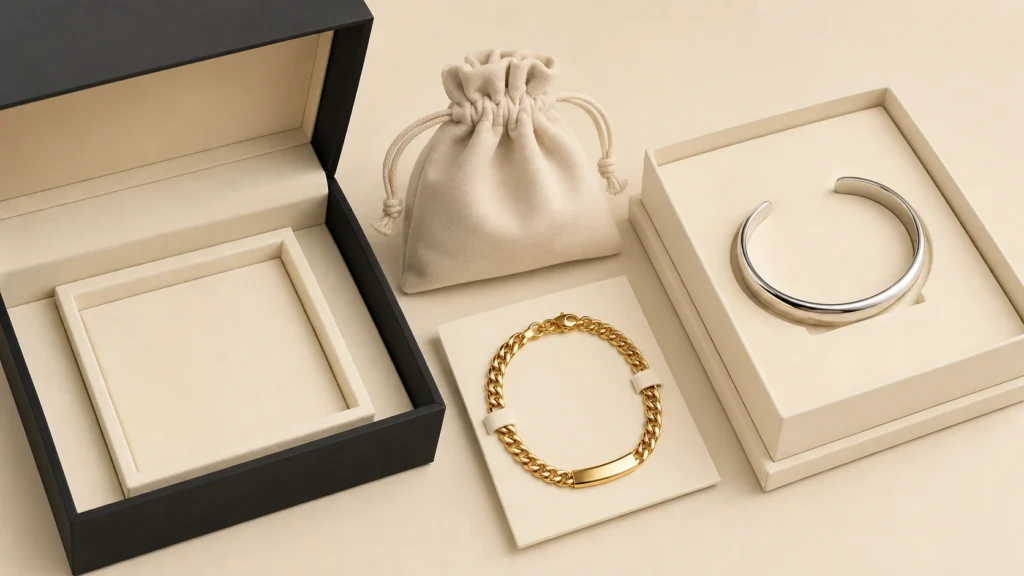
For most private-label jewelry brands, the practical choice is not simply “card, pouch, or box.” It is a packaging system with three layers: product restraint that holds the chain and pendant, customer-facing packaging that supports the brand experience, and transit protection that reduces crushing, abrasion, contamination, and tangling.

Quick Comparison of Necklace Packaging Options

Packaging optionBest forMain advantagesMain limitations
Necklace display cardLightweight necklaces, retail display, compact fulfillmentEfficient, visible, easy to label, space-savingNeeds secure chain routing and separate transit protection
Soft pouchFlexible ecommerce or gift presentationReusable, compact, tactileA loose chain can tangle; pendant may rub against chain or clasp
Folding cartonLightweight branded presentationPrintable; some formats store flatInternal restraint must be designed separately
Rigid jewelry boxPremium gifting and structured presentationStrong presentation, better crush resistance, customizable insertHigher volume, weight, material use, and shipping impact
Protective bag or sleeveOperational protection and inventory handlingHelps keep parts together and surfaces cleanerNot a complete brand experience

No format is automatically best. A delicate chain needs different restraint from a chunky link necklace, and a sharp-edged pendant needs different protection from a smooth disc pendant.

Start with the Necklace, Not the Box

Packaging development should begin with the finished necklace specification. Gather the actual length, extension chain, clasp size, chain gauge, pendant dimensions, finished weight, surface finish, stones or enamel, and any parts that can scratch one another.

Ask whether the chain kinks easily, whether the pendant slides, whether it is heavy enough to pull through card slots, whether the clasp or extension can touch the front surface, whether delicate details need clearance, whether the finish marks through rubbing, and whether the necklace must remain visible for retail display.

Use a real finished sample when testing packaging. A CAD rendering cannot show chain memory, clasp bulk, pendant movement, or behavior after repeated handling.

Necklace Display Cards: Compact and Retail-Friendly

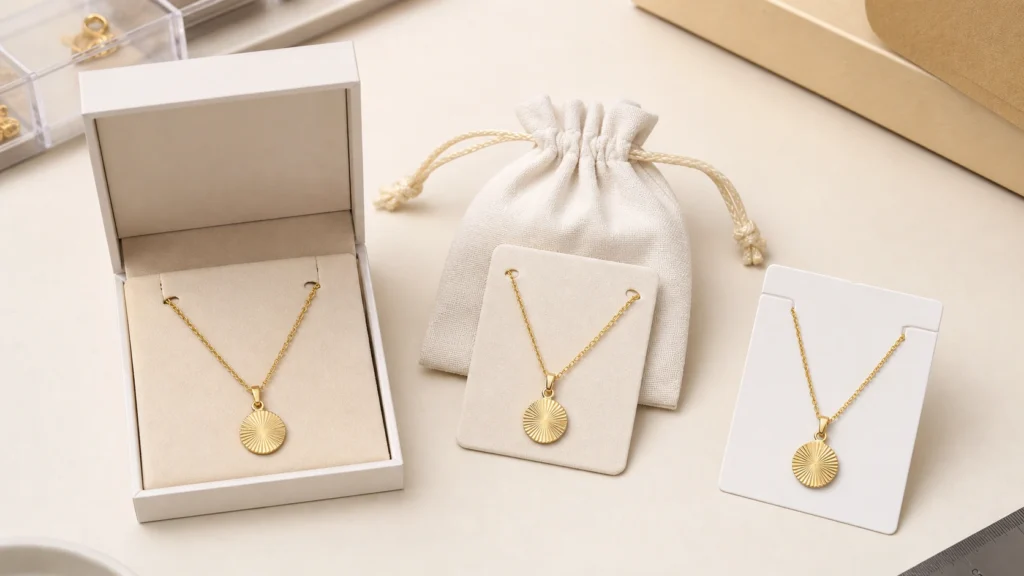
Display cards are practical for lightweight fashion necklaces, especially when a retailer or fulfillment team needs quick product identification. Cards can carry branding, care information, SKU data, or retail labels according to the brand’s requirements.

Design the chain routing carefully

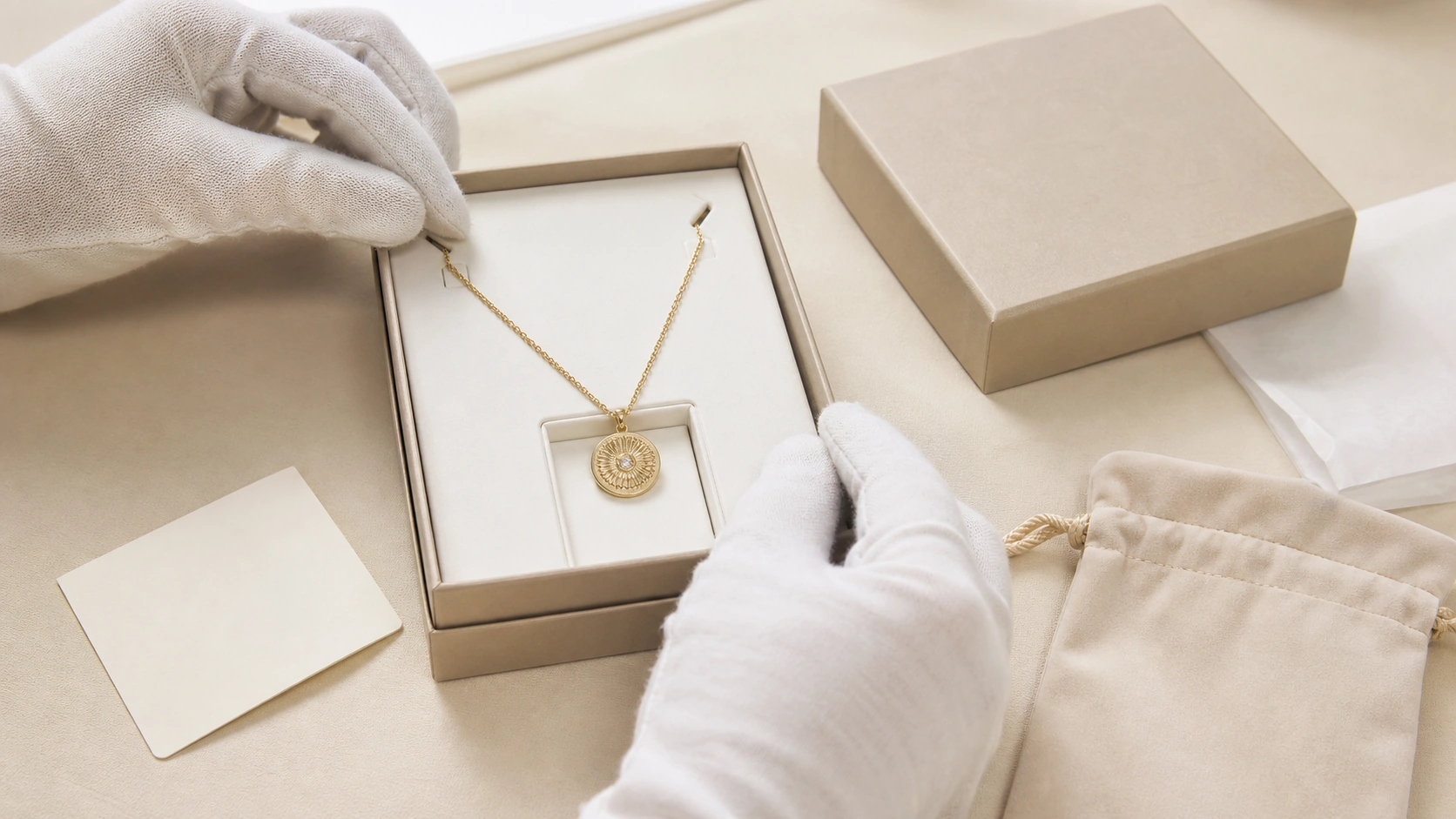
A card should restrain the chain without creating sharp bends. Features may include shoulder slots, holes, rear tabs, fold-over sections, or a lower pocket for excess chain and the clasp.

The pendant should sit at a consistent height. If it is too heavy for the board, the card may bow, tear around the slots, or allow the chain to pull free. Test board thickness, coating, slot geometry, and card size with the final necklace.

Protect the card and necklace in transit

A card alone rarely provides enough shipping protection. Consider a correctly sized sleeve, bag, carton, or mailer that stops movement and keeps the card clean. Avoid allowing several carded necklaces to rub together without separation.

Pouches: Flexible but Not Automatically Tangle-Free

Fabric or synthetic pouches can create a soft, reusable presentation and are easy to store. However, dropping a loose necklace into a pouch can allow the chain to knot around the pendant, clasp, or extension.

A pouch works better when paired with a small necklace card, chain keeper, folded tissue arrangement, or separate compartment. Check the material for lint, loose fibers, dye transfer, abrasive texture, odor, and hardware that can contact the necklace.

Rigid Jewelry Boxes: Strong Presentation and Structure

Rigid boxes can support premium gifting, protect against compression, and hold a custom insert securely. The trade-offs are storage space, shipping volume, weight, and material use.

Before selecting a rigid box, confirm closed and open dimensions, lid style, insert depth and material, attachment points, pendant recess and clearance, space for cards, scuff resistance, and master-carton efficiency.

Folding Cartons: A Flexible Middle Ground

Folding cartons can provide branded presentation with less bulk than a rigid box. Some structures ship flat before assembly. The carton still needs an internal product solution such as a card, board insert, molded pulp insert, or small pouch.

Do not assume a paper carton alone prevents damage. Performance depends on board strength, structure, closure, internal movement, outer packing, and delivery conditions.

Design the Insert Around the Necklace

The insert is the functional core of many necklace packages. Useful features can include:

  • Upper slots or holes that establish chain position
  • Rear channels or pockets for excess chain
  • A dedicated space for the clasp and extension
  • A recessed pendant area
  • Soft contact surfaces around polished or plated parts
  • Clearance for stones and raised details
  • Finger access so the customer can remove the necklace without pulling hard

The chain should not cross sharp paper edges or sit under excessive tension. Adhesive should not touch the jewelry, and exposed adhesive should not collect dust or transfer residue.

Necklace secured in a packaging insert to reduce tangling and pendant movement

Separate Presentation Packaging from Shipping Protection

A beautiful retail box may still need an outer mailer, cushioning, or carton. Build packaging in layers:

Layer 1: Direct jewelry contact

The card, insert, pouch, tissue, or protective material closest to the necklace should be clean, non-abrasive, and appropriate for the finish.

Layer 2: Branded unit package

The customer-facing box, carton, pouch, or sleeve carries the visual identity and organizes included information.

Layer 3: Fulfillment and transit package

This layer protects the unit through warehousing and delivery. The solution may differ between wholesale and direct-to-consumer fulfillment.

Branding Options for Private-Label Packaging

Options may include printed artwork, foil stamping, embossing or debossing, a branded sleeve, printed insert card, custom color material, a label, or a shaped insert. The exact result depends on substrate, finishing process, logo detail, color references, and production tolerances.

Use artwork suitable for the chosen process and approve a packaging proof or physical sample. Do not rely only on screen colors when a precise physical appearance matters.

Information, SKU, and Barcode Planning

Packaging may need a product name, material description, care guidance, country-of-origin statement, SKU, barcode, warning, importer information, or other retail data. Requirements vary by destination, sales channel, product claim, and retailer.

Create a content map showing what appears on the box, card, label, bag, and outer carton. Keep variable data such as SKU, color, or barcode separate from fixed brand artwork where possible. Ask the brand or retailer to supply and approve final barcode data rather than allowing a supplier to invent it.

Material and Sustainability Decisions

Paper, board, fabric, foam, molded pulp, plastic, magnets, coatings, adhesives, and metallic decorations create different performance and recycling considerations.

Avoid vague claims such as “eco-friendly” without defining and verifying them. Where evidence exists, specify measurable attributes such as a certified paper source, recycled-content percentage, reduced packaging weight, plastic-free construction, or a reusable format.

Consider jewelry-contact abrasion, strength, humidity, print compatibility, recycling practicality, coatings and adhesives, pack size, shipping efficiency, and supplier documentation. Check destination-market requirements before final packaging copy is approved.

Test Packaging Before Bulk Production

Approve packaging with the actual finished necklace, not an empty box or isolated printed sheet. A practical review includes:

  1. Confirming dimensions, color, material, and branding.
  2. Installing and removing the necklace several times.
  3. Checking chain restraint and pendant movement.
  4. Looking for pressure points, scuffs, residue, or fiber transfer.
  5. Closing, stacking, and handling the complete package.
  6. Packing it in the intended mailer or wholesale carton.
  7. Reviewing it after an agreed handling or transit simulation.
  8. Confirming labels, variants, and scanning where required.

The exact method and acceptance criteria depend on the necklace, structure, shipment route, and buyer requirements.

Common Necklace Packaging Mistakes

Choosing the smallest possible box

Insufficient clearance may press on the pendant, bend the card, or force the chain into tight curves.

Leaving the extension chain loose

Loose extension links and clasps can scratch the pendant or tangle around the main chain. Give them a rear pocket or retention point.

Treating a pouch as complete protection

A pouch may not prevent tangling, impact, or crushing. Add structure or restraint where required.

Designing artwork before selecting the structure

Artwork, dielines, folds, seams, slots, and labels interact. Confirm the physical structure before locking graphics.

Adding packaging claims without evidence

Claims related to recyclability, recycled content, certification, or environmental benefit should be supported and appropriate for the destination market.

Packaging Brief Checklist for Jewelry Brands

  • Necklace sample and product dimensions
  • Chain length, pendant size, clasp, and extension details
  • Preferred packaging format and target presentation
  • Required chain and pendant restraint
  • Brand artwork and color references
  • Fixed and variable printed information
  • SKU and barcode ownership
  • Destination market and sales channel
  • Ecommerce, wholesale, or retail-display requirements
  • Material restrictions or documented sustainability targets
  • Unit-pack and master-carton expectations
  • Sample review and acceptance criteria

Packaging MOQ, price, tooling, sampling time, and production time vary by structure, material, print process, quantity, and supplier. Confirm them after review of the packaging specification.

Final Recommendation

Use a necklace card when compact retail presentation and operational efficiency matter. Pair a pouch with an internal card or chain keeper rather than leaving the necklace loose. Choose a rigid box when gifting, structure, and stronger presentation justify the added space and cost. Consider a folding carton when the brand needs printable presentation with less bulk.

Whichever format you choose, solve chain restraint, pendant protection, information placement, and transit packaging before focusing on decorative finishes.

Jinnuo Jewelry supports private-label jewelry and custom packaging discussions within each project’s requirements. Buyers can review custom necklaces, explore custom jewelry services, or submit the necklace, packaging concept, target market, and fulfillment requirements through the quote request page.

CONTENT REVIEW

Prepared for Custom Jewelry Buyers

Written by
Jinnuo Jewelry Team
Reviewed by
Production & Quality Control Team
Last updated
Jul 31, 2026

Developing an OEM, ODM or Private Label Collection?

Share your collection direction, product category and branding requirements to discuss a suitable development route.
Email Us WhatsApp